
Do You Need Hebrew to Make Aliyah? The Honest Answer
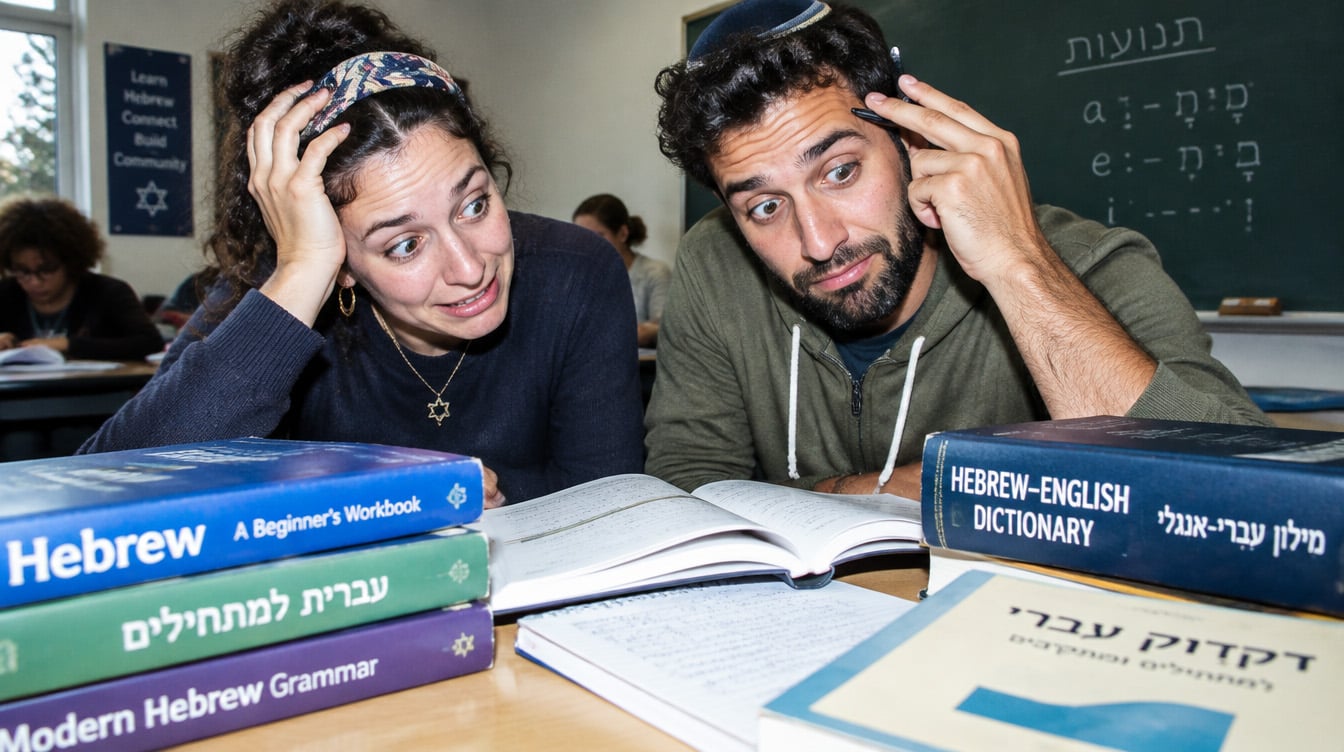
No. You don’t need a single word of it.
There is no language requirement for aliyah. No test, no proficiency level, nobody checking whether you can handle a verb conjugation. If you qualify under the Law of Return, you can arrive knowing exactly one Hebrew phrase, and most people do.
Israel was built by people who arrived speaking Yiddish, Arabic, Russian, Ladino, Amharic, Polish, and Persian. Modern Hebrew was revived relatively recently. A language requirement would have excluded nearly everyone who built this country.
That’s the easy part of the answer. Here’s the rest.
What Actually Works in English
More than you’d expect. If you work in tech, your entire professional life may happen in English, and many Olim build full careers here without professional-level Hebrew. Medical care in major cities is more accessible than people assume, with many Israeli doctors trained in English and searchable English-speaking practitioners in most areas.
Daily commerce in Anglo-heavy areas works fine: Ra’anana, Modi’in, parts of Jerusalem, central Tel Aviv. And the Anglo infrastructure is extensive, covering English-speaking shuls, lawyers, accountants, real estate agents, and neighborhood WhatsApp groups. You can build an entire life inside this ecosystem.
What Doesn’t Work
Here’s the honest part.
Full integration requires Hebrew. Not a value judgment, a mechanical fact. Workplace culture, humor, news, political argument, and the texture of ordinary conversation all happen in Hebrew. Without it you experience Israel through a filter that removes nuance, wordplay, warmth, and most of what turns conversation into connection.
Self-advocacy gets much harder. The contractor who overcharged you. The landlord ignoring the mold. The clerk giving a different answer than the last clerk. Your child’s teacher with something important to discuss. These require language, and handling them through halting Hebrew puts you at a real disadvantage.
Parenting creates a specific gap. Your kids will be fluent within a year or two. Homework in Hebrew, jokes in Hebrew, eventually thinking in Hebrew. Parents who never develop Hebrew describe a distance that grows as their children’s primary language diverges from theirs.
The job market narrows. Outside tech and international business, most Israeli employment requires functional Hebrew. Healthcare, education, government, law, retail, and small business all run in Hebrew.
You miss the ambient information. The news, the conversation at the next table, the train announcement. Losing background information is its own quiet form of isolation.
The Wall That Hits Everyone
Ulpan feels encouraging for about six weeks. Alphabet, vocabulary, simple sentences, visible progress.
Then the grammar arrives in force. The binyanim, those seven verb patterns Hebrew uses to build related meanings from a single root, show up and refuse to leave. And you realize what you’re learning in class bears only partial resemblance to what Israelis actually say at full speed.
Almost everyone hits this around week six or eight. The Olim who end up with functional Hebrew are simply the ones who kept going afterward. What helps: practicing outside class, using Hebrew before you feel ready, and understanding that the plateau is a stage rather than a verdict.
The Israeli Kindness That Slows You Down
Israelis switch to English the instant they detect your accent. They’re being helpful. The cumulative effect is that your practice opportunities quietly vanish, removed by the exact people you’re trying to practice with.
Memorize this: “Ani rotzeh l’hitamen b’Ivrit, bevakasha.” I want to practice in Hebrew, please. Some will honor it and slow down. Others will agree warmly and continue in English anyway. The ones who honor it are giving you more than another ulpan session would.
The Realistic Timeline
Months one to three: Survival Hebrew. Ordering food, directing a taxi, catching a third of a slow conversation.
Months four to eight: The frustrating middle, where comprehension outpaces speaking and you understand more than you can respond to.
Months nine to 18: Functional Hebrew. Daily situations handled independently, business conducted without an intermediary.
Years two to four: Comfortable Hebrew. You stop translating in your head and the jokes start landing.
Arriving at 50 means moving through these stages more slowly than arriving at 25. That’s neurology, not failure.
What to Actually Do
Come now. Don’t wait for your Hebrew to be good enough, because it won’t be, and waiting is how people spend a decade planning a move they never make.
But arrive with intent. Register for ulpan immediately through your absorption benefits. Practice in low-stakes places where mistakes cost nothing: the makolet, the pharmacy, the corner coffee shop. Build friendships with Israelis rather than living entirely inside the Anglo bubble, because the bubble makes it very easy to never need Hebrew, and never needing it is how people end up here eight years later still translating.
The Bottom Line
You can make aliyah without Hebrew. Thousands do it successfully every year.
But the Hebrew determines how deep the life goes. Whether you’re living in Israel or living in an English-speaking enclave that happens to sit inside Israel. Whether you’re integrated or adjacent.
Nobody needs perfect Hebrew and very few people get it. But functional Hebrew, the kind where you can argue with a contractor and follow a school meeting and catch the joke at the Shabbat table, is worth every uncomfortable month it takes to build.
Come first. Learn second. Just make sure the second part actually happens.
Olim Advisors helps new immigrants navigate every dimension of settling in Israel. Since October 7th, our real estate guidance package is provided to clients at no charge. Reach out. We speak English, and we’ll help you get to where you don’t need us to.