Docs Cite Benefits After Belgium Targets Mohels—That Misses the Point
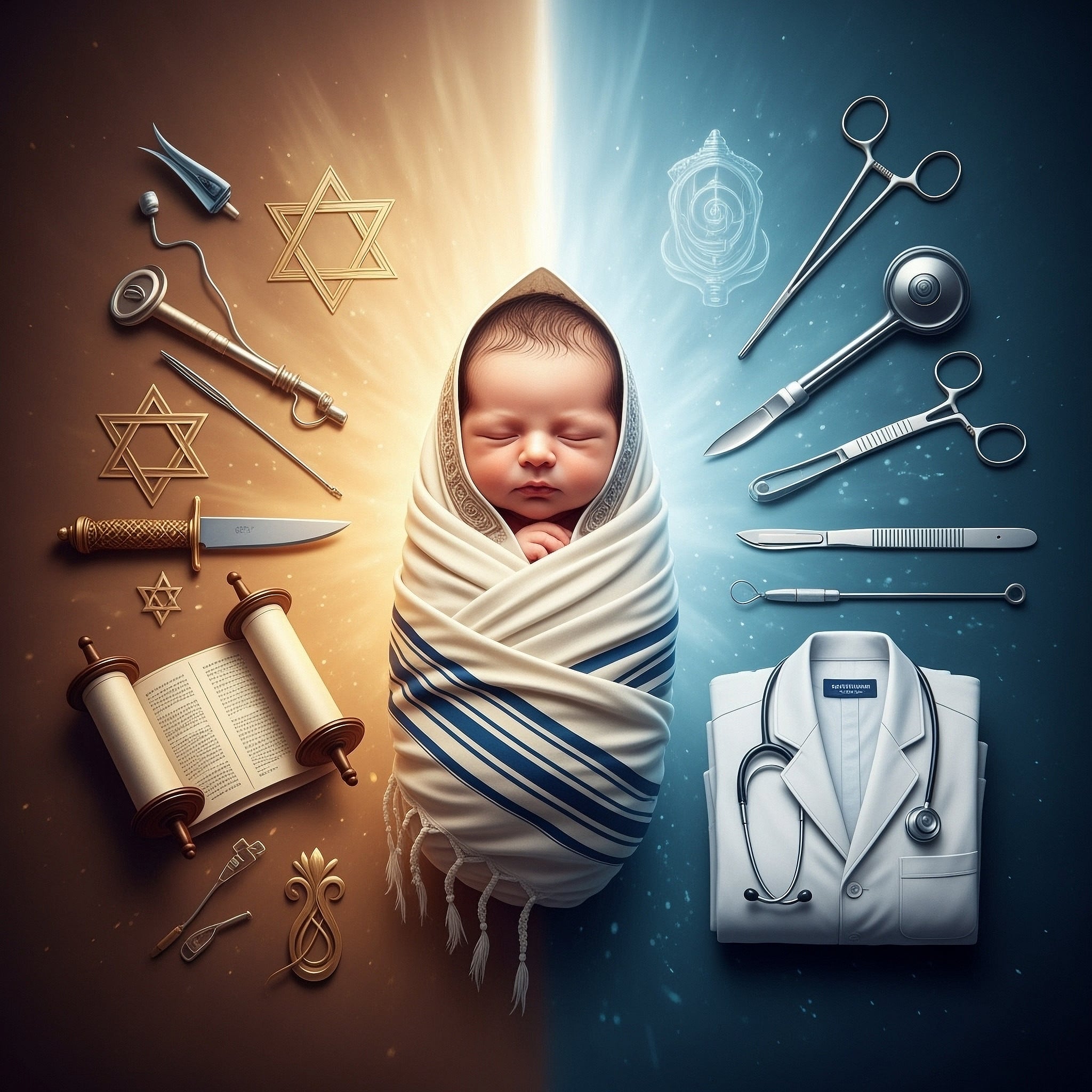
Who should shape a child’s body and soul—the parent, the community, or the individual?
This question sits at the heart of ongoing tensions between religious communities that see child circumcision as imperative, and liberal democracies that prioritize individual rights over collective traditions they deem harmful.
Right now, the European Jewish Association (EJA) is currently urging the European Commission to condemn recent police raids in Antwerp targeting Jewish ritual circumcisers, and to intervene with Belgian authorities to prevent further prosecution. The raids were prompted by an allegation that local mohels were endangering infants through unsafe practices; Belgian officials are now investigating whether these circumcisions were performed without the medical licensing or training required by national law.
Jewish leaders have framed the action in Belgium—and a similar action against a mohel in Ireland—as a threat to religious freedom and part of a pattern of state overreach into Jewish life in Europe.
In support of the EJA’s call, more than 20 Jewish physicians submitted a letter defending circumcision, claiming it has medical benefits—such as a reduced risk of urinary tract infections in infancy and penile cancer.
Yet here lies the paradox: brit milah is a religious ritual, not a medical procedure.
While some may view medical benefit as a secondary affirmation of brit milah, using it to justify the rite reduces a sacred act to a utilitarian calculation. And when mainstream medical consensus shifts—as it increasingly has—to suggest that circumcising healthy infants is not called for, that defense falls apart entirely.
Brit milah is a covenantal act, a sacred ritual performed on the eighth day of life, even if it might make more medical sense to avoid it altogether. To argue for it from a medical standpoint is to retreat from the very foundation on which it rests: faith. Moreover, it risks misrepresenting the intent and history of the ritual, blurring the line between religious belief and public health policy.
At its core, brit milah is not about health—it’s a perceived religious obligation, an act of submission to divine will, and a demonstration of loyalty to a God who once promised Abraham that this mark in the flesh would bind his descendants forever. The act asserts that the child belongs not to himself but to the collective.
Brit milah is not merely symbolic. It is performative: a shaping of the child’s Jewish identity before he can speak, before he can resist, before he can choose. And that is precisely where the controversy lies—because liberal societies are increasingly questioning whether a permanent, non-therapeutic bodily alteration should be performed on someone incapable of consent, regardless of religious intent.
Ultimately, this is not a debate about medicine. It is a debate about meaning. Who gets to decide what meaning takes precedence—the religiously devout or the proponents of modern secular ethics? When does one person’s sacred obligation become a violation of another person’s individual rights? Are children born into tradition or into freedom?
These are complicated questions—and ones I personally grapple with as a vocal non-circumcising Jew who believes that infant circumcision is unnecessary or even harmful. This is why I chose not to circumcise my Jewish son.
Like a growing number of Jews, I believe the covenant can be honored in other meaningful ways: through ethical living, ritual creativity, and conscious engagement with tradition. I suggest that Jewish individuals and communities outside the most traditionally observant circles should reflect seriously and courageously on this possibility.
At the same time, I also recognize that if brit milah is to be defended, it should be defended for what it truly is: a sacred obligation. That is the most coherent and respectful position—one that acknowledges the ritual’s spiritual significance rather than recasting it in the language of modern medicine. Framing mohels as quasi-medical professionals and Jewish infants as their “patients” not only misrepresents the nature of the act but invites it to be judged by standards it was never meant to meet.
Curious how circumcision became a hospital procedure for many Jewish families in America—and what that shift meant? On The Bruchim Podcast, historian Elizabeth Reis explores the medicalization of circumcision in mid-20th century New York, revealing how hospital births reshaped Jewish practice and sidelined religious ritual. This episode also touches on mohels in delivery rooms, rabbis critiquing new mothers, and connections to intersex medical treatment.