From Yemenite tradition to the coming Beith HaMikdash
Does a Heavenly Temple Replace the Earthly Avodah?
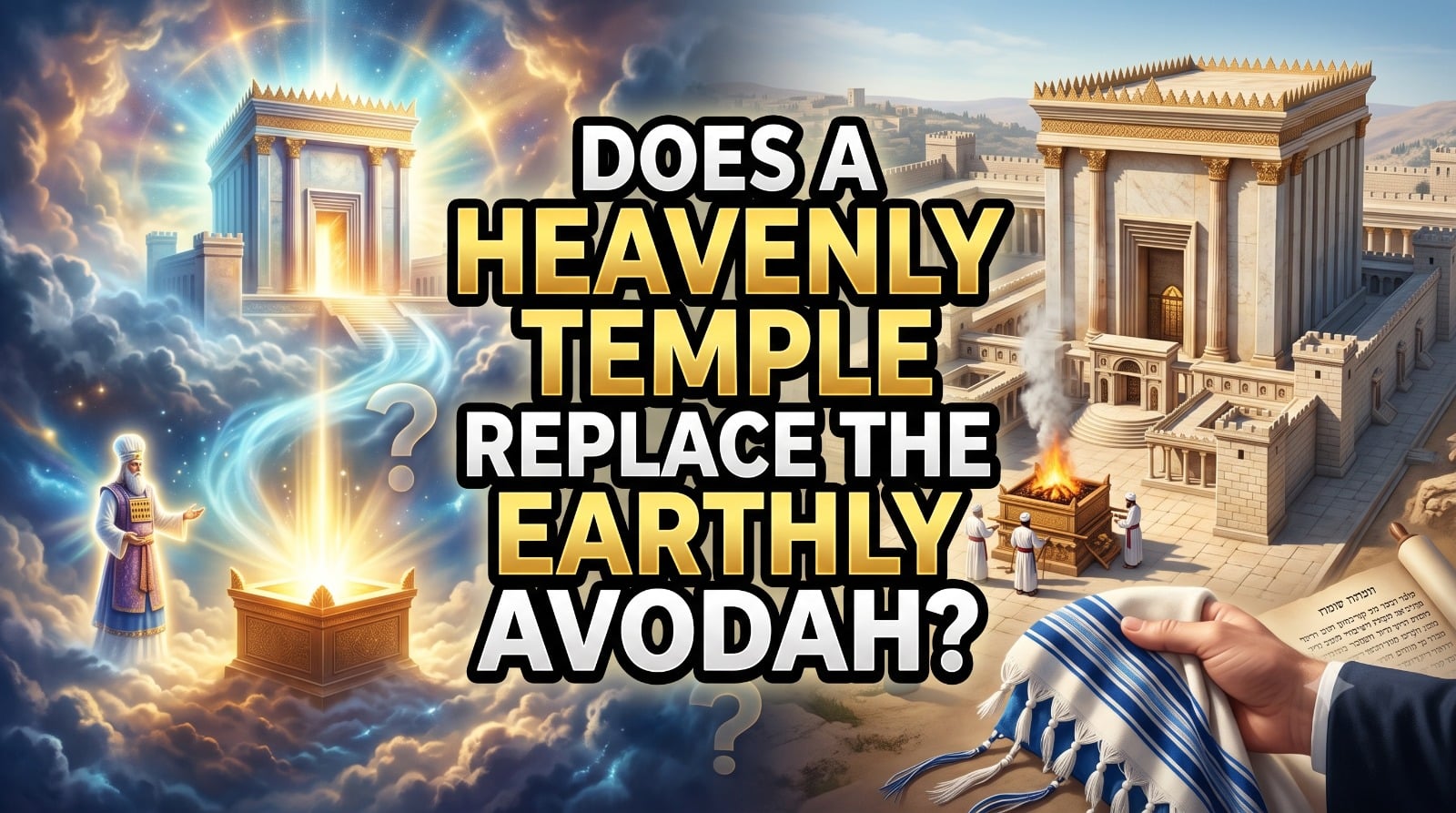
Do we need an earthly temple when the greater exists in Heaven? (Image generated using AI)
The claim moves quietly through communities that love the Hebrew Scriptures. The earthly Temple, they hear, was only a shadow. The real altar stands in Heaven. The real high priest serves there. The real and final cleansing happens above. Once that idea settles, the commandments that govern the avodah begin to look provisional, and the living people who still keep them begin to look like caretakers of something already surpassed.
The Bible answers the claim directly.
The Pattern Was Given for the Ground
When Hashem commanded the Mishkan, He told Moshe, “According to all that I show you, the pattern of the Tabernacle and the pattern of all its furnishings, and even so shall you make it” (Exodus 25:9). He repeated it: “See that you make them after their pattern, which is being shown you on the mountain” (Exodus 25:40).
The pattern language runs in one direction only. Heaven supplied the design. Israel built the structure and served in it. The text never calls the earthly version inferior, provisional, or destined for retirement once the pattern is grasped. The pattern was given so that Israel would have an authorized place of approach on the ground, made to specification, staffed by Kohanim, standing where Hashem set His name.
The prophets keep that direction. Ezekiel’s vision of the restored house measures gates, chambers, courts, and an altar, and it assigns offerings to Kohanim in a building located on the earth (Ezekiel 43:18-27). The final Temple vision in the Hebrew Bible is not an escape from the earthly service. It is a blueprint for it.
One Place, and No Other
The same Bible that reveals the pattern locks every offering to a single earthly location. “Take care that you do not offer your burnt offerings in every place that you see, but only in the place that the Lord will choose in one of your tribes. There you shall offer your burnt offerings, and there you shall do all that I command you” (Deuteronomy 12:13-14).
Leviticus 17 supplies the penalty. A man who slaughters an animal for an offering and does not bring it to the entrance of the Ohel Mo’ed is charged with bloodguilt and cut off from his people. The Sages count this among the thirty six cases of karet. The place is not flexible and the avodah is not portable.
Exile never changed that. Solomon prayed in advance for a captive Israel that would turn back “and pray to You toward their land, which You gave to their fathers, the city that You have chosen, and the house that I have built for Your name” (1 Kings 8:48). Daniel prayed at his open windows facing Jerusalem (Daniel 6:11). The loss of a standing house produced no substitute altar anywhere else, in Heaven or on earth. It produced prayer aimed at one location, and it still does.
What the Offerings Covered, and What They Never Covered
The Temple system named its own limits. The offerings addressed impurities and specific categories of failure. Willful rebellion, pesha committed b’yad ramah, with a high hand, stood outside that list. “The person who acts with a high hand blasphemes the Lord, and that person shall be cut off from among his people. Because he has despised the word of the Lord and broken His commandment, that person shall be utterly cut off; his iniquity is upon him” (Numbers 15:30-31). No korban is prescribed there.
David understood this. After his own willful pesha he brought no offering for it. He said so plainly: “For You do not desire an offering, or I would give it; You do not delight in a burnt offering. The offerings of God are a broken spirit; a broken and contrite heart, O God, You will not despise” (Psalm 51:16-17). He appealed to Hashem’s character, which Hashem had already declared after the golden calf: “The Lord, the Lord, God, merciful and gracious, long suffering, and abundant in goodness and truth, keeping mercy for thousands, forgiving iniquity and transgression and sin” (Exodus 34:6-7). The word rendered transgression there is pesha.
Yom Kippur reached the same category. The Kohen Gadol confessed over the live goat “all the iniquities of the children of Israel, and all their rebellions, for all their sins” (Leviticus 16:21), and the day was given so that the people would be clean before the Lord. The Sages teach that the day atones for offenses between a person and Hashem where teshuvah is present. The power stayed with Hashem throughout. The Kohen Gadol officiated. He never forgave anyone.
This matters for the argument. A system that openly declined to cover high handed rebellion by offering alone was never claiming to perfect anyone by mechanism. The charge that the earthly service could not finish the job attacks a claim the Torah never made.
A Living System Built for People Who Fail
Perfection was never the goal. Leviticus 4 legislates for an anointed priest who sins and for a whole congregation that errs, and it prescribes the remedy in advance. The Sages worked out the same problem for a court that rules in error and for a Kohen Gadol who errs on the Day itself, and they recorded the resolutions.
Judaism is not a museum of flawless performance. It is a living covenant. People fail, sometimes deliberately, and the response is teshuvah. Hashem stays faithful. The earthly avodah was the authorized means of approach inside a covenant that already accounted for human weakness and still demanded return.
Hashem Alone Forgives
The Hebrew Bible closes this question without leaving room for a mediating figure. “I, even I, am the Lord, and besides Me there is no deliverer” (Isaiah 43:11). “I, I am He who blots out your transgressions for My own sake, and I will not remember your sins” (Isaiah 43:25). Hosea told a nation with no functioning altar to come with words and to render for bulls the offering of their lips (Hosea 14:2-3). The address is always to Hashem. No second party is named, in Heaven or on earth, who holds the power to pardon.
What the Later Letter Claims
The letter to the Hebrews frames the earthly Levitical priesthood as a copy and a shadow, temporary, and unable to perfect those who approach through it. It presents a change of priesthood and of law, a superior covenant, and a single offering that accomplishes what repeated earthly offerings could not.
The structure is hierarchical, and it is explicit. The earthly system is limited. The heavenly work is superior and final. That framing is what allows a reader to place the decisive resolution of pesha and mortality in a heavenly high priest while still speaking respectfully of the earthly commandments. The two positions cannot be held evenly, because the letter itself does not hold them evenly. It subordinates the earthly.
The Unauthorized Path
When the pattern language of Exodus is converted into a hierarchy, the earthly service is demoted and a new route appears. Forgiveness is redirected toward another figure as its necessary or ultimate source. The one chosen place is bypassed. The people who still keep the commandments of the avodah are recast as keepers of a shadow. A reader already inclined to treat the Hebrew Bible as preparatory concludes that the real work happens somewhere he cannot see.
That is the stumbling block, and the Torah did not put it there. Hashem alone claims the power to forgive and to deliver. Teaching that another is the source of that forgiveness, and making that teaching the basis of reliance, establishes a path the Torah never authorized. The offense is not private belief. The offense is the public road that turns people away from exclusive return to Hashem.
A Heavenly Location Does Not Solve Rebellion
Relocating the decisive service upward does not fix anything, because the problem was never the address. Job’s friends stated the principle and the book never disputes it: Hashem puts no trust in His servants, and He charges His angels with error (Job 4:18); the heavens are not clean in His sight (Job 15:15). Proximity to Heaven has never produced guaranteed obedience. Moving the altar into the sky simply moves the conversation away from the commandments that still bind Israel on the ground.
The Torah on the Heart Is the Same Torah
The promise that the Torah will be written on the heart, and that no man will need to teach his neighbor, describes the internalization of the Torah already given (Jeremiah 31:33). It changes where the Torah is written. It does not change what is written, and it does not move the altar or cancel the place Hashem chose. The commandments remain the commandments. The avodah remains the avodah.
The altar was established on earth. The Torah was given to be kept on earth. Hashem forgives those who return to Him, and He has never delegated that to anyone. The people who keep walking in those commandments are the living witness, and the Bible says how that ends: “In those days ten men from all the languages of the nations shall take hold of the tzitzit of a Jewish man, saying, we will go with you, for we have heard that God is with you” (Zechariah 8:23). The hem is still visible. Anyone who wants the Bible as it was given should start by taking hold of it.
Related Topics
Related Posts