


Does a Protest in Edgware Prove There Is Two Tier Policing In London?
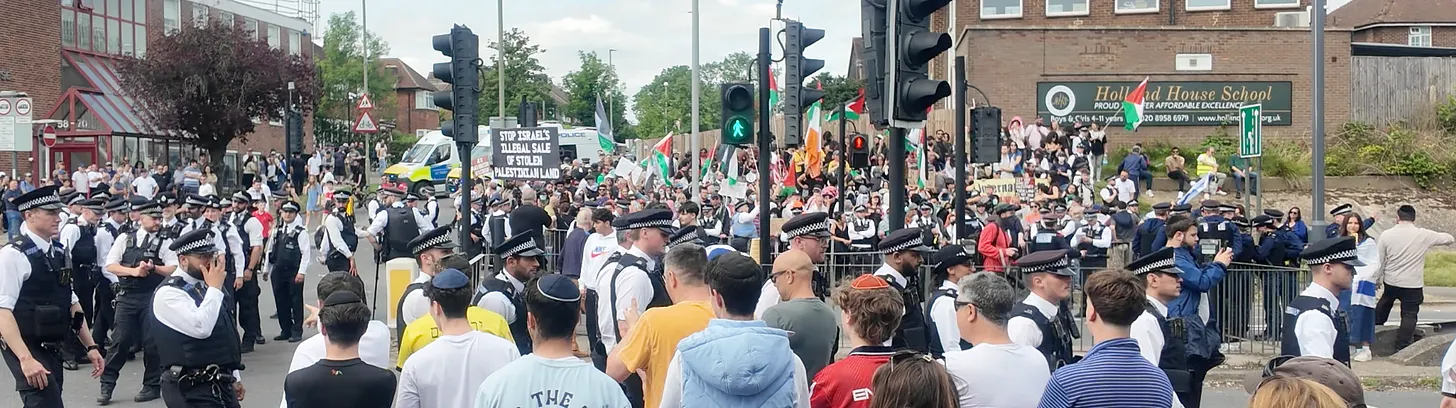
The phrase “two-tier policing” has become one of the most politically charged accusations that can be leveled at the police. Critics see it as evidence that different groups are treated according to different standards. Defenders dismiss it as a slogan designed to undermine confidence in law enforcement.
The Great Israeli Real Estate Event was always likely to attract opposition. Protest is a cornerstone of democratic society, and the police have a duty to facilitate it. However, that duty is not absolute. The rights of protesters must be balanced against the rights of others to go about their daily lives free from intimidation and disproportionate disruption.
The central question arising from Sunday’s events is therefore not whether pro-Palestinian demonstrators had the right to protest. They did. The question is whether the Metropolitan Police exercised their powers consistently and proportionately when deciding how and where that protest should take place.
Edgware is not Parliament Square. It is not Whitehall. It is not Trafalgar Square. It is a heavily Jewish area, home to synagogues, schools, community organizations and businesses. Families attending synagogue, elderly residents going about their daily lives and parents collecting children do not have the option of simply avoiding their own neighborhood.
The disruption extended far beyond those attending the event itself. The A41, one of north London’s principal arterial roads, was reportedly closed for around two hours, affecting countless local residents and commuters with no involvement in the dispute. Yet the greater impact may have been psychological rather than logistical.
For more than two years, British Jews have lived through an unprecedented period of anxiety. The aftermath of October 7 brought celebrations of the atrocities in some quarters, weekly demonstrations in central London, and a steady normalization of rhetoric that many Jews regard as hostile not merely to Israeli government policy, but to Jewish self-determination itself.
Alongside this has come a growing sense of physical insecurity. Jewish communities have watched the firebombing of Hatzola ambulances, attacks against synagogues, stabbings in heavily Jewish areas and terrorist attacks targeting Jews abroad. Whether these incidents occurred in London, Manchester, Sydney or elsewhere is almost beside the point. British Jews do not consume such events as detached observers. They experience them collectively.
Against that backdrop, one might reasonably have expected the Metropolitan Police to exercise particular caution before facilitating a politically charged demonstration in the middle of a Jewish neighborhood. Instead, the policing plan appeared remarkably permissive, ignoring the established contemporary community impact of pro-Palestinian demonstrations.
Recent events had already demonstrated the disruptive tactics employed by sections of the pro-Palestinian movement. Demonstrations had targeted Waterloo and Liverpool Street stations, deliberately choosing major transport hubs. Outside Woolwich Crown Court, protesters attempted blocked the A2016, interfered with the prison van carrying Palestine Action activists, and showed support for a proscribed terrorist organization, resulting in more than one hundred arrests. And all these were in the 3 days prior to the Sunday event.
None of this negates the right to protest. It does, however, raise legitimate questions about whether police should have anticipated a heightened risk of disruption when planning for Edgware.
The circumstances surrounding the protest raise another uncomfortable question. In the days preceding the event, there had been intense political agitation. Richard Burgon raised concerns in Parliament. The Mayor of London issued a public statement. Almost one hundred MPs reportedly signed a letter to the Foreign Secretary urging intervention.
The justification advanced for this extraordinary political attention was that the event involved the sale of property in the disputed territories captured by Israel in 1967. Yet the organizzers denied that this was the case.
Whether one accepts that denial or not, it is striking that so many prominent political figures were willing to intervene publicly before the factual dispute had been conclusively resolved. If the organizers were correct, why did an event concerning property within Israel’s internationally recognized borders become the subject of parliamentary debate, mayoral intervention and pressure from nearly one hundred MPs?
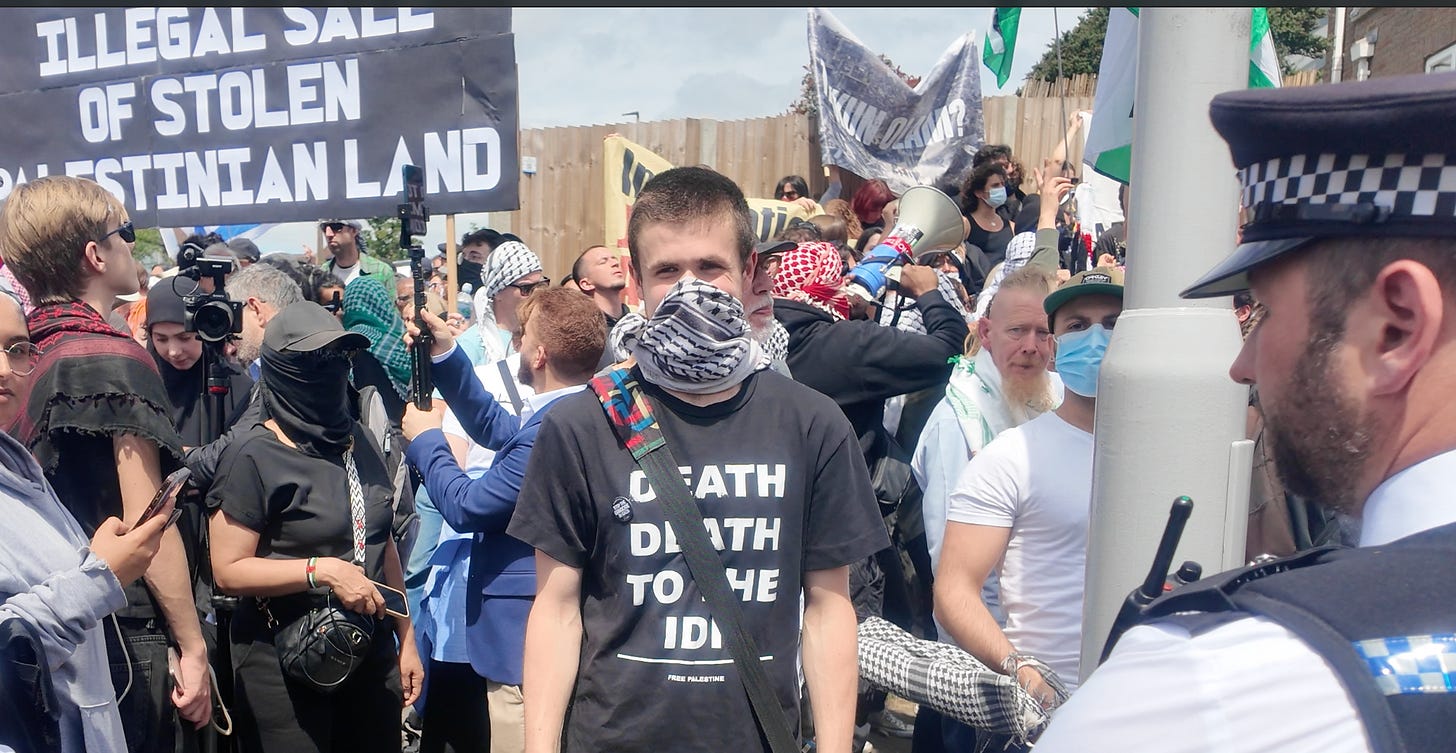
One answer may lie in the fact that, for some anti-Zionists, the distinction is irrelevant. The chants heard in Edgware offered little indication that the issue was confined to settlements beyond the Green Line.
Demonstrators chanted, “Smash the Zionist settler state.” Supporters may insist that this represents opposition to Zionism rather than hostility towards Jews. Yet many British Jews have parents, children, siblings and friends living in Israel. Calls for the destruction of the world’s only Jewish state are not experienced as abstract political theory. They concern the safety of people they know and love.
A participant wore a shirt bearing the words, “Death, death to the IDF.” There will be those who argue that this constitutes criticism of a foreign military. Yet many British Jews have family members serving in the Israel Defense Forces or have themselves undertaken military service through dual nationality or residence. Police do not have the luxury of ignoring how such messaging is likely to be received by the community within which it is displayed.
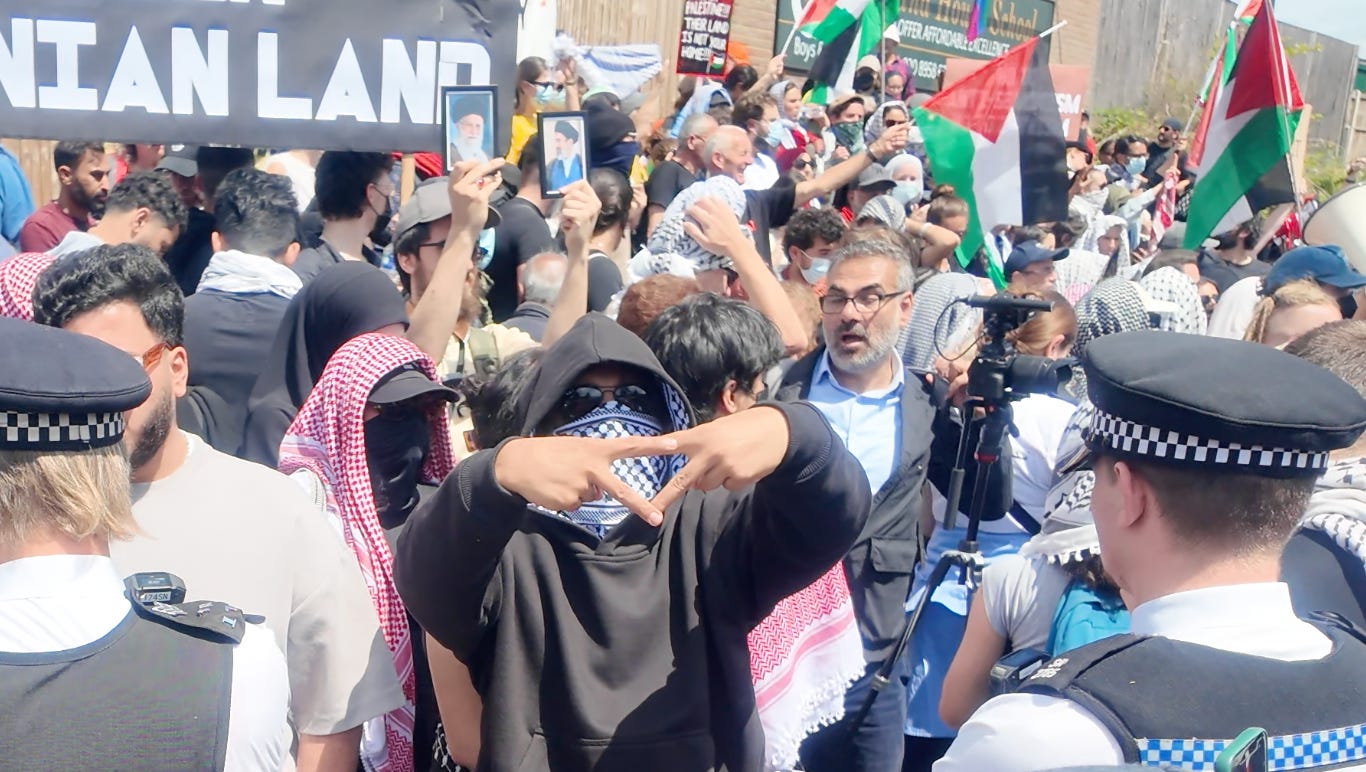
Most importantly, alternatives existed.
Section 14 of the Public Order Act 1986 provides police with powers to impose conditions on public assemblies where necessary to prevent serious disorder, serious disruption to the life of the community or intimidation. Those conditions can include restrictions relating to location.
The Metropolitan Police did not face a choice between facilitating protest and protecting the Jewish community. They could have done both.
A nearby location could have been designated. Robust barrier plans could have been implemented. Protesters could have exercised their democratic rights without creating the perception that a Jewish neighborhood itself had become the object of protest.
The comparison with Whitechapel is difficult to ignore. Earlier this year, protests associated with UKIP were prevented from taking place there because of concerns regarding disorder, community tensions and the impact upon local residents. The principle appeared straightforward: highly charged demonstrations should not unnecessarily be brought into the heart of communities where doing so risks intimidation and serious disruption.
If that principle was right in Whitechapel, why was it not applied in Edgware?
This is not an argument for special treatment. Jewish communities should not be shielded from political disagreement, nor should protest rights be curtailed simply because a message is unpopular.
Yet equality before the law demands consistency. If police possess powers designed to balance competing rights, those powers should be exercised according to objective principles rather than the identity of the communities involved.
As the demonstration came to an end, protesters delivered one final chant: “Zionists, Zionists, watch your back, we will be coming back.”
There will be those who dismiss these words as little more than political theatre. Yet for many Jews standing outside synagogues and community institutions after two years of rising antisemitism, they carried a very different meaning.
Because if the message communicated in Whitechapel was that communities deserve protection from unnecessary intimidation, the question arising from Edgware is impossible to avoid.
Why didn’t that principle apply to Jews?
Until the Metropolitan Police can provide a convincing answer, the allegation of two-tier policing will continue to resonate far beyond the Jewish community.

