
Does Amnesty call genocide by its name?
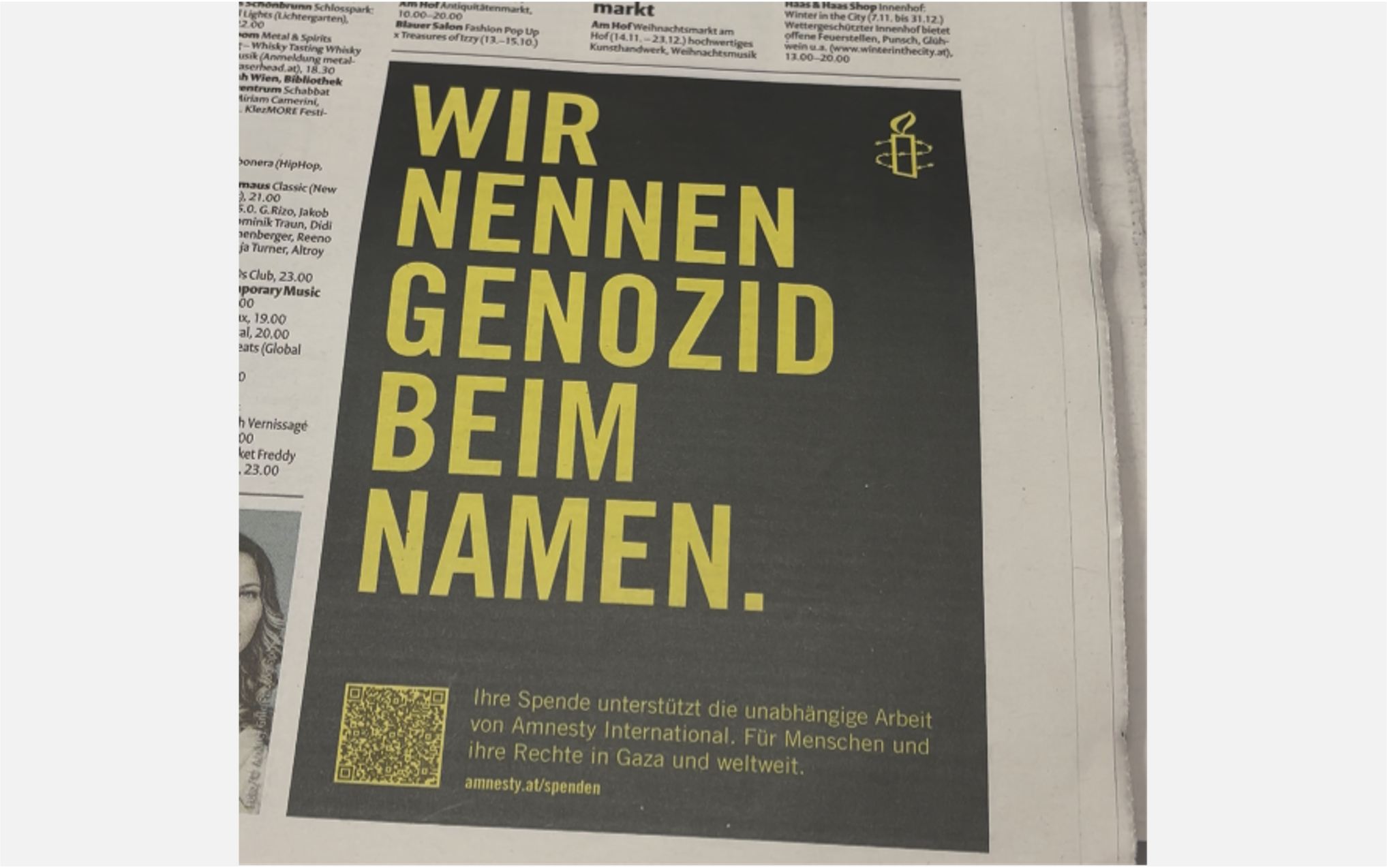
In an appeal for donations from November in the Austrian weekly newspaper Falter, Amnesty International chose the banner “we call genocide by its name.” Amnesty’s recently published report about the atrocities committed by Hamas on October 7 puts their claim to the test.
The report came out over a year after the organisation’s report accusing Israel of genocide and just a few days after a similar report recording the attack by the Rapid Support Forces (RSF) on the Zamzam displaced persons camp in Sudan, which occurred between 11 and 13 April 2025. Amnesty has provided no explanation why it took more than two years to compile a document based almost entirely on video footage that was available from 8 October 2023.
Reporting by the Free Press suggests the delay may have been the result of opposition within the organisation. High-ranking Amnesty representatives worried in internal communications from August 2025 about “the real risk the report could be used to divert attention from the current crisis [in Gaza] or justify ongoing genocide”.
In keeping with protocol established by other human rights organisations, Amnesty accuses Hamas and other Palestinian “armed groups” of crimes against humanity, but carefully avoids the term “genocide” in all references to October 7. Each of the over 30 occurrences of the word in Amnesty’s report refer exclusively to Israel and serve only to remind potentially disappointed readers that the story’s main villain – while temporarily set aside – has not been forgotten.
Yet, a genocide report about October 7 would have been so much easier to produce. The terror attack featured all the hallmarks of genocide that Israel’s conduct in Gaza lacked.
Genocidal Rhetoric
While Amnesty in its report about Israel instrumentalised out-of-context citations and bad faith interpretations to make it seem like leading Israeli politicians had said things they did not actually say, on the Hamas side no such intellectual dishonesty would have been required.
Genocidal and dehumanising rhetoric is so ubiquitous that it is difficult to find a Hamas official who has not engaged in it. We need not look any further than the preamble of Hamas’s founding charter:
Israel will exist and will continue to exist until Islam will obliterate it.
Article 7 of the charter leaves no room for doubt what the obliteration would look like:
[…] the Islamic Resistance Movement [Hamas] aspires to the realisation of Allah’s promise […]: ‘The Day of Judgement will not come about until Moslems fight the Jews (killing the Jews), when the Jew will hide behind stones and trees. The stones and trees will say O Moslems, O Abdulla, there is a Jew behind me, come and kill him.’
The sentiment is frequently reflected in speeches by leading Hamas members. For example:
- Fathi Hamad, member of the Hamas Political Bureau and former interior minister, said in 2018: “We are looking forward to […] the cleansing of Palestine of the filth of the Jews” and to the establishment of an Islamic caliphate “once the nation has been healed of its cancer – the Jews.” A few weeks later he called on Muslims to kill “Zionist Jews” wherever they find them.
- Yahya Sinwar, Hamas leader and principal architect of October 7, said in 2017: “Over is the time Hamas spent discussing recognizing Israel. Now Hamas will discuss when we will wipe out Israel.” In a public speech in 2018, he promised: “From us here in Gaza [Israel] will never get anything but guns, fire, martyrdom, death and killing.”
- Khalil Al-Hayya, Sinwar’s deputy and successor, said in 2024: “The Zionist regime proved to the whole world that this regime is the epitome of evil and unrest in the region, and the whole world should try to uproot this cancer.”
Top-down and premeditated
While Amnesty has not managed to produce evidence of any Israeli war crimes ordered top-down with criminal intent – no whistleblower testimony or leaked written orders, protocols or policy documents – Hamas had been planning an invasion as far back as 2017. Even then the plan targeted the murder of 600 civilians and included livestreaming atrocities and “attack[ing] the kibbutzim in order to take hostages”.
Assertions whereby Hamas fighters were targeting only military sites, and crimes against Israeli civilians were only committed by trailing Palestinians or rogue Hamas members, do not hold up to scrutiny.
In a 6-page document handwritten by Yahya Sinwar in August 2022 and retrieved by the IDF from Gaza earlier this year, the Hamas chief gives explicit instructions regarding the invasion eventually conducted by Hamas in 2023.
In paragraphs 2 and 3 Sinwar stresses the importance of broadcasting horrific images both to stoke euphoria among Palestinians, Israeli Arabs and the “entire Islamic nation” as well as strike terror into the hearts of Israeli Jews.
Among the things unit commanders are instructed to “carry out deliberately” – meaning to plan, document and broadcast – are point-blank shootings, “slaughtering people with knives” (i.e. decapitation) and “burning entire neighbourhoods or a kibbutz”.
Additional documents mostly retrieved from invaders killed on October 7 as well as intercepted communications leave no doubt that the instantiation of Sinwar’s vision that day was a result of Hamas terrorists meticulously following these orders.
A handwritten note found in the pocket of a Hamas military commander urged his operatives to kill as many Jews as possible, behead them and mutilate their bodies. Another document was a battle order to inflict maximum civilian casualties in Kibbutz Alumim.
In intercepted communications from October 7 one Hamas commander, referred to as Abu Muhammed, instructs his subordinates to “start setting homes on fire. […] I want the whole kibbutz to be in flames.” Another commander, Abu Al-Abed, told his operatives to “set fire to anything.” Several commanders are captured reminding fighters to film and broadcast “scenes of horror”. One commander orders his team to “slit their throats […] as you are trained.”
Additionally, these communications feature instructions explicitly genocidal in its language. A commander named Abu Muath tells his fighters to “kill everyone you encounter.” Another named Abu Al-Baraa is captured saying “Slaughter them. End the children of Israel.”
There is no analogue on the Israeli side.
Evidence of War Crimes
As genocide is predicated on the special intent to destroy the victimised group, one would expect such an extraordinarily cruel endeavour to be accompanied by widespread deliberate killing of civilians. Atrocities of this kind have occurred in almost all other genocides, with the large-scale forced sterilisation campaign against Uyghurs in Xinjiang – which bears no resemblance to what Israel has been accused of in Gaza – possibly representing the only exception.
Amnesty’s best attempt to argue deliberate killings of Palestinian civilians rests on 15 airstrikes attributed to the Israeli Air Force in which the organisation “did not find evidence of a military objective”. Only 6 of these attributions are substantiated by any evidence. In at least one of the 6 there was a very easily identifiable military objective: senior commander in the Al-Quds Brigades, Shaldan Al-Najjar. That Al-Najjar’s identity and affiliation had been known months prior to the publication of Amnesty’s genocide report speaks to the quality of the underlying research.
In chapter 3 of the Begin-Sadat Center’s report Debunking the Genocide Allegations the authors examine one of the most extensive databases on alleged Israeli war crimes in Gaza but discern only a relatively small number of killings of civilians supported by any forensic evidence at all – let alone dispositive evidence – with a total of 27 Palestinian and 7 foreign victims.
For comparison, the New Yorker last year published a database of possible war crimes committed by the US army in Iraq and Afghanistan. The journalists compiled a list of 781 possible war crimes ranging from sexual assault to multiple homicide with more than 1,800 alleged victims. The list is comprised exclusively of cases that were taken seriously enough by the US army to investigate. In 151 cases internal investigators found enough evidence to determine criminality including 39 cases of homicide and 17 cases of multiple homicide with a total 129 identified victims. This does not include several high profile mass casualty events like the Fallujah killings of 2003 (17 killed) or the raid on Ishaqi in 2006 (at least 11 killed) which in the eyes of the investigators did not meet the evidentiary standard of probable cause.
Consequently, while more evidence about Gaza is bound to surface in the coming months and years, Israeli conduct in war compares favourably even to Western benchmarks. This is especially true, since each of the above examples of alleged IDF transgressions are plausibly explained (based on currently available information) by either lawful strikes on military targets or some combination of deficient intelligence, poor coordination and excessively lax applications of the rules of engagement. Negligent deaths resulting from the latter may still rise to the level of criminality, but they lack the special intent inherent in genocide, crimes against humanity and all war crimes as defined by Article 8 of the Rome Statute.
The same cannot be said for other theatres of conflict in the Middle East. In the last year alone, the world has witnessed several demonstrations of how sectarian hatred translates into war crimes, the kinds of which one would expect to see in a campaign of extermination:
- Between March 6 and March 10, attacks by Sunni government forces against Alawites in Syria’s coastal region resulted in the deaths of over 1,500 civilians according to the Syrian Observatory for Human Rights (SOHR) – mostly executed over sectarian affiliation. Less than a week of clashes produced dozens of videos verified by Human Rights Watch capturing extrajudicial killings. Amnesty International reported, but refrained from using the word genocide.
- Between July 13 and July 20, clashes in Syria’s southern city of Suwayda between Druze militias and government forces left over 2,000 dead according to SOHR. The human rights organisation estimates that more than 800 Druze civilians were extrajudicially executed by Defence and Interior Ministry officials. Multiple videos capture explicitly sectarian unlawful killings. Amnesty International reported, but refrained from using the word genocide.
- On October 26 the Rapid Support Forces (RSF) captured the city of El Fasher from Sudanese Armed Forces. In the following days the Arab RSF fighters committed mass atrocities against the civilian population targeting non-Arab communities in particular for their ethnic identity. Countless videos of extrajudicial killings and other abuses have been posted on social media. Some credible though yet unverified estimates put the death toll at over 60,000. If the number holds up, it will mean that in a city with one tenth the population of the Gaza Strip the RSF have killed as many Sudanese in a few days as Israel is alleged to have killed Palestinians in two years – according to estimates by the Hamas-run Gaza Health Ministry. Amnesty International reported, but refrained from using the word genocide.
The contrast between these examples and Gaza is stark. Each case produced numerous clips of unambiguous dead-to-rights war crimes within just a few days of violence. The entire war in the Palestinian enclave has produced none.
The October 7 attack, on the other hand, clearly fits the regional pattern of gratuitous violence. Just among the most cut-and-dried atrocities captured on camera and verified by Amnesty International are the attempted decapitation of an injured civilian in his home, multiple instances of terrorists tossing grenades into civilian bomb shelters, dozens of instances of terrorists shooting at civilian vehicles and dozens of point-blank range executions of nakedly obvious non-combatants – including unarmed civilians fleeing and hiding, injured people lying on the ground and hostages begging for mercy.
That means we have more evidence of deliberate killings of civilians from a single day of Hamas invasion into Israel than from two years of what Amnesty International has called “the most documented genocide in history”.
Calling genocide by its name
With the release of the most recent report Amnesty will claim to have done its due diligence in calling out crimes against humanity committed on October 7. But the organisation clearly understands the propaganda value of certain words. When Amnesty’s Israel branch accused the State of Israel of crimes against humanity and ethnic cleansing but resisted the genocide designation, it was suspended for anti-Palestinian racism.
More than two years after the worst slaughter of Jews since the Holocaust, Amnesty International still refuses to call October 7 an act of genocide when its case against Israel is laughable by comparison.
Taken seriously the slogan “we call genocide by its name”, chosen for its funding appeal, would imply that Amnesty is not shy about using the term “genocide” appropriately when supported by the facts. But while Amnesty is certainly not shy about using the term, the suggestion that it does so appropriately or in deference to any facts is preposterous.
—
A German version of this article was first published by the Austrian think tank Mena-Watch.