Persia Bred Top-Tier Diggers for Millennia. Why Leave Its Uranium Buried?
In the second week of June 2026, as American and Iranian negotiators reported that a deal was within reach, a CNN report citing five sources familiar with United States intelligence described something that points in the opposite direction. Rather than preparing to surrender its stockpile of highly enriched uranium, Tehran had spent the preceding weeks deliberately collapsing the tunnels that hold it and rigging the entrances with explosive mines. The Jerusalem Post and The Times of Israel carried the same account.
The material in question is the roughly 440 kilograms of uranium enriched to 60 percent that the International Atomic Energy Agency has described as a short technical step from weapons grade. The proposed agreement would require Iran to relinquish it. The fortification of the site, undertaken at the precise moment that transfer was being negotiated, has been treated in parts of the coverage as a complication. It is better understood as an answer.
A buried stockpile is not a surrendered stockpile. Satellite imagery reviewed by The New York Times already shows fresh excavation near the tunnel entrances at Isfahan, where most of the material is believed to be held. Iran is not sealing this uranium in order to give it up. It is sealing it in a form that it, and only it, can later reopen.
This raises a question the negotiation has so far avoided. If a state can bury this material and recover it at a time of its own choosing, what is actually achieved by leaving it in the ground?
A civilization built on what lies beneath
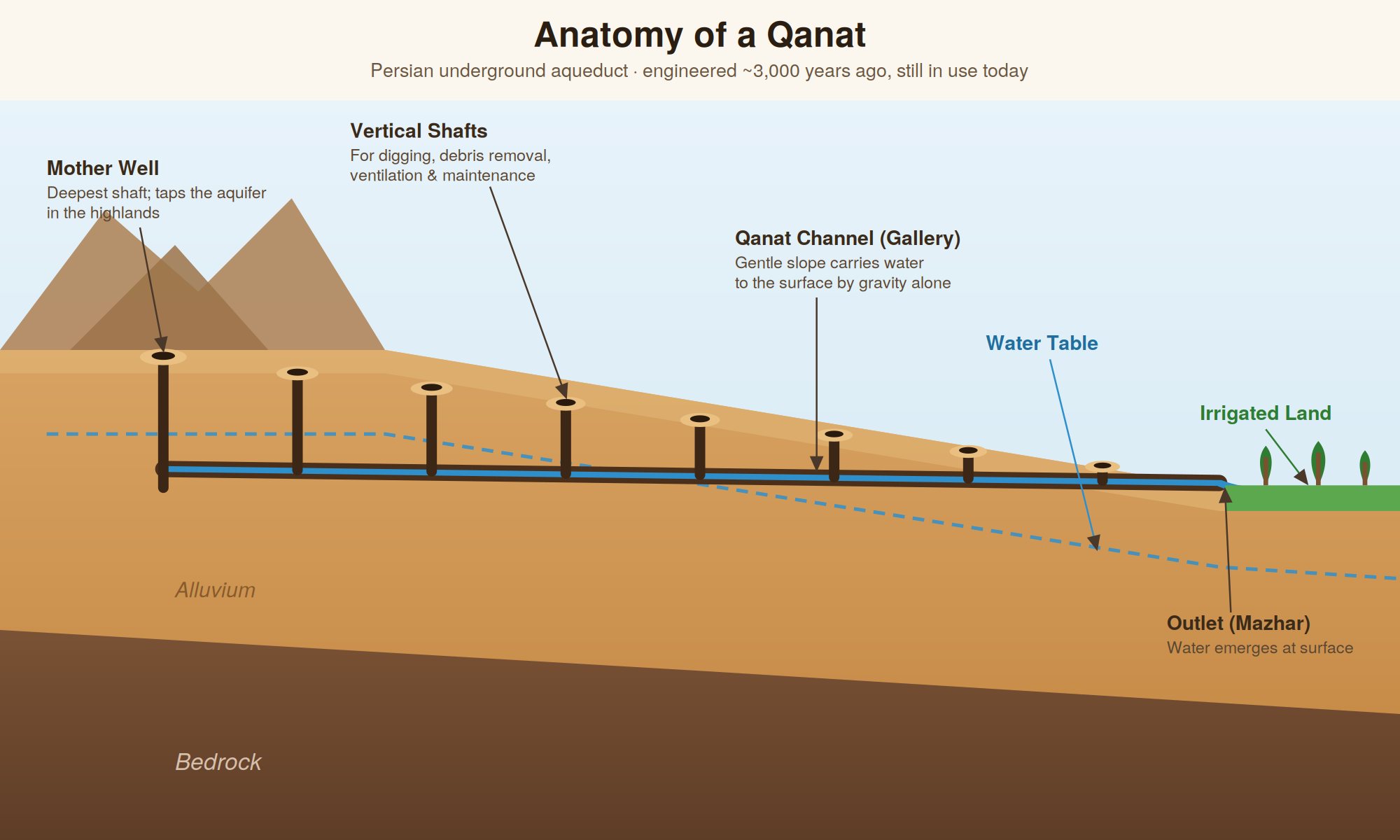
Long before Iran built centrifuges, Persia built tunnels. Around three thousand years ago, on the arid plateaus of what is now Iran, engineers devised the qanat, an underground aqueduct that taps groundwater in the highlands and carries it for kilometers, by gravity alone, to the edge of a settlement. In 2016 the United Nations inscribed the Persian qanat on its World Heritage list, recognizing a tradition of subterranean engineering older than the Roman aqueducts and still in service today. Tens of thousands of qanats remain active across the country. The oldest, at Gonabad, descends through a mother well roughly three hundred meters deep and has carried water for some two and a half millennia.
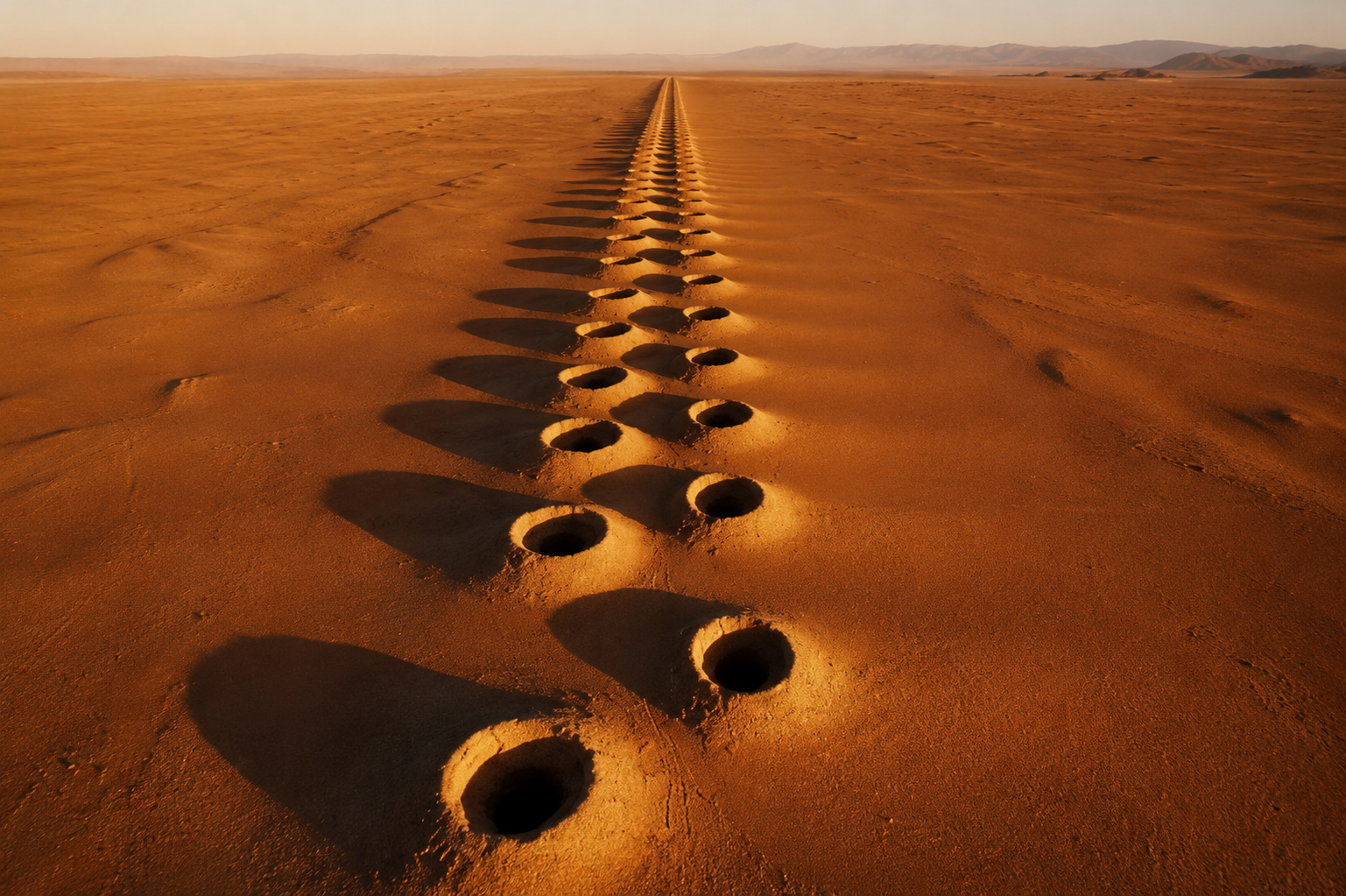
The method rewards a kind of patience and precision that does not leave a people quickly. A qanat begins with that mother well, sunk into elevated ground until it reaches the water table. From there a gallery is cut at a slope of less than one degree, so that the water flows without eroding the channel, and that slope must hold over distances that can exceed seventy kilometers. Along the route, a line of vertical shafts is dug at regular intervals. The shafts remove spoil during construction, admit air to the men working far below, and provide access for the centuries of maintenance that follow. Seen from above, they appear as a string of evenly spaced craters running across the desert toward the green line of an oasis.
None of this is incidental to Iranian identity. It is one of the founding achievements of the civilization, certified as such by the very international body now concerned with what Iran has buried. A country does not hold a three-thousand-year, UNESCO-recognized mastery of digging into the earth and then misplace the instinct for it. Whatever else is true of Iran, it belongs to the small group of states that are world-class at moving things into the deep ground and bringing them back out.
From the qanat to the missile city
That instinct did not stay in antiquity, and it did not stay civilian. Modern Iran has carried the same logic into its military infrastructure, burrowing its most valuable assets into mountains where they are difficult to reach and harder still to destroy. The enrichment hall at Fordow sits roughly eighty to ninety meters beneath a mountain near Qom. A newer site at Kuh-e Kolang Gaz La, known as Pickaxe Mountain, is assessed to be deeper still, possibly beyond the reach of the largest American bunker-busting bomb. When the United States struck these facilities in June 2025, it sent its heaviest weapons down their ventilation shafts. Analysts at the Center for Strategic and International Studies concluded that the bombs were aimed at those shafts precisely because the rooms themselves lay beyond reach. By some accounts roughly three-quarters of the visible tunnel entrances were struck, yet operations resumed within days as crews cleared the debris. The bombs reached the doorways. The mountain kept the rooms.
The doctrine also travels. Iran did not only dig for itself; it financed and instructed others to dig. Hezbollah’s tunnel network in southern Lebanon, which by open-source estimates runs to hundreds of kilometers, was built by the organization’s Jihad Construction Foundation, a ranch of Iran’s own Jihad Construction, under the supervision of the Islamic Revolutionary Guard Corps. A general of the Guard’s Quds Force is believed to have overseen the project. The technical expertise came from North Korea, which Iran regarded as the professional authority on military tunneling, in a relationship that dates to the 1980s and deepened after the 2006 war. When the Israel Defense Forces dismantled the largest of these complexes near Kantara in 2026, they reported finding Iranian funding, Iranian planning, and construction methods they described as distinctly Iranian.
This lineage should be stated precisely, because it is often blurred. The qanat is Persian. The tunnelers of Gaza and southern Lebanon are not the descendants of the men who dug it. What connects them is not ancestry but sponsorship. Hezbollah did not exist before 1982, when Iran assembled it; Hamas was founded in 1987; their underground networks are recent constructions, built with Iranian money, Iranian engineering, and North Korean technique. The thread that runs from the qanat to Fordow to the tunnels of Lebanon is the Iranian state itself, an heir to the ancient art and the modern hub that has exported it across the region.
Why “buried” is not the same as “gone”
Set against this record, the fortification of the uranium reads differently. Collapsing a tunnel and mining its entrance is not the act of a state resigned to losing its material. It is the act of a state that knows exactly how to place something deep in the ground and, when it chooses, how to take it back out. The same satellite imagery that documents the burial at Isfahan also documents fresh excavation there. The recovery is not a hypothetical. By the available evidence, it has already begun.
“Irretrievable” is therefore the wrong word, and a dangerous one to accept at a negotiating table. Material is only irretrievable to those who cannot reach it. To the people who invented the art of reaching buried things, a sealed tunnel is not a vault closed forever but a store closed for now, with the key kept in a single pocket. Any agreement that leaves the stockpile in Iranian ground, however thoroughly buried and however carefully photographed, rewards the one party in the world best equipped to reverse the arrangement at a later date.
The disposition that actually removes the risk is the one that removes the material. Every gram of the 440 kilograms taken out of Iran under international verification, or, as I have argued previously, https://blogs.timesofisrael.com/iran-can-keep-its-440-kg-of-60-uranium-but-only-diluted-to-3-6/. Either path ends the danger. Burial does not end it. Burial relocates it to a place chosen by Iran, on a timeline chosen by Iran.
The question, then, is not whether Iran can recover uranium it has buried. The civilization that gave the world the qanat settled that three thousand years ago. The question is whether anyone will sign an agreement that rests on the promise of a master digger to leave the digging undone.