
Owner of the world's largest Herzl collection
Dog Tags. Yellow Ribbons. End this Nightmare.
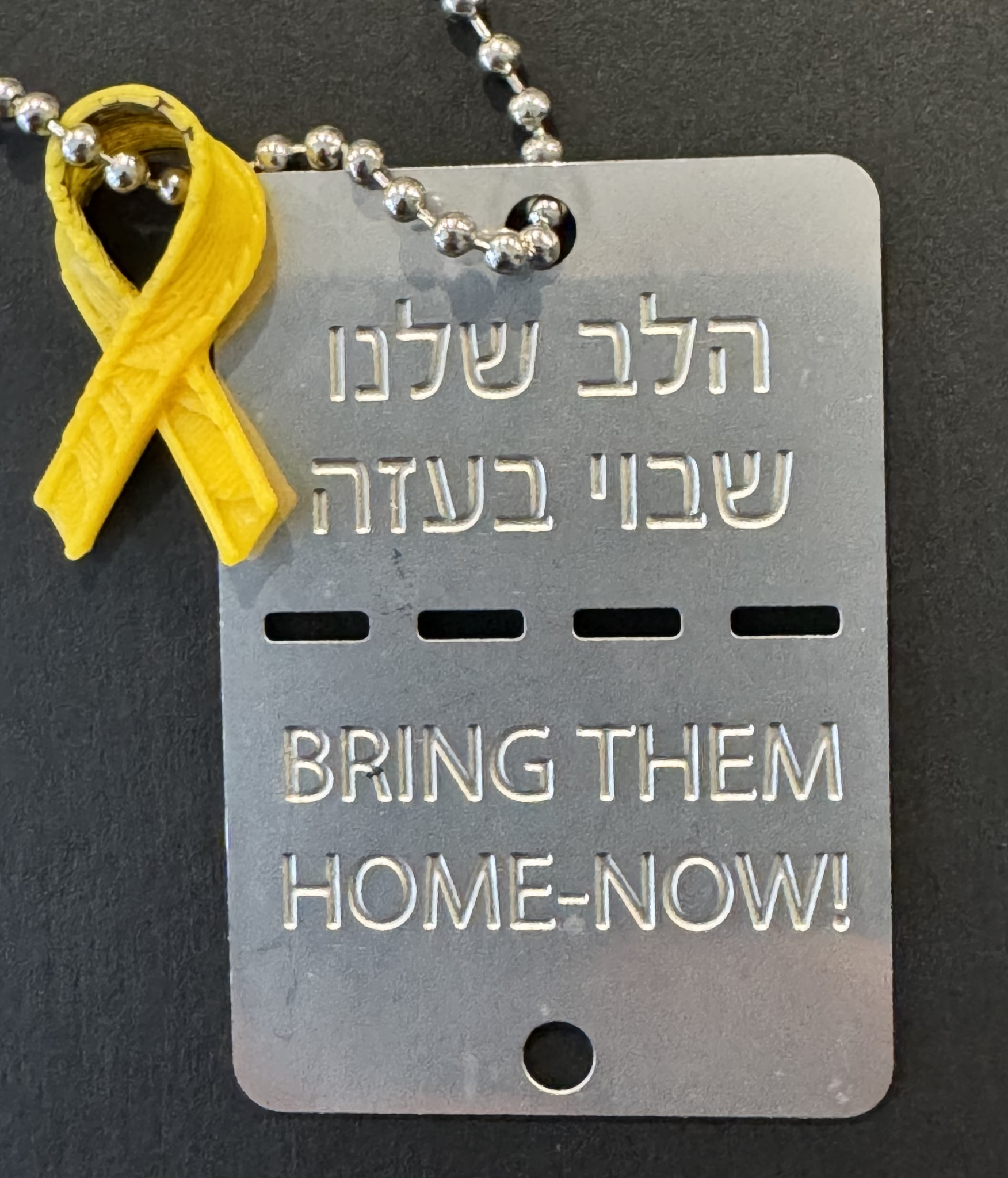
My hostage necklace. Photograph by 'David Matlow.
I write a weekly column for the Canadian Jewish News (www.thecjn.ca) called Treasure Trove. Since February 2021 I have showcased 230 items in my column. This is the first Treasure Trove that features an item I wear every day.
Like all of us who wear the hostage dog tags, I look forward to the day when I can take it off as that would mean the hostages are finally home.
They are modelled on the dog tags soldiers wear, a practice that started in the United States Civil War when soldiers were worried that they would not be identified after they were killed and so would be buried in unmarked graves. Soldiers who could afford it purchased engraved metal tags from private vendors to ensure this did not happen to them. It was only in 1906 that the United States Army required that ID tags be worn by its soldiers.
The Hebrew text of the hostage dog tags (halev shelanu shavui b’Aza) means “our heart is captive in Gaza”. Notice that the word “heart” is singular and not plural. The idea that the Jewish people share one heart comes from the moment we first became a nation at Mount Sinai. Rashi noted that when the Jewish people arrived at Mount Sinai they encamped like one person with one heart. In other words, they were united.
Whether the Jewish people share one heart in working for the return of the hostages is a question that history will judge. Our people are not complete, and our heart will remain broken, until all of the hostages (living and dead) are brought home.
The yellow ribbon is also a cry for the return of the hostages. Its origin is much more pedestrian than the Torah or United States military history. The yellow ribbon as a symbol of hostage return started with the US diplomats held hostage in Iran in 1979. Penne Laingen, the wife of Bruce Laingen who was one of the hostages, was asked what Americans can do to help the hostages. She thought that demonstrations of violence and anger would not help free them, so she suggested that instead:
“Tell them to do something constructive, because we need a great deal of patience. Just tell them to tie a yellow ribbon around the old oak tree.”
This is in reference to this 1973 song by Tony Orlando and Dawn: “Tie A Yellow Ribbon Round the Old Oak Tree” (if you are too young to know this song, you can listen to it here: https://www.youtube.com/watch?v=2eGARhVbwtI). It tells the story of a person released from prison who wondered whether his love wants him back, and if she does she should tie a yellow ribbon on a certain tree to let him know. If he doesn’t see it when his bus rolls in to town he will know she doesn’t want him and will stay on the bus. Happily, she ties 100 yellow ribbons on the bus and everyone on the bus cheers for him. He says “I’m coming home”.
We wait for the day that all of the hostages are home, the yellow ribbons can be put away and the dog tags can be taken off. It is then that the work of healing and repair can really begin. One day in captivity is too long. It is now 730. May this nightmare end soon.
For more treasures from the Herzl and Zionism Collection of David Matlow which appears weekly in the Canadian Jewish News see https://herzlcollection.com/treasure-trove
Related Topics
Related Posts