Dolly Parton’s Jewish Children
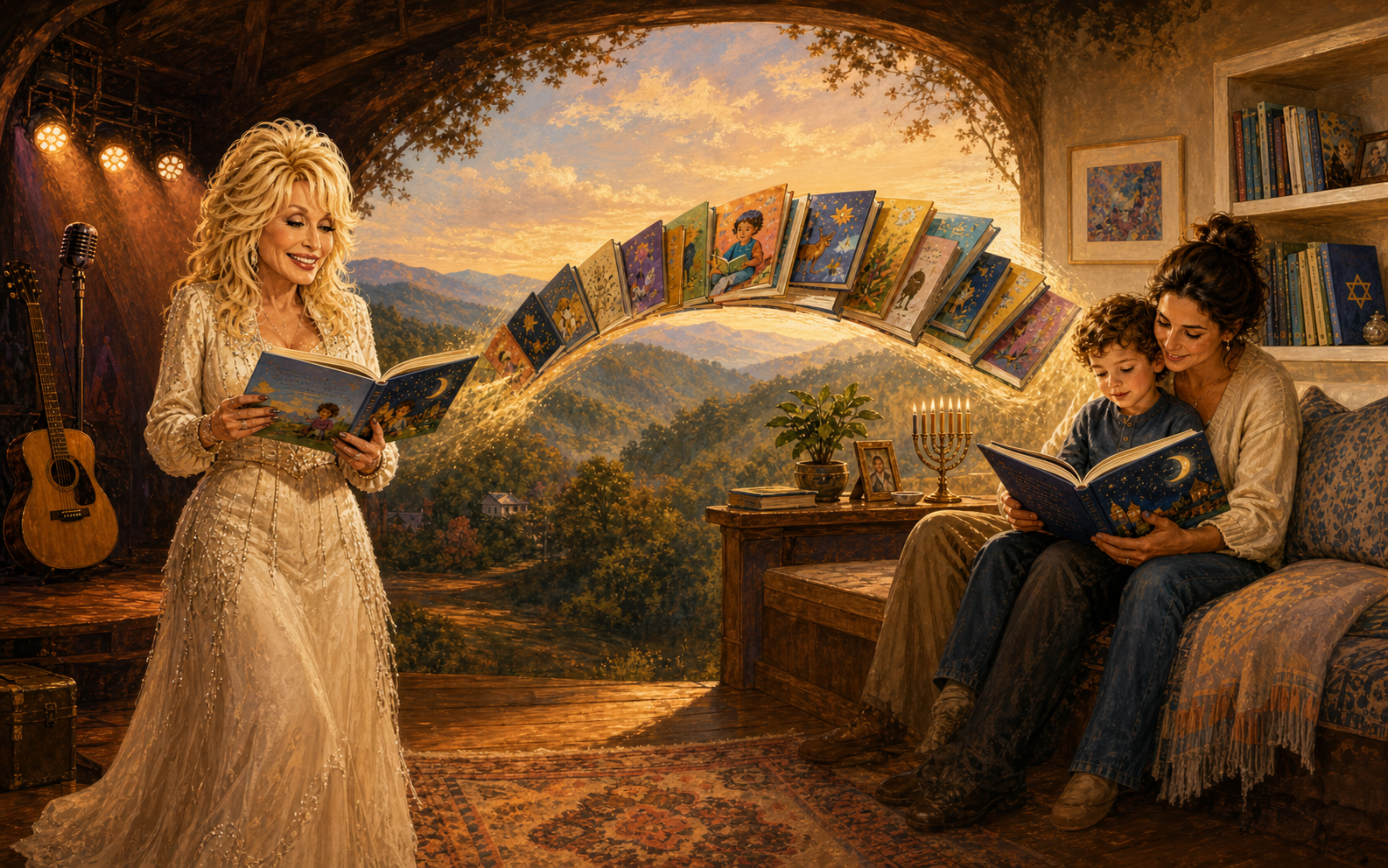
How a country singer’s dream became PJ Library—and brought Jewish stories to my grandson
Dolly Parton was an American original. She did not become one by trying to be different. She became one by refusing to be anyone other than herself.
The hair was enormous. The heels were impractical. The rhinestones arrived before she did. She laughed before anyone else could laugh at her and then made it clear that she had been in on the joke all along. “I’m not offended by all the dumb blonde jokes,” she once said, “because I know I’m not dumb. And I also know that I’m not blonde.”
That was Dolly. She could be funny without being frivolous, glamorous without pretending the glamour was real. She sang about poverty, heartbreak and working women because she knew something about all three. She was never embarrassed by where she came from, what she believed or who she had decided to become.
Fame changes almost everyone. Dolly Parton somehow used it to become more completely herself.
That may be why so many people loved her. She was a churchgoing woman from the mountains of Tennessee who became a hero to gay men. She could move between Hollywood and Nashville, blue America and red America, without seeming like a visitor in either. In an increasingly divided country, Dolly belonged to everyone.
When she died this week at the age of 80, the tributes celebrated her songs, her voice, her humor and the remarkable journey that carried her from a one-room cabin in Tennessee to stages around the world. But Dolly’s greatest legacy may not be something she sang.
It may be something she mailed.
In 1995, Dolly created the Imagination Library, which began sending free books to young children in her home county. She started the program in honor of her father, a man she described as one of the wisest people she had ever known, despite never having learned to read or write.
What began in one Tennessee county became one of the largest children’s book-gifting programs in the world. By June of this year, the Imagination Library had distributed more than 325 million books and was sending another 3.5 million every month to children in five countries.
Her father lived long enough to see the program succeed. Before he died, he told Dolly that he was prouder of the Imagination Library than anything else she had accomplished.
For a woman who had already written “Jolene” and “I Will Always Love You”—and who would go on to win 11 Grammys and 10 Country Music Association Awards, receive the Kennedy Center Honors and the National Medal of Arts, and enter both the Country Music and Rock & Roll halls of fame—that was saying something.
Dolly and her husband never had children of their own. She eventually came to believe there was a reason. “God has a plan for everything,” she once said. “I think it probably was his plan for me not to have kids so everybody’s kids could be mine. And they are now.”
She meant the millions of children who received books through the Imagination Library. But she could not have known just how true those words would become.
Because some of Dolly Parton’s children were Jewish. And one of them is my grandson Cameron.
Each month, a PJ Library book arrives at Cameron’s home. His favorites include Mishpuchah!, P Is for Pastrami and, appropriately, Tea with Zayde, the story of a child sharing a long-distance teatime ritual with her grandfather.
Family, food and zaydes. Not a bad foundation for a Jewish childhood.
They are silly books, as the best children’s books often are. But while Cameron laughs, words and ideas that have traveled through generations are quietly becoming part of his childhood.
Until this week, I had never thought much about the chain of events that brought those books into his home. I knew about PJ Library. I knew about Dolly Parton’s efforts to promote childhood literacy. I did not know that one existed because of the other.
Now, when I picture Cameron opening one of those books, I see something else inside the package: an idea born in the Tennessee mountains, recognized by a Jewish grandfather and eventually passed along to my own grandson.
The Jewish grandfather was Harold Grinspoon.
In 2005, Grinspoon heard Dolly discussing the Imagination Library on the radio. She explained how the program selected books and mailed them directly to children from birth until kindergarten. Each package arrived with the child’s name on it. The book did not belong to a school or public library. It belonged to the child.
Grinspoon immediately understood the power of the idea because he had been thinking about a different kind of literacy: Jewish literacy. He worried that many Jewish children were growing up disconnected from the stories, values and traditions that had sustained their people for generations. Their parents often wanted to give them a Jewish foundation but did not always know how.
They may not have attended Jewish schools. They may not have belonged to synagogues. They may not have felt comfortable explaining traditions they barely understood themselves.
But they knew how to read a bedtime story.
As Grinspoon listened to Dolly, the solution became obvious. “We should create a Jewish version of Imagination Library,” he told his daughter-in-law, Winnie Sandler Grinspoon.
That was the moment PJ Library was born.
I love that story. There was no task force, no expensive consultant and no yearlong feasibility study. There was simply a Jewish philanthropist listening to a country singer from Tennessee and recognizing a wonderful idea.
There is a temptation within every community—especially one as old and occasionally insular as ours—to believe that the best answers must come from within. Harold Grinspoon knew better. Whatever else can be said about us, Jews usually recognize a good idea when we hear one.
Grinspoon heard one from a country singer in Tennessee and made it Jewish.
PJ Library began in western Massachusetts in 2005. Today, it has distributed more than 65 million books and sends another 650,000 each month to families in more than 40 countries. But the most meaningful measure of its success is not found in those enormous numbers. It is found in children like Cameron, laughing over pastrami and sharing tea with Zayde.
Dolly eventually learned what her idea had inspired. In 2023, as PJ Library celebrated its eighteenth birthday, she was asked about the Jewish program modeled after her own.
“I’m always honored when my Imagination Library inspires others, like Harold Grinspoon and PJ Library,” she said. “That is so very special to me.”
Of course it was. Dolly Parton understood that generosity is not diminished when someone makes your idea their own. It is multiplied. A song written about one broken heart finds its way into millions of others. A literacy program created for the children of one Tennessee county spreads around the world. An idea born from one daughter’s love for her father becomes a way for Jewish parents and grandparents to pass their own inheritance to their children and grandchildren.
Harold Grinspoon paid Dolly the highest compliment one dreamer can offer another. He took her dream seriously enough to dream it again.
Dolly once said that perhaps God had not given her children so that everybody’s children could be hers. She was right in more ways than she knew.
Every month, another PJ Library package arrives in a Jewish home. Another child discovers a story. Another family shares a tradition. Another link in our ancient chain is strengthened.
Dolly Parton never intended to help preserve Jewish life.
But she did.
Goodbye, Dolly. Rest in peace. Your children are still reading.