
Physician, Author, Podcaster
Don’t Fall Off
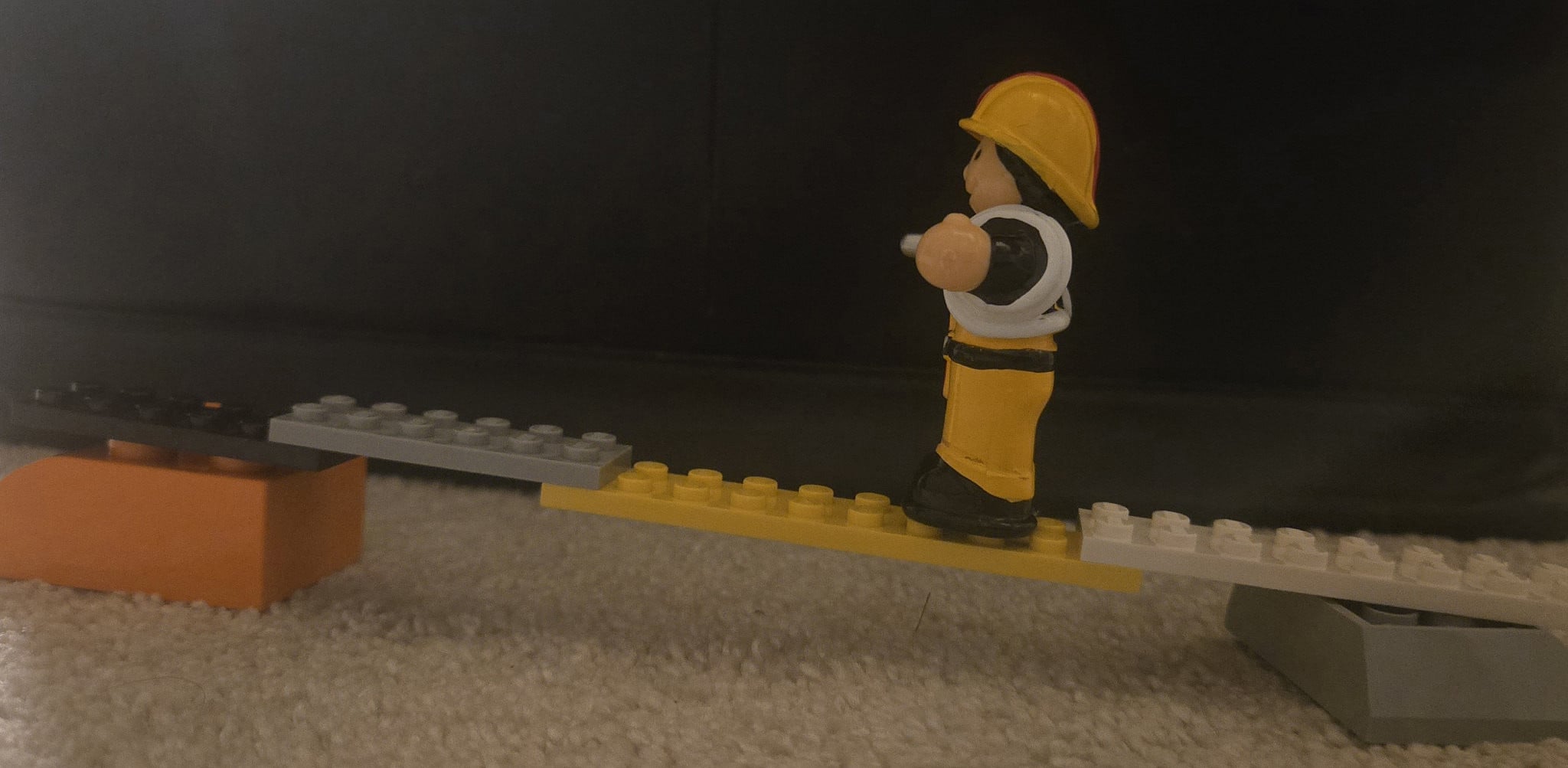
Photo by the author - "Crossing a Narrow Bridge"
Nearly forty years ago at summer camp, I learned a song about a bridge.
This year, I learned the significance of the bridge.
The song was “Gesher Tzar Me’od,” “A Very Narrow Bridge.” It was based on the teaching of Rebbe Nachman of Bratslav, the 18th century Hasidic master. In his master work, Likutei Moharan, he taught, “Know this! That a human being must pass over a very narrow bridge (gesher tzar me’od), and the rule and the essence (ha’k’lal v’ha’ikar) is that they should never be afraid at all.”[1]
Like high school students will, we changed the words when we sang it in English. Instead of “never be afraid,” we said, “and the important thing is . . . DON’T FALL OFF!!!”
We were closer to the truth than we realized. Re-reading Rabbi Alan Lew’s This Is Real and You Are Completely Unprepared, for the fifth time, I came across his interpretation or Rebbe Nachman. Lew writes, “All the world is a bridge, Rebbe Nachman said, a narrow bridge between the nothingness at the beginning and the nothingness at the end. We spend our whole lives on this precarious span, unaware that we are even on it. Then one day we wake up and see it, and we feel terror. We say to ourselves, My God, what have I been doing with my life?”[2]
Not only do I see the bridge, and the nothingness at either end that Rabbi Lew describes, but I see the nothingness that is below, and to either side. I am a doctor, and my job, more or less, is to do exactly what my friends and I used to scream in high school, as we stood on chairs and someone pointed out the words on a painted mural using a broom handle. My job is to make sure people don’t fall off.
The end of the journey will be nothingness, no matter what I do, regardless of my brilliance or my technical prowess. The beginning of the journey is in the past, an off-ramp from someone else’s bridge. But over the railings, there is an abyss. And the bridge is not only narrow, it’s like Galloping Gertie, the Tacoma Narrows Bridge that fell into the water in the 1930s. It shakes up and down, side to side, and the shaking gets worse the closer to the destination we get. And my job is just to help people reach the destination – if I can, without being afraid at all.
It seems impossible. It is nearly impossible. Life is frightening, especially once we realize we’re on the bridge, even more so when we realize what’s underneath us (or what isn’t underneath us). But it’s what we do. We try to keep people from falling off, and from being afraid, even though we all know the end of the bridge, the place we’re trying to get to, is nothingness, too.
Crossing the bridge is the ikar, the most important thing. Not crossing without fear, but the crossing itself, is the whole point. It’s what we’re supposed to be doing with our lives, to answer Rabbi Lew’s rhetorical question. And the point of medicine is to help people continue that journey.
There’s a thing I have to do as a primary care doctor called a Medicare Adult Wellness Visit. Every person insured by Medicare is supposed to have a visit like this once a year. On paper, the assignment looks like a box-checking exercise of prevention and screening recommendations that an AI could do faster and better than me, covering fall risk, nutrition, and end-of-life planning, among other things. Certainly, I didn’t need to go to medical school and residency to conduct a visit like this, right?
But once I stopped thinking about what was on the paper, and focusing on who was in the room with me, I began to frame the visit as the “what really matters most to you” visit. “Staying lucid until the end.” “Visiting friends.” “Not being hospitalized and isolated.” “Finishing a life’s work. A job has become a joy, and the box-checking is a tool I use to help achieve the ikar, the main point – to help that person complete the crossing. And yes, we even talk about the person’s fears. Believe it or not, these visits do a great deal to help someone not be afraid.
I don’t mean this as an ad for Medicare Wellness Visits, although I hope some of my colleagues who find them infuriating can take this as a way to re-energize themselves around caring for their older patients. I mean for us to think about our whole careers like this: we must always keep our eyes on the bridge. It is all there is, and no matter how hard we try we cannot make it longer or change or control what lies at the far end. But we can do our best to hold a person’s hand and ensure they make the crossing, all the way to the end, without fear, without falling off – and without their life resembling a great engineering disaster. If we can pull that off, we’re doing about as well as we can.
[1] Likutei Moharan Part II, 48:2:7.
[2] Lew, Rabbi Alan. This Is Real and You Are Completely Unprepared. Back Bay Books: New York, 2003, p. 214.
Comments