
Political analysis, conflict dynamics & human rights
Doxxing of India’s Top Military Officer Reflects a New China-Pakistan Tactic
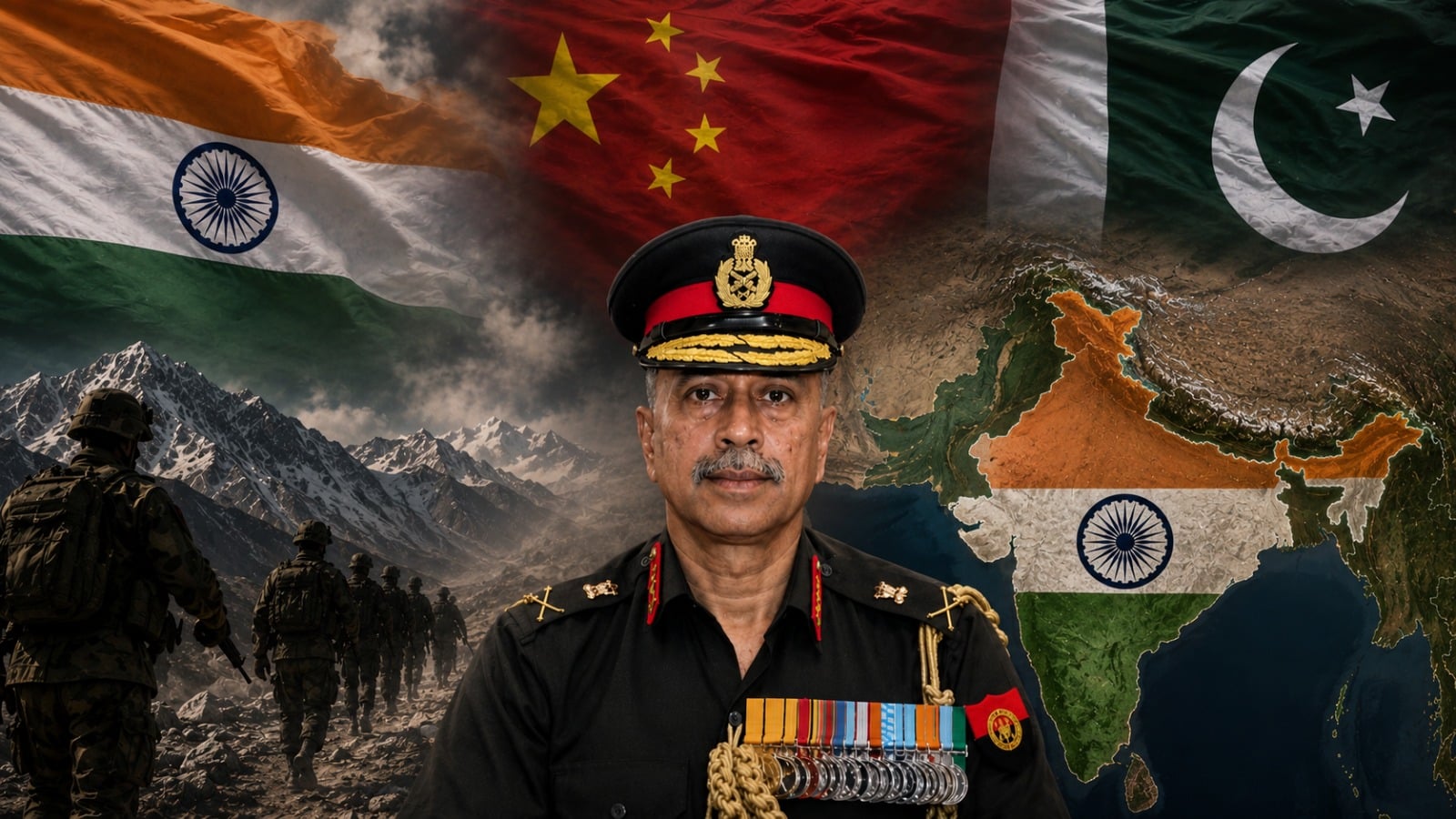
Photo illustration: Courtesy of Author
For those of us who study international security and human rights in conflict zones, one reality has become impossible to ignore: modern wars no longer begin only with missiles, invasions, or terrorist attacks. Increasingly, they begin online.
The ongoing confrontation stretching across the Middle East — involving Israel, Iran, Iranian proxies, cyber militias, and Western powers — has transformed the region into a laboratory for twenty-first century warfare.
Drones now operate alongside disinformation campaigns. Intelligence operations are amplified through digital ecosystems. Psychological warfare travels faster than conventional military escalation. In many cases, information itself has become a weapon.
This transformation is not confined to the Middle East.
The doxxing of India’s newly appointed Chief of Defence Staff, Lt. Gen. N.S. Raja Subramani, this week reflects how the methods of hybrid warfare visible across the Israel-Iran confrontation are increasingly spreading into other geopolitical theaters.
According to Indian media reports such as India First Post, personal contact and location details associated with the senior Indian military official were circulated online through accounts linked to coordinated Chinese and Pakistani influence networks.
Canada-based Ruchi Wali wrote, “this intimidation, disruption & building pressure the top military office, comes when India hardens its China posture. No surprise here”.
The episode illustrates how strategic intimidation in the digital age increasingly targets not just governments or military assets, but individuals, institutions, and public perception.
For observers of Middle Eastern security dynamics, the pattern is deeply familiar.
Over the past decade, Israel has repeatedly found itself confronting adversaries operating simultaneously across physical and digital battlefields. Iranian-linked cyber operations, online propaganda ecosystems, covert intelligence campaigns, and psychological warfare tactics have become embedded features of regional conflict. The wars of the future are no longer linear. They are hybrid, decentralized, and psychologically driven.
India now appears to be confronting elements of the same evolving security landscape.
The Globalization of Hybrid Warfare
For decades, geopolitical conflict was largely defined by conventional military power: troop movements, territorial incursions, air strikes, and naval dominance. Today, however, strategic competition increasingly unfolds below the threshold of open war.
Cyber intrusions, disinformation campaigns, online harassment networks, data leaks, and digital influence operations now function as instruments of geopolitical coercion. They create pressure without formal escalation. They destabilize institutions without requiring direct military confrontation.
The targeting of India’s new defense chief fits squarely into this emerging doctrine of hybrid warfare.
China and Pakistan have steadily expanded strategic cooperation over the last two decades, not only through military coordination and infrastructure partnerships but also through cyber capabilities and information ecosystems. Indian security agencies and international cyber analysts have repeatedly warned about coordinated influence operations targeting Indian institutions during periods of heightened political or military tension.
At the same time, India has become increasingly important within the wider geopolitical balance shaping both Asia and the Middle East.
New Delhi has strengthened defense and intelligence cooperation with Israel, expanded strategic partnerships with the United States and Europe, and deepened its role in Indo-Pacific security frameworks. Simultaneously, it has attempted to preserve communication channels with Gulf Arab states and Iran, maintaining its traditional policy of strategic autonomy.
This balancing role has elevated India’s global importance — but also increased its vulnerability to hostile influence campaigns from competing regional actors.
Why India’s New Defense Chief Matters
The doxxing attempt also draws attention to the strategic significance of the office now held by Lt. Gen. Raja Subramani.
India’s Chief of Defence Staff position was established to improve coordination between the country’s Army, Navy, and Air Force while preparing the military for future-oriented warfare challenges. The office reflects India’s recognition that modern security threats are increasingly interconnected across cyber, intelligence, space, and conventional military domains.
Raja Subramani’s own military background explains why his appointment attracted attention within strategic circles.
Commissioned into the Garhwal Rifles in the mid-1980s, he has served across some of India’s most sensitive operational theaters, including Kashmir, India’s northeastern frontier, and sectors facing China. Over a military career spanning nearly four decades, he has held senior operational and command positions involving both China and Pakistan — India’s two principal security rivals.
Equally important, he represents a generation of Indian military leadership shaped not only by battlefield experience but also by exposure to integrated warfare doctrines increasingly adopted by major global powers. His experience with strategic planning and international military education reflects India’s broader attempt to modernize its defense architecture for an era defined by cyber warfare, intelligence integration, and technological competition.
In this context, the digital targeting of such a figure carries symbolic significance beyond India’s domestic politics.
Lessons From the Middle East
What is unfolding around India increasingly mirrors lessons already visible across the Middle East.
The Israel-Iran confrontation has demonstrated how future conflicts are likely to operate across multiple layers simultaneously: cyber sabotage, covert intelligence actions, drone warfare, online propaganda, infrastructure disruption, and psychological operations designed to shape both domestic morale and international perception.
The Russia-Ukraine war reinforced the same reality. Military operations now unfold alongside narrative warfare conducted across social media platforms, cyber networks, and global information systems.
The core objective is not always immediate military victory. Increasingly, it is to exhaust institutions psychologically, undermine public trust, pressure political leadership, and create strategic uncertainty.
That is why incidents such as the doxxing of India’s new defense chief deserve international attention. These are symptoms of a rapidly changing global security environment where the line separating war, coercion, propaganda, and digital intimidation is becoming progressively blurred.
For democracies confronting increasingly sophisticated hybrid threats — whether in Israel, India, Europe, or elsewhere — the challenge is no longer simply defending borders. It is defending institutions, information systems, and public resilience itself.
Because in modern conflict, the first battlefield is often no longer territorial. It is digital.
Related Topics
Related Posts