
Dreaming of Ladders
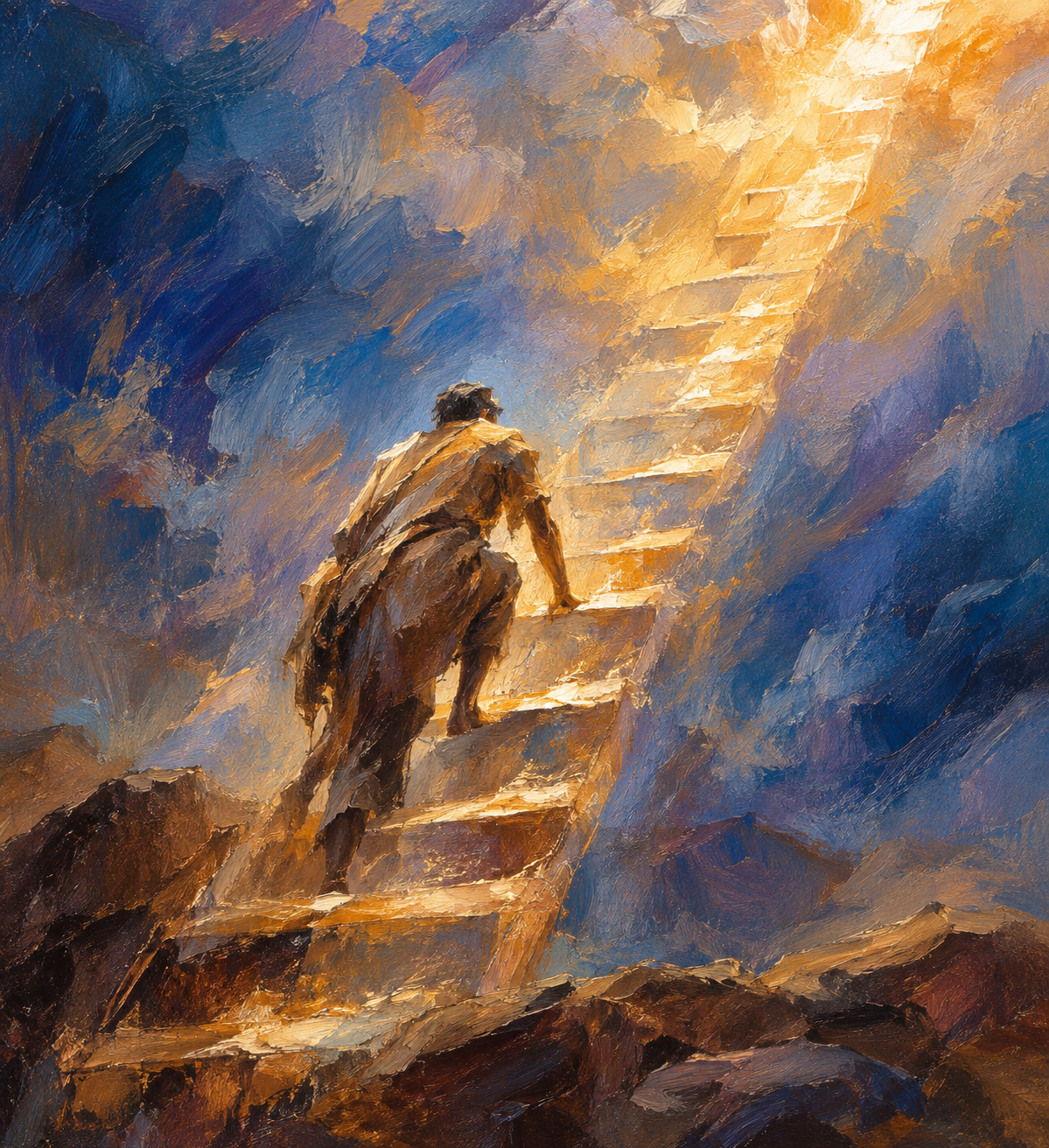
It is one of the most beautiful and memorable visions of the Torah. Yaakov flees. Night falls. Exposed to the elements, he takes a stone[1], places it behind his head, and falls asleep:
He dreamt, and behold, there was a ladder standing on the ground and its head reached the heavens, and there were messengers of God going up and down it (lit. him). And behold standing above it (lit. him) was The Lord, who said, “I am The Lord, the God of your father Avraham and the God of Yitzhak: the ground on which you are lying I will give to you and to your offspring…Behold, I am with you: I will protect you wherever you go and will bring you back to this land. I will not leave you until I have done what I have promised you.” (Bereishit 28:12-15)
Various commentaries put forward alternative explanations for the imagery of this dream. Rashi[2] comments that Yaakov is observing a changing of the guard: the angels who accompanied him during his time in Israel are replaced by those who will accompany him during his exile. God watches from above, guarding him. Although this is a mystical idea, it carries a beautiful message: Wherever Yaakov will go, he will not go alone. The company might change, but the care will remain.
Ramban[3] offers a different explanation: the vision is a glimpse of God’s hierarchical management of the world. The angels ascending and descending the ladder are messengers of God dispatched to manage the world. This is part of Ramban’s broader philosophy: authority from God is devolved onto other forces, which, like forces of nature, control the world[4]. God oversees and can override those subordinate forces, but generally works through nature. God standing at the top of the ladder tells Yaakov, that he will be the exception to this norm. God will take care of him personally wherever he goes.
Rambam[5] views it as a parable of prophecy itself. The word “מלאך (Malakh)” means both angels and messengers. Those climbing the ladder are prophets who carry messages from God. With almost palpable excitement, Rambam points out that a prophet’s ascent precedes their descent, because what they learn and achieve in their ascent, they must carry down with them, to instruct and teach others.
There is perhaps an alternative explanation of this dream, one which gives us insight into the enigmatic figure of Yaakov. In the Book of Daniel, when Daniel offers an interpretation for the haunting dream of the King of Babylon, Nevuchadnezzar, Daniel begins his explanation by telling the King:
אַ֣נְתְּ מַלְכָּ֗א רַעְיוֹנָךְ֙ עַל־מִשְׁכְּבָ֣ךְ סְלִ֔קוּ…(דניאל ב:כט)
O King, your thoughts came upon your bed… (Daniel 2:29)
This line is somewhat vague. Rashi[6] explains that it means “what you thought about during the day came into your mind while you slept.” This is something that many will confirm from lived experience. Our thoughts during the day chase us well into the night.
If that is the case with Yaakov, then the Torah is telling us a striking idea. If Yaakov dreamed of ladders stretching from earth to heaven at night, it meant he thought about them during the day. At the back of his mind, through all the turmoil and hardship, was a deep, profound desire to reach heavenward[7].
God’s appearance at the head of the ladder was His affirmation of Yaakov’s vision. The angels went up and down the ladder, their progress was never linear, just as Yaakov’s tumultuous life would never be. His life would be a constant climb, but its aspiration and at its destination stood God. God comforted him: the ladder might be perilous and long, but “I will be with you wherever you go.”
This is why the vision of the ladder is written in such an ambiguous and vague way. The ladder is being personified. It has a “head” and it “stands” on the ground. These are human features, not those we associate with inanimate objects. The text deliberately blurs the distinctions between Yaakov and the ladder. Likewise, it is ambiguous whether the angels are ascending and descending the ladder or are within Yaakov[8]. It is also not clear whether God is standing at the top of the ladder or by Yaakov’s head. This is because Yaakov is the ladder. His feet are muddied by the earthly difficulties of life, but his head reaches heavenward.
Perhaps the most convincing argument for this idea is that Yaakov himself seems to have understood his dream thusly:
Yaakov awoke in the morning and took the stone that he had put under his head and set it up as a monument and poured oil on the top of it. He named that site Bethel (The House of God)…(he said) “This stone, which I have set up as a monument, shall be a House of God…” (Bereishit 28:18-22)
What role did the stone play in his dream? It is not mentioned in it at all. Yet, Yaakov decides to mark the place with this stone and decides it will also serve as the cornerstone of the “House of God” he committed to build. It might simply be that he had nothing else that he could use. But if we look at the text another reason springs out: The one thing we know about the stone is that it was placed by Yaakov’s head. There is another “head” mentioned in the dream: The “head” of the ladder, where God stood. Both the stone and God stood at the head of two different things. Or were they two different things? Yaakov woke up and immediately made the stone the cornerstone of the House of God. It would be used to represent God’s presence on earth. Perhaps this was because it already had represented God. Yaakov understood that the ladder was within him. If God stood at the “head” of the ladder, then He could be represented (in a purely abstract sense) through the stone that was under his head.
This gives us unique insight into Yaakov’s mind. It is very hard to understand the inner Yaakov. The man is often missed for the myriad of tragic events that engulfed his life. He had no peace in the house he came from, and little in the one he built. He was tricked into marrying a woman he never wanted but was too noble to abandon her. Worked to the bone, he is accused of dishonesty. The love of his life dies in childbirth. One child is raped. Two more take barbaric revenge. Another is, seemingly, killed. Another is imprisoned. Two more have dramas in their own personal lives. The youngest, under the pressures of famine, is sent to the mercy of a foreign, unpredictable ruler. Yaakov truly suffered, but true to his name[9], he always held on and always aspired to climb the ladder.
Of all the forefathers, it is the complex and fraught life of Yaakov that serves as the most relatable model. There is no such thing as unhindered progress in life. We are muddied by earthly matters whilst clinging on to a ladder and reaching for its heights.
The father of the Jewish People is the man who even in the darkest of nights dreamed of a ladder that could stretch from earth to heaven.
–
[1] See Rashbam, Bereishit 28:11
[2] Rashi, Bereishit 28:12-13
[3] Ramban, Bereishit 28:12-13
[4] With the exception of the Land of Israel
[5] Moreh Nevukim 1:15
[6] Daniel 29:2
[7] See Bereishit Rabba 69:1
[8] This is debated between R. Chiya Rabbah and R. Yannai (See Bereishit Rabba 69:3). The text is written in such an ambiguous way that perhaps beyond both readings being both plausible they are both intended.
[9] Bereishit 25:26