An Aging Jewish Feminist
Dwelling within Tension: Second Chances—Parshat Behaalotcha
THE LIGHT OF THE MENORAH AND THE SHADOWS OF CRITICISM
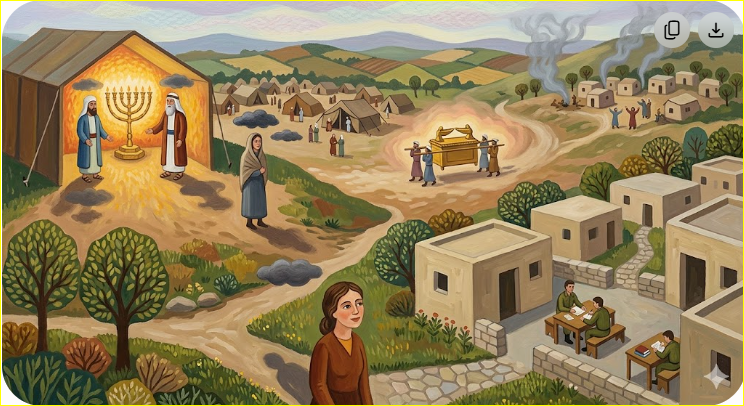
My late sister, Menorah Rotenberg, was born toward the end of June. I often imagine my father sitting in synagogue a week or two before her birth, listening as the Torah portion went on and on about the golden candelabra (menorah). To this day, we don’t know for certain why my parents named her Menorah—but this has always been our best guess for her very unusual name. That portion was Parshat Behaalotcha, which opens with the commandment to kindle the menorah, but quickly descends into the messy, fractured realities of human nature. It is a parsha I find myself returning to every year in the synagogue, thinking deeply about family, legacy, and the voices that shape us.
My mother, Charlotte Lebowitz, (whose yahrzeit is this week) for instance, was a woman of immense drive, but she also possessed a distinctly snobbish streak and a sharp tongue. In her eyes, she was better than many others—the wealthy wives who didn’t work, the nouveau riche, and the poor who frequented my father’s store at the edge of Spanish Harlem. She could be impatient and judgmental, always in motion, and she had very little patience for the elderly. Yet, when she suffered her first heart attack, my energetic mother became dependent and querulous. Having now reached the very age at which my mother had her first heart attack, my uneasiness has given way to a deeper appreciation for what she endured. I inherit her curiosity and engagement with the world, recognizing that human lives, like the biblical narratives we read, are deeply layered.
I see a reflection of this sharp-tongued judgment in Behaalotcha itself, where Miriam and Aaron speak critically of Moses regarding the Cushite woman he married. The rabbis historically framed Miriam’s act of “speaking up” as a specifically female failing: gossip (lashon hara). Her past merits—saving Moses as a child, leading the women in song with her timbrel—seem erased the moment she challenges authority. Stricken with leprosy and shut out of the camp for seven days, her punishment raises painful questions about gender, voice, and selective justice.
As a midrash writer, I have often wondered: how did Miriam experience her isolation? Did she question why Aaron was spared? In a midrash I wrote about “The Discredited Prophetess” in the mid-1980s I explored this silenced voice. When Aaron begs Moses for her healing, Moses cries out to God: “O God, please heal her!” (Numbers 12:13).
Here, divine power manifests not in battle, but in restoration. Miriam must wait, but the community does not march on until she is readmitted. In a fractured society, this model of compassion—prioritizing healing over victory—is often the one we need most.
THE BLESSING, THE BATTLE CRY, AND THE PERIPHERY ON FIRE
This need for healing is underscored by the profound theological tensions running through the book of Numbers. Last week’s parsha, Naso, includes the timeless Priestly Blessing:
“May the Lord bless you and protect you… bestow favor upon you and grant you peace” (Numbers 6:23–27).
This blessing embodies grace and ultimate peace. Yet, contrast this with the verses my granddaughter prepared for her bat mitzvah last year, as the war broke out, from Beha’alotcha. As the Ark begins its journey, Moses proclaims a militaristic cry:
“Advance, O God! May Your enemies be scattered, and may Your foes flee before You!” (Numbers 10:35).
How do we reconcile the God of peace with the God of war? In light of current events—especially the war in Gaza and Lebanon—this question feels devastatingly urgent. The longing for peace remains profound, yet the language of military strength dominates public discourse, drawing severe international criticism and raising difficult moral questions about how religious language is used to justify power.
The Torah does not offer a simplistic spirituality. The inverted Hebrew letter nun surrounding Moses’ battle cry in the Torah scroll hints that these verses stand within their own tension. As the sages teach, absolute justice and perfect peace rarely coexist. Jewish tradition asks us to dwell within the tension. But immediately after this battle cry, the narrative shifts back to internal strife. In Numbers 11:1–3, the people complain, and God responds with a fire that consumes the outskirts of the camp, a place named Taverah.
Today, we are painfully familiar with such imagery. Fires—both literal and metaphorical—ravaged communities in the north and south of Israel. The northern periphery has once again become unliveable. Rashi interprets “the people” in this passage as wicked individuals whose complaints were merely pretexts to distance themselves from God. This resonates deeply in contemporary Israeli society, where different groups accuse one another of evasion and irresponsibility—whether criticizing the ultra-Orthodox community for avoiding military service or accusing protesters of undermining the state.
Yet, when does complaint become justified protest, and when does it become destructive? Jewish tradition values moral dissatisfaction; tikkun olam (repairing the world) emerges from a refusal to accept injustice. Today, however, disagreement is increasingly labelled as treason, and violence is used to suppress dissent, threatening the very foundations of democracy.
THE EVOLUTION OF THE SECOND CHANCE
What, then, connects the story of divine fire with our desperate need for a middle path? It is the concept of responsibility balanced by compassion—the ultimate “second chance.”
I saw the seeds of this in September 1968, when my husband and I moved to Jerusalem from Alonei Yitzchak. By chance, I bumped into an old English Literature classmate from 1965, an encounter that led to a teaching position at the Pre-Academic Center of the Hebrew University. We taught in temporary classrooms in the Italian Salesian Sisters’ convent in Musrara before moving to Mount Scopus. We were pioneers, commuting through an Old City that was then still safe, jokingly betting on our daily driving routes.
Most of my students at the convent had served in the army during the Six Day War in June 1967 and had missed their exams. As final exams approached, I discovered—much to my surprise—that students who failed were entitled to a second chance, known as Moed Bet. Having previously taught at Rockland Community College in New York, where failing meant retaking the entire course, I found this astonishing. In Israel, soldiers were given another opportunity.
Over my 40-year teaching career—five at the Hebrew University and thirty-five at Ben-Gurion University of the Negev—I watched Moed Bet evolve into Moed Gimmel, a third chance. What began as an accommodation for soldiers expanded to include students who were ill, pregnant, or simply trying to improve a grade. For instructors, it became exhausting; we couldn’t finalize grades or go on vacation.
After retiring in 2009, I began to see things differently. From the outside, I developed greater sympathy for the concept. These past years, in the wake of COVID, an endless war and national trauma, I actively encourage the students I meet to use these opportunities. Universities are offering flexibility under these grueling circumstances. Still, there are consequences—an engineering or medical student may graduate on time but with gaps in their knowledge. Let’s hope they have the integrity to make up what they missed, or society will suffer in the future.
Remarkably, the ancient precedent for this institutional flexibility is found right here in Parshat Behaalotcha. In Numbers 9:1–12, certain individuals were ritually impure due to contact with a corpse and could not offer the Passover sacrifice. They approached Moses, asking why they should be excluded. God responded with a compassionate solution: they could offer the sacrifice one month later. This became known as Pesach Sheni—the original second chance.
God even extended this allowance to travelers, broadening the scope beyond the original request. One might see here the biological seeds of both Moed Bet and Moed Gimmel. Surely, our soldiers who have spent months in Gaza or Lebanon qualify for such compassion. Yet, this leniency had limits; anyone who was clean and able, but simply chose not to participate, was punished. God allowed flexibility, but not exploitation.
CONCLUSION: BEYOND THE FIRE
Both the educational system and the Torah reflect the eternal tension between justice and compassion. Flexibility is necessary, but it must not be abused. Today, as our society heats up—politically, socially, and literally—we seem to be losing our capacity for moderation, empathy, and dialogue. The haftarah for this week reinforces the ultimate path forward with Zechariah’s famous declaration:
“Not by might, nor by power, but by My spirit, says the Lord” (Zechariah 4:6).
True strength lies in moral and spiritual integrity. Perhaps what we need most right now is not more fire, but more patience. We need a collective willingness to grant one another a second chance, a moed bet. And maybe we even need a moed gimmel—to repair what has been broken, until the final words of the Priestly Blessing, “and grant you peace,” become not just a prayer, but our reality.
Related Topics
Related Posts