
Israel expert, educator and guide
Echoes of 1936: Silencing the Canary
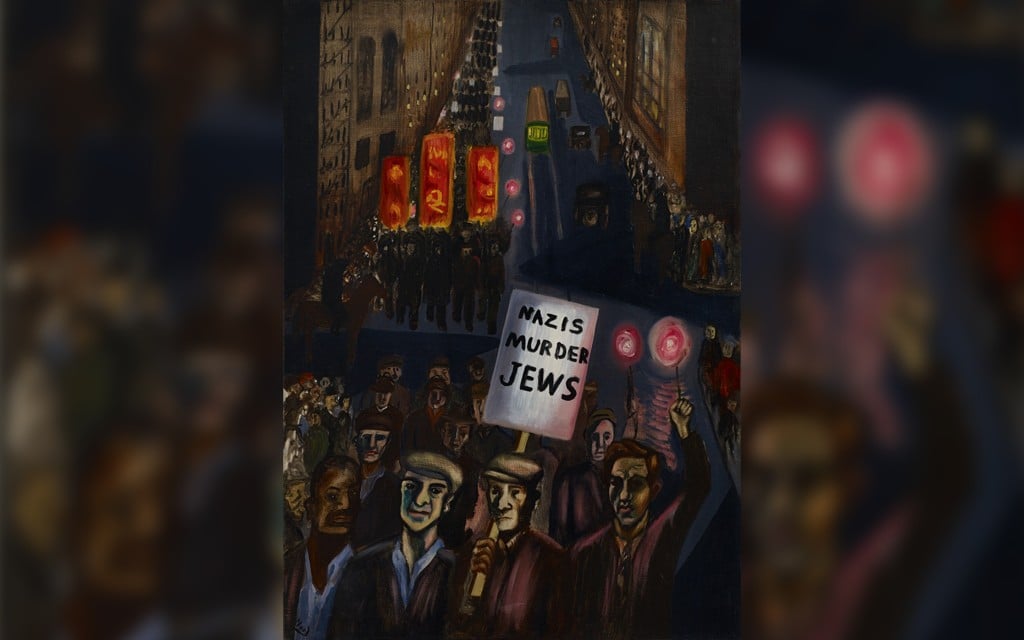
Nazis Murder Jews; Alice Neel, 1936 Courtesy of the Rennie Collection, Vancouver
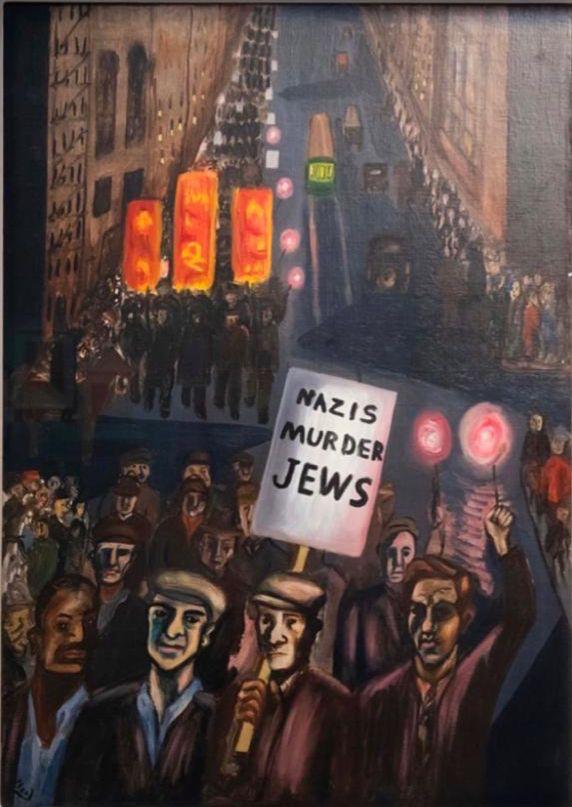
In 1936, the American artist Alice Neel painted a scene of a torchlight protest in New York City. The painting is claustrophobic, dominated by dark, heavy strokes and a dense crowd of demonstrators. In the center, illuminated by the torches, a single white placard carries a blunt, chilling message in black paint. It reads: “Nazis Murder Jews.”
Looking at this painting today, the immediate question is one of foresight. How did a group of activists marching through the streets of New York in 1936 grasp the lethal endgame of the Third Reich, years before the industrial machinery of the Holocaust was fully assembled? And conversely, why did the educated political class, the diplomatic corps, and the elite media fail to see what was plainly written on a cardboard sign?
The popular aphorism, often attributed to Mark Twain, suggests that history does not repeat itself, but it rhymes. The rhyme between the mid-1930s and our current moment is growing deafening. If we examine the mechanics of how the West ignored the gathering storm then, we can recognize the exact same machinery of denial operating today.
In 1936, the international community gathered in Berlin for the Olympic Games. The Nazi regime temporarily sanitized its virulent antisemitism for global consumption. It worked flawlessly. Many American and British journalists returned home with glowing reports of German efficiency and hospitality. They viewed Hitler as a stabilizing force, a bulwark against Bolshevism, or simply a nationalist leader with whom one could do business.
Did the political class miss the warning signs? No. The information was entirely available. The Nuremberg Laws, which stripped Jews of their citizenship, were passed in 1935. The violence in the streets of German cities was widely reported. The protestors in Alice Neel’s painting did not possess secret intelligence. They simply chose to take the Nazis at their word.
The political elite, however, engaged in a massive, collective exercise of willful blindness. For leaders like Neville Chamberlain, acknowledging the true nature of the Nazi project meant accepting that a catastrophic war was unavoidable. To preserve the illusion of peace, they rationalized the irrational. They convinced themselves that Hitler’s demands were finite and based on legitimate grievances regarding the Treaty of Versailles. This delusion paved the way for the betrayal of the Sudetenland, the Anschluss, and the shattered glass of Kristallnacht in 1938. The signs were not missed. They were actively, intentionally ignored for political expedience.
Today, we are witnessing a catastrophic failure of exactly the same nature.
The stated intent of radical jihadist organizations like Hamas, Hezbollah, and their primary sponsor, the regime in Iran, is not a secret. It is not hidden in classified documents. It is broadcast on state television, written into their founding charters, and shouted in their public squares. Their objective is the eradication of the State of Israel and the murder of Jews.
Yet, much like the political class of the 1930s, a significant portion of today’s Western political establishment, academia, and media refuse to take these actors at their word. Instead, they engage in the exact same process of rationalization.
When a terror organization commits mass atrocities, the Western impulse is to immediately sanitize the violence by translating it into the comfortable, secular language of Western political science. The religious, genocidal ideology is stripped away. It is reframed as a territorial dispute, a reaction to economic blockade, or a manifestation of post-colonial or anti-clonial resistance.
This is not born of ignorance. It is born of fear and intellectual hubris. To accept that there are powerful forces in the Middle East driven by a theological imperative to murder Jews, and that many who espouse this ideology are now thoroughly entrenched in the West, means admitting that the Western diplomatic toolkit of compromise, tolerance, economic incentives, and two-state solutions is fundamentally inadequate. It forces the uncomfortable realization that the West is now fighting this exact same zero-sum conflict at home.
Therefore, the political class projects its own rationalism onto irrational actors. They assume that if they can just address the supposed root causes, the violence will cease. This is the modern appeasement. It is the belief that if you concede enough diplomatic ground, or inject enough financial aid, a terror organization will abandon its core reason for existence.
When crowds march through the streets of London, New York, and Paris today, chanting slogans that call for the eradication of Israel from the river to the sea, the media often characterizes them as pro-peace activists. The cognitive dissonance is staggering, but it is not unprecedented. It is the same dissonance that allowed foreign dignitaries to salute the swastika at the 1936 Olympics while concentration camps were already being constructed.
There is, however, a profound difference between the zeitgeist of 1936 and our current reality. In the 1930s, the Jewish people were a stateless minority, entirely dependent on the goodwill of host nations that ultimately betrayed them. Today, there is a sovereign, militarily capable Jewish state. Therefore, the immediate threat we face is not the construction of new extermination camps in Europe. The architecture of the threat has evolved.
The modern campaign focuses instead on the systematic isolation, vilification, and delegitimization of Israel. By extension, Jews worldwide are rendered legitimate targets simply for supporting it. This is not standard geopolitical criticism. It is a calculated effort to lay the intellectual and moral groundwork for the eradication of Jewish life globally, alongside the Jewish State’s eventual destruction. By incessantly framing the sole Jewish nation as an inherently evil, illegal or colonial enterprise, the international community strips Israel of its fundamental right to self-defense, and diaspora Jews of the basic human dignity required to exist openly and equally in society. Once the state and its supporters are successfully delegitimized in the global consciousness, the violent jihadist campaign to eradicate them is no longer viewed as terrorism; it is sanitized as justifiable resistance. Those in the political and academic classes who participate in this vilification are providing the necessary ideological scaffolding for the physical violence they often claim to abhor.
We are not doomed to repeat history, but failing to learn its central lesson guarantees catastrophe. The lesson of 1936 is that when an ideology openly declares its intention to murder Jews, you must believe them the first time. The protestors holding the sign in Alice Neel’s painting understood this basic truth. The tragedy of the 20th century is that the people in power did not. The tragedy of the 21st century will be if we allow the delegitimization of the Jewish state to pave the way for the exact same mistake.
Alice Neel’s “Nazis Murder Jews” belongs to the collection of Bob Rennie, founder of Vancouver’s Rennie Collection, who has spent decades building a globally recognized collection focused on social justice, identity, and politics. Rennie recently highlighted the profound emotional resonance of this piece during his honorary doctorate address at Adler University. The painting is currently at the Jewish Museum in New York, which is actively finalizing its permanent acquisition. Prioritizing the artwork’s historical legacy over its monetary worth, Rennie is selling the piece, appraised at up to $3 million, to the museum for $1.5 million, effectively donating the remainder.
Speaking about the transfer of the work, Rennie emphasized that finding a safe and appropriate custodian was far more important than maximizing its financial return. He noted that preserving Neel’s legacy as a “canary in the coal mine” and ensuring the painting remains accessible within its historical and cultural context were paramount considerations. As Rennie explained, “There is no better home than the Jewish Museum”.
Related Topics