Ed Sheeran Says He Has No Soapbox. His Opener Just Built One on His Stage.
You were the opener once, Ed. You know the job. Now do the headliner’s.
My husband and I had our first dance to “Thinking Out Loud.” It is a song about being seventy and still wanting the same person, which is a lot to promise in front of everyone you know, and Ed Sheeran gets it said in four minutes without once sounding like he is making a speech.
I have never seen Ed Sheeran live. I am a Swiftie, and he came to me the way he came to a lot of us: singing the boy half of “Everything Has Changed,” then opening every North American date of the Red Tour in 2013—a ginger with a loop pedal warming up arenas full of people who had come for someone else. That was enough to get him into my wedding.
Last Friday he headlined MetLife, and his opener wore a keffiyeh and led the stadium in “Free Palestine.” Jewish families walked out. He has said nothing. I could yell. Plenty of people already are, and I spend my working life on what Jewish people are owed in rooms they paid to be in, so I could yell professionally. I am going to try explaining first, because I think he can still hear it.
What a Jewish Fan Saw From the Upper Deck
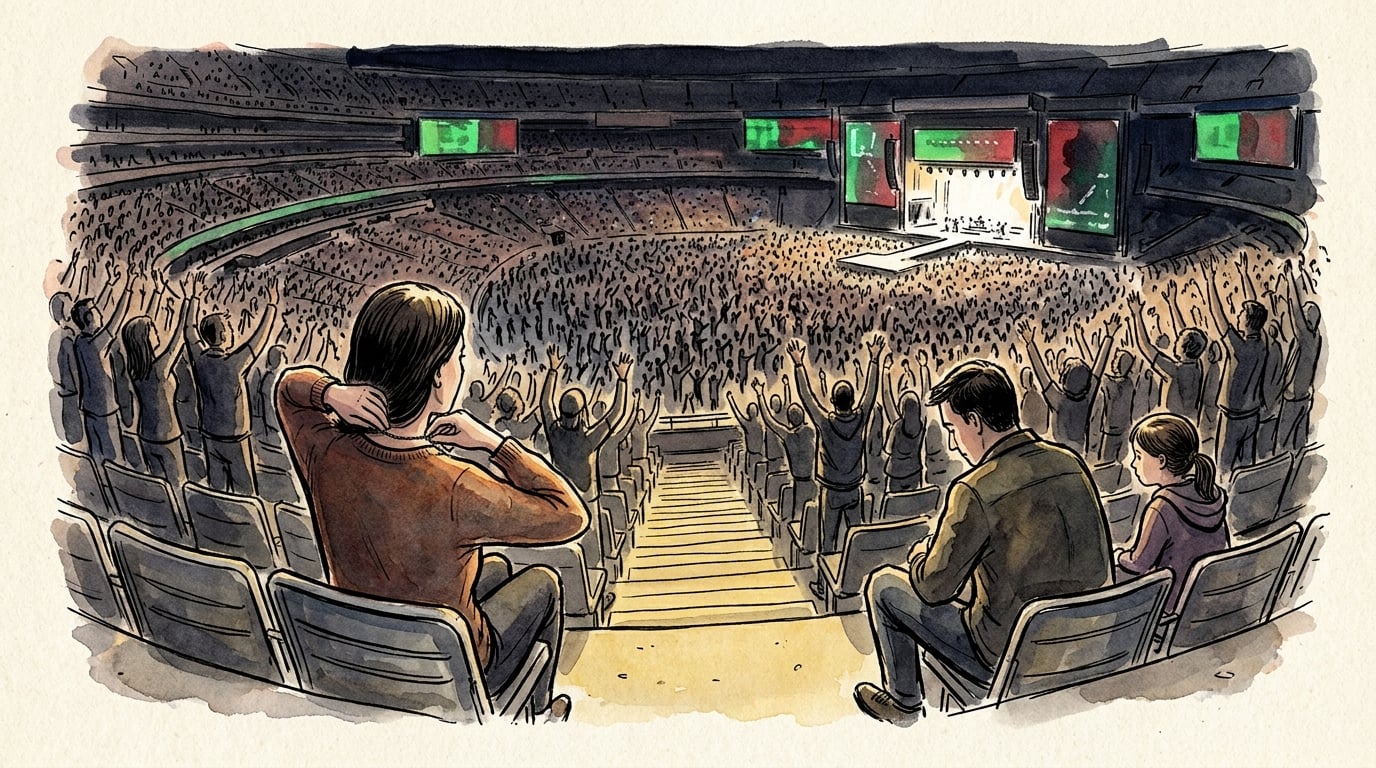
Picture a Jewish fan in the upper deck. There were real ones, so this is not hard. She bought the tickets in the spring. She drove to the Meadowlands with her husband and her daughter for a night of love songs, and the opener walked out with a keffiyeh around his neck.
Then the screens filled with a Palestinian flag and the words Free Palestine. Then his Gaza protest song, “Hind’s Hall,” dedicated to the Columbia encampments. Then the word she has spent two years hearing aimed at her: genocide. Then the two words he said he had wanted to say on stadium stages across America, and tens of thousands of people around her said them back. Free Palestine. Free Palestine. Then Cuba, the Congo, Sudan, Iran, and ICE as a terror organization, in case anyone thought it was a concert. She did not sing along. She tucked her necklace into her shirt. Somewhere below her, young Jewish girls were leaving the stadium in tears. She checked where the exits were, which is a thing you learn to do.
He also said this: “To all of my Jewish brothers and sisters: Criticism of Israel, criticism of apartheid, being against genocide in no way is criticism of you.” Those are his words, and I believe he believes them. She did not feel criticized. She felt found.
The keffiyeh is not a scarf. It is what the men who came through the fence at Nova had on their faces while they murdered her friends—there were people in that stadium who had buried friends from Nova—and what Abu Obeida, the Hamas spokesman who never shows more than his eyes, wore to praise them for it. It was Yasser Arafat’s uniform for decades while his organization existed to destroy Israel and its offshoot, Black September, murdered eleven Israeli athletes at the Munich Olympics. Leila Khaled hijacked a plane in one and is still painted on walls wearing it, holding a rifle. It has been a fighter’s face covering since the British Mandate, when Arab militants were told to wear it so nobody could tell them from everyone else. That is the garment Macklemore picked for a stadium. She does not see his intent. She sees the last face her friends saw.
And “Free Palestine” is not a wish for peace. To a lot of the people who chant it, it means Israel gone—one Palestinian state where the only Jewish one used to be—and the ones who mean it that way are not shy about it. In May 2025 a man shot two Israeli embassy staffers leaving a Jewish museum in Washington and shouted it as the police took him. Eleven days later a man threw fire at people walking for the hostages in Boulder and shouted it too. That is what those words were attached to the last time she heard them on the news. You can tell her it means peace. Her body is not listening. It is looking for the exits.
He did the whole set again on Saturday—after the Israeli-American Council had asked Sheeran to pull him, after she and people like her had walked out of the first show and said why. Nobody on that stage has asked what it was like in the seats.
A Word to the Headliner
This is not to Macklemore, who has his own tour and is welcome to it. This is to you, Ed.
You know what an opener is. You were one for six months in 2013, opening for Taylor Swift in front of crowds that had not come for you. You know the rules because you lived them: play your songs, make her crowd like you, hand the room back in better shape than you found it, and do not make it about anything but the music. Macklemore took that job and turned it into a rally, then did it again the next night after he had been asked to stop.
You also wrote a song about this. In 2017 you wrote “What Do I Know?” on the spot in a record executive’s office, and the whole song is you saying you have no soapbox, only a stage and a guitar, and that you will use them for love because that is the one thing you know anything about. You said you wanted American crowds walking out with that in their ears. Last Friday a chunk of your crowd walked out early with something else in their ears. Somebody put a soapbox on your stage. It has your name on the side.
Your Stage, Your Call
The ask is small and it is yours alone. What do you want this tour to stand for? What do you want a Jewish family in the upper deck to remember about the night they came to hear you sing? You have answered that question in every song you have ever written. Answer it here.
I know what this ask looks like. When a festival drops an artist over his politics, my side calls it cancellation, and we are right. But nobody is asking a government or a venue to stop Macklemore from performing. He has a tour. A headliner picks his opener every tour, and nobody has ever called that speech. Macklemore may say “Free Palestine” anywhere he likes. The only question is whether you want it said on your stage, to your crowd, under your name, for eight more shows.
I know he is your friend—you sang on the song he wrote for his newborn daughter. I know most of MetLife cheered or did not notice. I know you may have seen Saturday coming and been fine with it. If that is the answer, then I have mine, and so does every Jewish fan you have, and we will do what we did with Dave Matthews: keep the songs, keep the wedding video, keep our money.
I would rather be wrong about you.
Rosh Hashanah Is a Good Week for a Fresh Start
Rosh Hashanah starts Friday night. Then ten days, and Yom Kippur on the 21st. For Jews, that stretch is the annual deadline for deciding what we are going to do differently, and the next show with Macklemore on the bill is Philadelphia, the 19th, right in the middle of it. I did not plan that. But I am a lawyer, and I have never been handed a deadline that clean.
It is not your calendar, Ed. It is still a good week for a fresh start, and you would be doing it because you decided to, not because a petition made you. Say one sentence to the families who left early—that they are welcome at your shows and that what they saw was not your message—and make sure whoever opens in Philadelphia understands the job. Or change the bill. Either is yours to choose. Silence is a choice too, and it is the only one that answers the question for you.
I picked your song, Ed, because it was about staying. Your Jewish fans are deciding whether to. The woman in the upper deck has not decided whether to come back. The shofar sounds Friday night. Come out before Philadelphia and give them a reason.