
Dave Matthews Was Our Soundtrack. Now His Crowd Chants Slurs.
Dave Matthews didn’t just lose me over Israel. He turned the one place that felt like home into a place where kids feel free to scream slurs. Here’s what we do about it — and why we don’t have to give up the music.
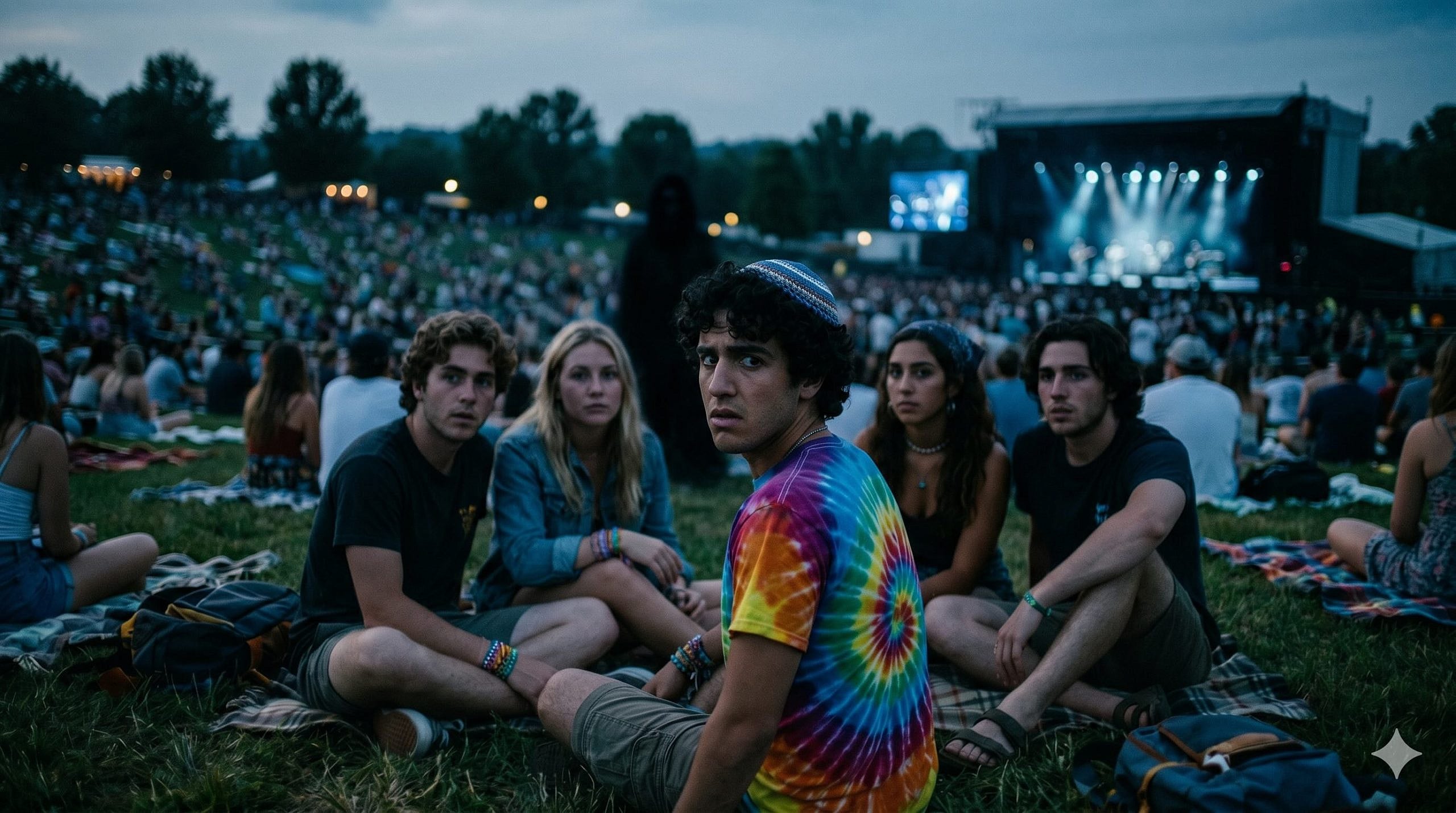
A friend of mine was at the Dave Matthews Band show in West Palm Beach this past weekend. He posted a story from the lawn — the old crew, all of them, grinning in the dark with the stage lights behind them. I knew most of the faces. I have stood in that exact spot more times than I can count.
I replied with one word. Fomo.
I meant it. Genuinely. There was no irony in it, no asterisk, no little voice in the back of my head. I saw the photo and felt the pull of twenty years of muscle memory and I wanted, with my whole chest, to be there.
An hour later, my phone buzzed again. Same friend.
Dave just went off about Gaza. Fml. We left.
And then, a few texts down, the part I can’t stop thinking about. The kids standing behind his brother, responding to whatever Dave said from the stage, said this out loud, to a crowd, in 2026: “Yeah, f*** the Jews. F*** those kikes.”
He’s one of the biggest Dave fans I know. It was the twentieth year since his first show. He left in the middle of it. And then he texted me: write an article on it.
So here we are.
A Very Specific Kind of Jew
Let me tell you who I was before October 7, because you cannot understand what was lost unless you understand what it was.
I am not religious. I never have been. But I am culturally Jewish in a way that is so specific it practically has a uniform. I went to Jewish summer camp. I was in BBYO. I was an AEPhi in undergrad, an AEPi sweetheart, the whole ecosystem. I once made a rush poster with the Grateful Dead dancing bears and the slogan “Get Chai with AEPi.” Was it a little on the nose? Yes. A little pick-me? Also yes. But every single one of my friends knew exactly what it meant, because we were all the same phenotype: the tie-dye-t-shirt, summer-camp, youth-group Jew. The one who maybe smoked a little too much weed in college. The one who could fold a perfect spiral tie-dye in her sleep. The one who never, ever missed Dave when he came to town.
This is not a bit. There is actual scholarship on it. There is a Boston University doctoral dissertation — and I am not making this title up — called So Much More Than Kumbaya: Music at Jewish Summer Camps and the Formation of Jewish Identity.[1] Its whole argument is that communal song at camp doesn’t just accompany Jewish identity; it builds it. The melodies become the architecture. You carry them out of the canteen and into the rest of your life, and they keep meaning home no matter how far you get from the lake.
That is what jam-band culture became for a certain kind of American Jew. It is not an accident that “Jews love Phish” is a sentence everyone in my world just nods at — there is a Penn State University Press book about that, too, with two of the band members being Jewish, the band playing “Avinu Malkeinu” and “Yerushalayim Shel Zahav” live, and Jewish fans describing how they learned the music at camp and passed it down to their own campers “like Torah.”[2] Same instinct, different jam. The setlist becomes the text. The lawn becomes the beit midrash.
For my people, in my corner of Florida, the annual Dave shows at the amphitheater in West Palm Beach were exactly that. A reunion. You’d run into your buddy from BBYO at the tailgate. You’d bump into someone from Hebrew school on the lawn. You’d pass a joint to your camp friends during “Crash” and feel, for three minutes, like the whole scattered diaspora of your adolescence had reassembled itself in one humid field.
I know more people than I can count whose first dance at their wedding was “You & Me.” My own brother’s, about a week ago. I probably would have picked it too, if half my friend group hadn’t gotten there first.
That is how deep this ran. Dave wasn’t a guy we liked. Dave was the soundtrack to our peoplehood.
It Was Never About Dave
Here is the thing I want every tie-dye Jew reading this to sit with, because it took me a while to get here myself.
The magic of that lawn was never coming from him.
We made it. We brought the camp friends and the BBYO buddies and the Hebrew school faces. We brought the friendship bracelets and the spiral tie-dye and the inside jokes that went back to a bunk bed in the woods when we were twelve. We brought twenty years of our own lives and laid them down on the grass, and the music was the excuse that got us all in the same place at the same time. He played “Crash.” We supplied everything that made it mean something.
He was the vessel. He was never the source.
I need that to be clear before I say the next part, because the next part is the hard part, and I don’t want anyone walking away thinking that what we’re losing is him. It isn’t. It never was.
The Breakup
I am not going to pretend Dave just disagrees with me about a foreign policy question.
A fellow Times of Israel blogger, Michael Kohler, already wrote his own goodbye to Dave, and he laid out the pattern plainly: the rant at Madison Square Garden, the worse one at Saratoga, the calls for a ceasefire and “free Palestine” delivered alone on a darkened stage between songs, the recitation of Hamas casualty figures as though a hundred-year conflict can be adjudicated in the ninety seconds before the band kicks back in.[3] He’s right about all of it. I won’t re-litigate the facts; they’re one tab over.
What I’ll add is the part that turns this from a political disappointment into a breakup.
In December 2023, Dave sent a private letter — through his management, to the Jewish fans who’d organized in a Facebook group called the DMB Jew Crew — condemning October 7 “strongly and unequivocally,” calling the murder, rape, and abduction of civilians “abominable,” saying he wanted every hostage home.[4] Beautiful words. Privately. Meanwhile, in public, in front of twenty thousand people, he was doing the keffiyeh, the “genocide” sign, the one-sided sermon.[5]
Read that again. He knew exactly what to say to us. He said it where no one could see. And then he walked onstage and said the opposite to the world.
Rami Feinstein — an Israeli singer-songwriter, Dave devotee, married to “You & Me” like the rest of us — put it perfectly. He heard “Crash” come on in a Dunkin’ Donuts and described it as “that feeling of an encounter with an ex-girlfriend you don’t want to meet.” We had some good times together, he said, but now I just don’t want to see her face anymore.[6]
That’s it. That’s the feeling. It is not the cold absence of someone you never cared about. It is the specific, nauseated grief of running into a person you used to love and realizing they were never quite who you thought.
And the cost is not abstract. I want to go back to the kids behind my friend’s brother — the ones who heard a beloved, gentle, “well-intentioned” musician editorialize about Gaza and felt licensed to scream “f*** those kikes” into a crowd. Dave would be horrified to be associated with that sentence. I believe that. It doesn’t matter. When you stand on a stage in front of twenty thousand people and hand them a villain, you don’t get to control which of them takes you up on it. The road from “free Palestine” between songs to children chanting slurs on the lawn is shorter than he thinks. My friend walked his family out through the middle of it.
The lawn isn’t home anymore. It’s hostile territory wearing the costume of a place we used to feel safe.
We Don’t Have to Burn the Records
So here is where I part ways with the impulse to torch everything.
I am not deleting “You & Me.” My brother is not getting an annulment over it. I am not going to stand at the next wedding and glare at the DJ. The song that played at the most important moments of our lives belongs to us now, not to him — the same way the melodies from camp belong to the people who sang them, not to whoever happened to write them down. You cannot un-live a memory because the man behind the microphone turned out to be a disappointment.
Play the old songs. Play them at the wedding. Play them in the car. Play them on the lawn of someone’s backyard with the same camp friends and the same spiral tie-dye, and pass the same joint during “Crash” if that’s your thing. The catalog is already ours. We paid for it years ago, in a currency he can’t claw back.
What I will not do is buy another ticket.
I will not hand my money, in 2026, to a man who has decided that the room I helped build is a fine place to deliver remarks that send Jewish families to the parking lot mid-show. That’s not censorship and it’s not a tantrum. It’s just the most basic principle there is: you do not pay to be made unwelcome. You do not fund the thing that’s pushing you out. Stream the old albums into the void all you want — but the live show, the ticket, the merch table, the thing that puts him back on that stage next summer to do it again? That part’s over. We’re allowed to close that account.
Build Your Own Lawn
And then — this is the part I actually care about — we build the thing somewhere else.
Because the reunion was never really about the venue. It was about us. The camp friends are still alive. The BBYO buddies still answer the group chat. The melodies still live in our bodies. None of that required Dave Matthews; it only ever borrowed him.
So make your own art. I mean that literally. After October 7, Rami Feinstein didn’t just stop listening — he recorded a cover of Dave’s “Gravedigger,” reworked for the hostages, featuring photos of DMB Jew Crew families holding up the faces of the kidnapped.[7] He took the very thing that broke his heart and turned it into something that belonged to his people again. That’s the move. That’s the whole move.
There is a wide, weird, wonderful world of Jewish music and Jewish artists who would be thrilled to have our ticket money and would never once make us feel like the enemy for showing up. There are still bands whose lawns are open to us. There are backyards and basements and camp reunions and Shabbat tables that have been doing the communal-song thing for three thousand years and will keep doing it long after this particular heartbreak is a footnote. The diaspora has relocated its reunions before. We are, if nothing else, extremely good at carrying the melody somewhere new when the old room stops being safe.
So, to my friend who texted me from the parking lot: yes. I’ll write the article. Here it is.
You were right to leave. And you were right that it’s exhausting — that you can’t seem to enjoy anything anymore without it curdling halfway through. I felt that exhaustion in my own chest when I typed Fomo and meant it, an hour before I learned what I was actually missing.
But here’s what I’ve landed on. The thing I had Fomo about doesn’t exist on that lawn anymore. It packed up and left with you. It’s in the group chat and the wedding playlist and whatever field we decide to gather in next.
He can keep the stage. We’re taking the songs, the friends, and the whole point of the thing.
We always brought those ourselves anyway.
–-
[1]Evan Stuart Kent, So Much More Than Kumbaya: Music at Jewish Summer Camps and the Formation of Jewish Identity (doctoral dissertation, Boston University College of Fine Arts, 2014).
[2]Stephen Silver, “What’s Jewish about the jam band Phish? Many things, according to a new book,” The Jerusalem Post / JTA, September 9, 2023.
[3]Michael Kohler, “Say Goodbye, Dave,” The Times of Israel (The Blogs).
[4]Jessica Russak-Hoffman, “‘Dave Matthews Broke My Heart’ talk to address private letter musician sent to Jewish fans after Oct. 7,” JNS, January 8, 2026.
[5] Id.
[6] Id.
[7] Id.