CEO of Time to Stand Up for Israel
Effective Communication: Why I Refuse to Sugarcoat the Truth About Israel
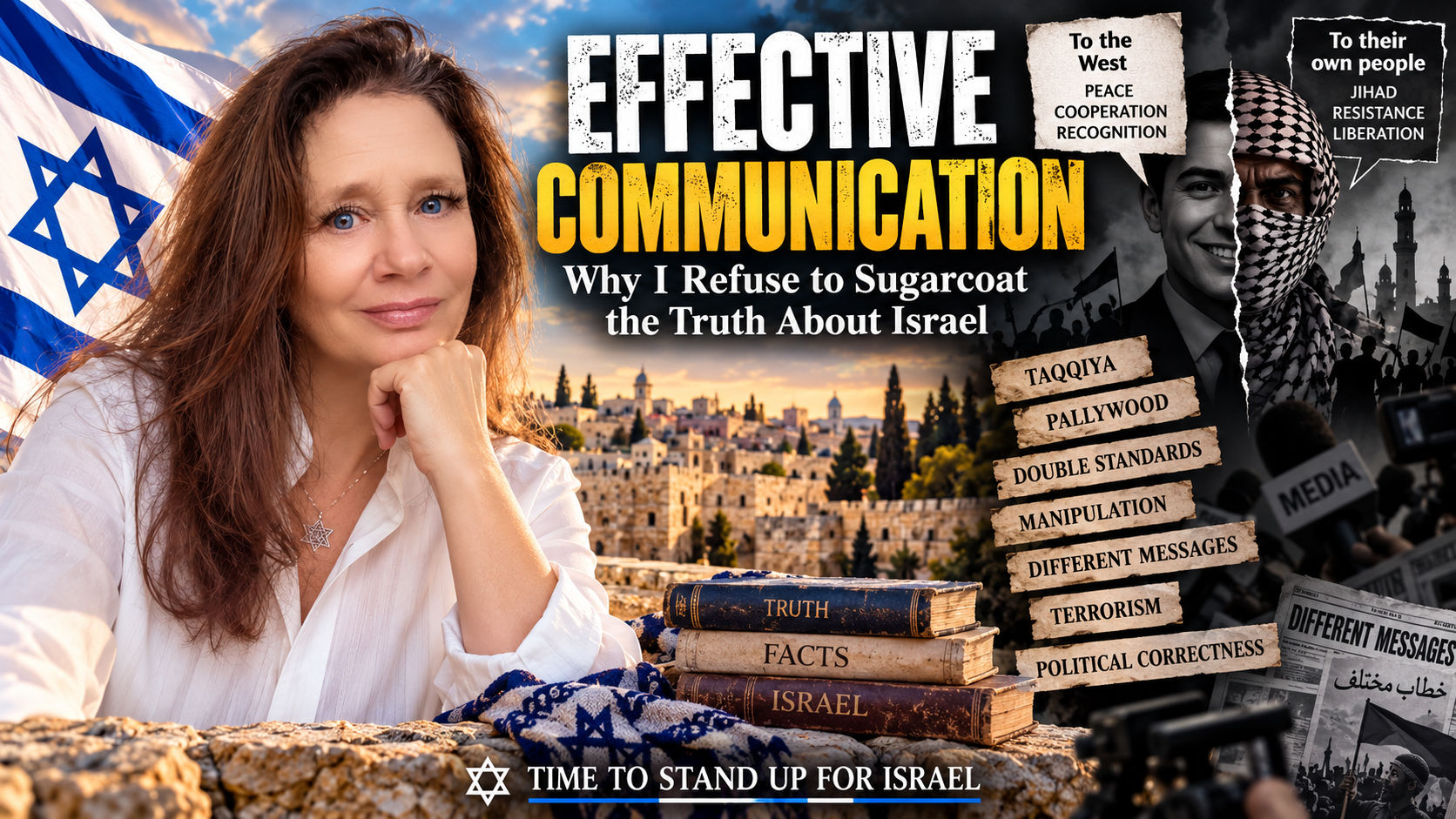
Photo Credits: Sabine Sterk
There is one sentence I have heard countless times throughout my years of advocating for Israel, and every time I hear it, my irritation reaches another level. “Sabine, I agree with you one hundred percent, but you need to add more nuance to your argument.” Really? What exactly does that mean? That I should make uncomfortable truths more comfortable? That I should carefully select my words to avoid offending people who have absolutely no difficulty spreading the most outrageous accusations against Israel? Or that I should sacrifice clarity on the altar of political correctness? Because that is precisely how I experience these well-intended recommendations, and frankly, I have had enough of them.
For more than twelve years, I have dedicated an enormous part of my life to defending Israel, confronting antisemitism and exposing narratives that I believe deliberately distort reality. During those years, I have watched how accusations against Israel travel around the world at astonishing speed, while corrections, historical context and inconvenient facts struggle to reach even a fraction of the same audience. No effort seems too great when the objective is to portray Israel as the villain, and somehow, it is always Israel’s defenders who are expected to moderate their language, demonstrate endless understanding and explain themselves with extraordinary diplomatic sensitivity.
I find that hypocrisy absolutely infuriating.
My perspective is not exclusively shaped by books, television documentaries or Western academic interpretations of the Middle East. I actually lived in Syria. I experienced an Arab society from within, observed cultural differences and learned enough Arabic to understand that communication is not simply about the words someone speaks. It is also about what remains unspoken, the audience being addressed, the intentions behind a message and the difference between public appearances and private realities. As a highly sensitive person, I pay particular attention to behaviour, inconsistencies and emotional signals. Does that make me infallible? Certainly not. But it has taught me to question appearances rather than automatically accept carefully constructed political performances.
Consider Yasser Arafat, whose conduct during the Oslo peace process remains one of the clearest examples of why I distrust political messaging that changes according to its audience. In September 1993, the world watched Arafat and Israeli Prime Minister Yitzhak Rabin participate in a historic diplomatic breakthrough. Arafat had formally recognized Israel’s right to exist in peace and security, renounced terrorism and committed the PLO to peaceful negotiations. Western leaders celebrated, cameras captured the handshakes and millions were encouraged to believe that a new era had begun.
Yet in May 1994, Arafat addressed a Muslim audience in Johannesburg in Arabic and compared the Oslo agreement to the Treaty of Hudaybiyyah, an agreement from early Islamic history. He also invoked jihad in connection with Jerusalem. His defenders subsequently argued that his words referred to peaceful struggle and that the historical comparison did not establish an intention to break the agreement. Nevertheless, the contrast between his diplomatic language and his religiously charged rhetoric was significant enough to raise legitimate questions about his intentions.
And that is exactly my point. Why should we judge political leaders exclusively by what they tell Western diplomats when their messages to other audiences can sound remarkably different? Why should a polished English statement automatically outweigh contradictory rhetoric or subsequent actions?
The concept of taqiyya, which historically concerns concealing religious belief under threat or persecution, is frequently invoked in these discussions. I believe political deception deserves serious scrutiny, but I also recognize that taqiyya is not evidence that Muslims generally practice dishonesty. My criticism concerns identifiable political conduct, not an entire religion or population. Likewise, what critics call Pallywood reflects my frustration with manipulated or misleading portrayals of the conflict, although allegations of fabrication must themselves be supported by evidence.
What concerns me most is the Western inability, or unwillingness, to recognize that political communication in the Middle East cannot always be interpreted through European expectations. Power, survival, reputation and strategic interests shape political behaviour everywhere, but the consequences of misunderstanding those dynamics in this region can be devastating.
I have absolutely no intention of pretending otherwise.
People sometimes confuse directness with aggression, conviction with intolerance and uncomfortable facts with a lack of compassion. I reject that reasoning. I can care deeply about innocent civilians while refusing to excuse terrorism. I can recognize human suffering while questioning who bears responsibility for prolonging it. And I can defend Israel without pretending that every decision made by an Israeli government is beyond criticism.
My responsibility as an advocate is not to make everyone comfortable. It is to communicate what I believe is true, as clearly and forcefully as possible. I do not deliberately publish falsehoods, and when I discover a factual mistake, I correct it. That is not weakness. That is integrity.
The Middle East is not a diplomatic reception where carefully chosen words automatically produce goodwill. In my experience, perceived weakness can invite exploitation, and excessive concern about appearing politically correct can obscure the seriousness of a threat. That does not mean abandoning accuracy, fairness or judgment. It means understanding that honesty does not require permission from those who dislike hearing it.
So, will I become more politically correct? No. Will I soften my language simply to satisfy people who prefer comfortable narratives? Absolutely not.
I will be bold, direct, uncompromising and, above all, accountable for my words.
Because effective communication is not about making the truth easier to swallow. It is about making the message impossible to misunderstand.
Related Topics