Elul – ‘Give Him the Best Death You Can’
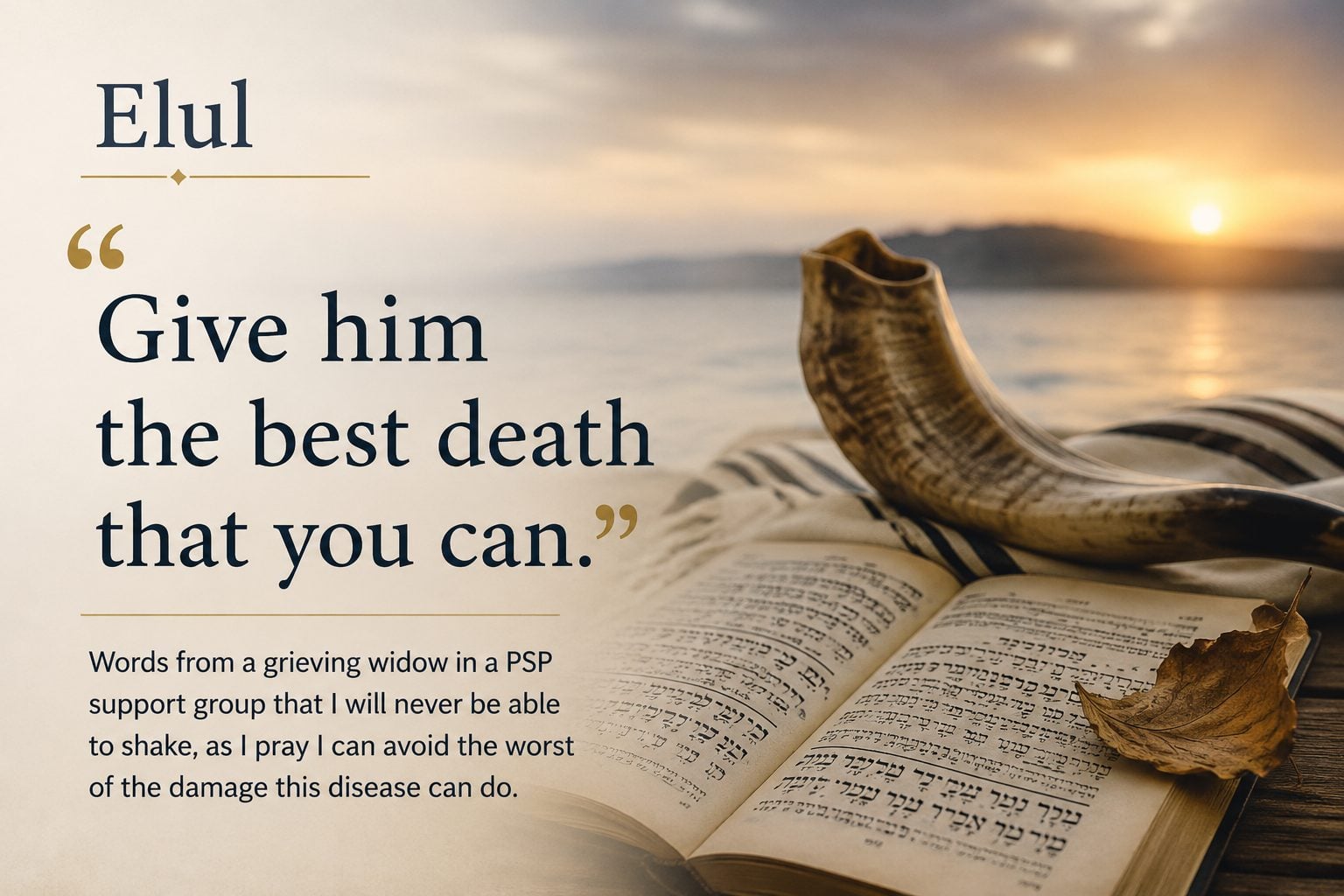
As I enter Elul, the holy month before the Jewish New Year and the beginning of a period that leads us towards the Days of Judgment, I feel as though I have been shaken awake.
I live with Progressive Supranuclear Palsy, or PSP, a rare and progressive neurological disease. I know what it is doing to my body. What I read today forced me to confront, much more starkly, what it could potentially do to the person I am.
Recently I wrote about fear and anxiety on my PSP blog. I have seen those feelings in writing now. Today I have almost no words.
And yet, somehow, here I am trying to find them.
Today I read something on one of the PSP forums that genuinely shocked me. Not because it was new information. Not because it taught me something I didn’t already know intellectually. It shocked me because it forced me to feel something emotionally that I would much rather have left as an abstract possibility.
The damage I could one day unwittingly do as a patient.
The post was written by a woman who had lost her husband. She missed him terribly. While describing the final years of his illness, she shared a piece of advice someone had given her. During the difficult periods, when the gentle man she had married would yell and shout at her, she said she repeated those words to herself three or four times a day simply to get through it.
The advice was:
“Give him the best death that you can.”
I have not been able to get that sentence out of my head.
Part of what disturbed me was her description of her husband. By all accounts, he had been a gentle man. Yet PSP changed his behaviour so profoundly that he would shout and argue with the person he loved most.
It wasn’t him. It was PSP.
And that is what frightens me.
It could be me one day.
And as Elul begins, as we approach Rosh Hashanah and the Days of Judgment, I find myself praying even harder that it won’t be.
The reality is difficult to face. We all know that everyone dies. But not everyone dies after years of a truly awful disease that can affect behaviour, personality and emotional control. Not everyone risks becoming angry with the people they love in ways that would once have been completely out of character, because disease has affected parts of the brain involved in controlling behaviour.
That thought scares me more than many of the physical limitations.
Don’t get me wrong. The physical side frightens me too. I’m sitting here at 51, in a wheelchair, with a full-time carer. I know perfectly well what PSP can do to a body.
But what haunts me is something different.
The possibility of becoming someone my loved ones struggle to recognise as me.
And then there was something else in her message that caught me completely off guard.
She didn’t simply describe what she had endured. She said she missed him. She said she would do anything to have him back.
Anything.
Even if that meant having him back yelling at her. Even if it meant having him back arguing with her.
I found that almost impossible to comprehend.
This was the same husband whose illness had pushed her to repeat “Give him the best death that you can” three or four times a day just to get through it. Yet after everything she had endured, she would still have chosen his presence over his absence.
There is something utterly heartbreaking about that.
There is also something extraordinarily beautiful.
It speaks not only to the cruelty of PSP, but to the depth of a love that somehow survived it.
The more I think about that sentence, though, the more part of me wants to argue with it. I want to reject it. I want to say that the role of a husband, wife, parent, child or friend should never be to give somebody the best death they can.
But I am in no position to make that argument.
The woman who wrote those words has walked a road I have not. She lived it. She has, so sadly and so lovingly, earned the right to say it.
I am standing on the other side of the disease.
I am not one of the people who may ultimately have to bear that burden.
I am the person who may unintentionally inflict it.
Thank G-d, I don’t yet know what that feels like for the people around me. So I cannot tell her she is wrong. I cannot tell the person who gave her that advice that they were wrong.
All I can do is try, for as long as I possibly can, to make those words unnecessary.
I can try to remain myself. I can try to remain kind. I can try to remember this moment if PSP ever pushes me towards anger or argument. I can try to remember the people I love when the disease makes remembering how to behave towards them more difficult.
Perhaps that is all I can do.
And perhaps even that will not always be within my control.
That is where my faith has to enter the story.
Elul is traditionally a month of introspection, repentance and preparation. We examine ourselves as we approach Rosh Hashanah. We think about the people we have hurt, the people we love, the person we have been and the person we want to become.
This year, those questions feel rather different to me.
I have to place my trust in G-d because, ultimately, I do not know what lies ahead. I don’t know whether determination, love and self-awareness will always be enough to overcome whatever PSP may do to my brain. I desperately want to believe that I can simply decide never to become that person, but it would be arrogant of me to pretend that I know I can.
So I pray.
I pray that whatever lies ahead has a purpose, even when I cannot understand it. I pray that whatever burden is placed upon me, and upon the people who love me, will be as light as possible. And I pray that whatever PSP takes from me, it leaves me enough of myself to continue showing those people the love they deserve.
Because I cannot ignore what I see in the support groups.
Again and again, carers describe versions of the same agony. The person they love is still there, yet the disease can make them behave in ways that seem completely unlike themselves. The suffering belongs to both sides: patients who never wanted to behave that way, and carers who somehow continue responding with patience, compassion and love.
My thoughts and prayers are with every one of them.
Perhaps one day this post will be read back to me. Perhaps I will still be able to read it myself.
If that day comes, I hope these words remind me who I am.
I hope they remind me to fight against whatever anger, frustration or arguments PSP may bring. I hope they remind me of the people around me and of the man I want them still to recognise.
I am rarely speechless.
Today, I almost am.
I stumbled across this story completely by accident while showing my mother why I wasn’t sure she should join one of the PSP support groups. I opened a random discussion expecting to find an ordinary conversation.
Instead, at the beginning of Elul, I found a sentence that woke me from my slumber.
A sentence that forced me to confront not only how I may die, but how I want to live and who I desperately want to remain as I travel towards whatever lies ahead.
As the Days of Judgment approach, that has become one of my deepest prayers: that I can avoid the worst of the damage PSP can do, and that whatever else this disease takes from me, it does not take away my ability to show love to the people who have shown so much love to me.
All because today I encountered the words of a grieving widow:
“Give him the best death that you can.”
I wish I had never read them.
But perhaps, especially at this time of year, I needed to.
I know I will never forget them.