London based entrepreneur, cybersecurity analyst doing a PhD in AI
The Pharoah Index and Distributed Trust
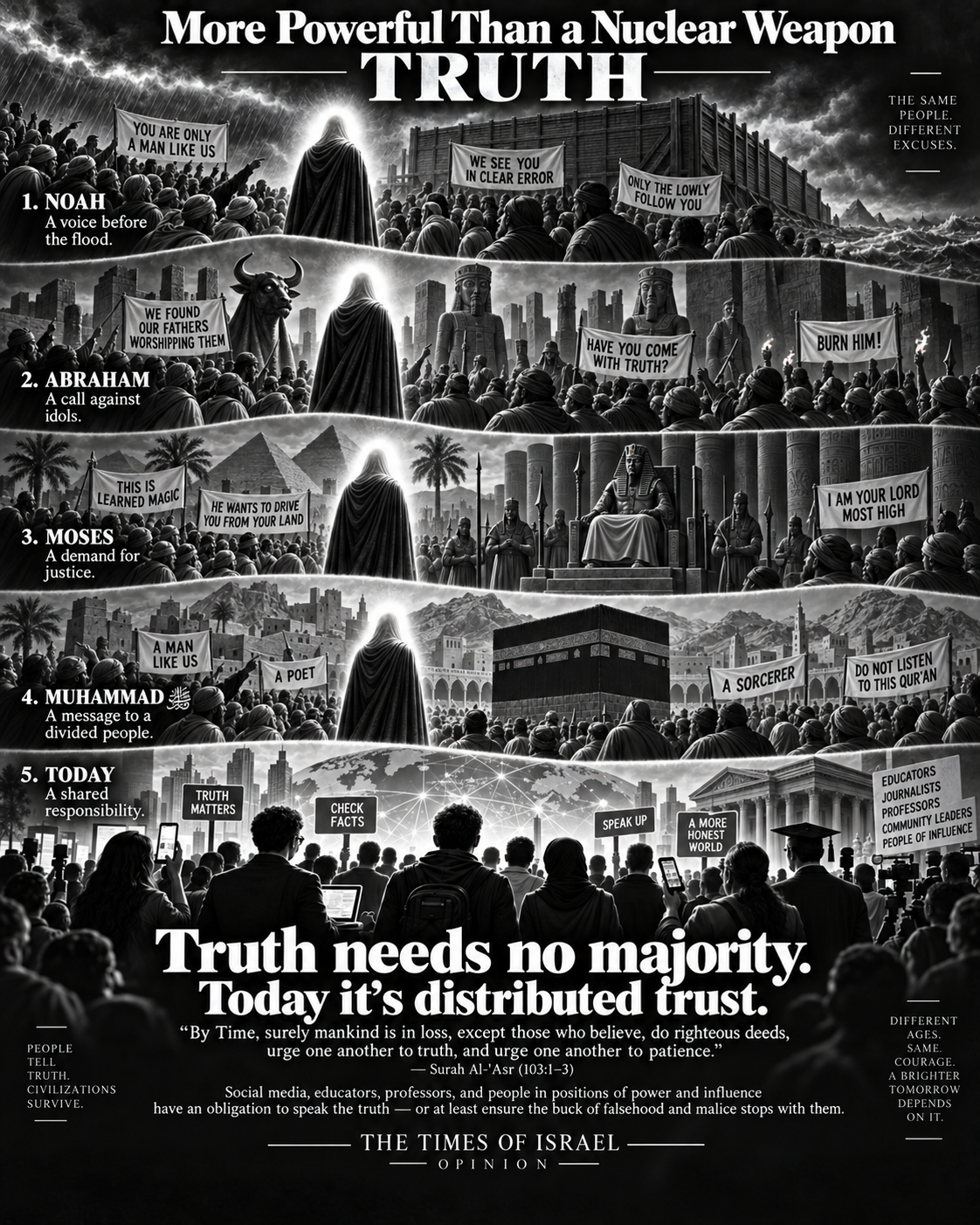
More Powerful Than a Nuclear Weapon: Truth
The Pharaoh Index and the architecture of distributed trust.
There is something almost absurd about the image.
One man stands before an enormous crowd.
Everyone surrounding him appears to believe the same thing.
And he says:
“Yes. You are all wrong.”
At first glance, this looks like arrogance.
Sometimes it is. A person can be spectacularly wrong while being spectacularly confident.
But human history contains the opposite possibility too.
Sometimes the single person really is right.
Einstein famously said, when challenged regarding the his general theory of relativity – “Why 100, if I was wrong, 1 would have been enough”.
The 1931 collection titled Hundert Autoren gegen Einstein (“One Hundred Authors Against Einstein”) compiled various essays and critiques against his theory of relativity. Part of this was due to the Nazi Movement and was therefore what was then labelled “Jewish Physics”. People still have this tendency today of labelling God’s creation by hurtful names – such as “children are terrorists” , “Gaza’s children are terrorists”. We would be well minded to remember not to use such language, when one of the great Jewish Scientists, who had to run away to Britain was himself subject to it at one point in time.
And everyone around him really is wrong. We almost have a sense of DeJaVu with certain humanitarian crises today where children are killed. Everybody who argues otherwise, knows deep down, from the offset, that they are really wrong. The harder you have to shout, the more wrong you usually are. Truth whispers quietly. It has no need to shout.
The Qur’an repeatedly places prophets in precisely this position.
Noah (alayhis salaam) before his people.
Abraham (alayhis salaam) before an inherited civilisation of idols.
Moses (alayhis salaam) before Pharaoh.
Muhammad ﷺ before Quraysh.
Each confrontation looks radically asymmetrical.
On one side:
the state, the tribe, inherited customs, economic interests, armies, priests, prestige and numbers.
On the other:
a human being carrying a proposition.
This is true.
That may be why truth is ultimately more powerful than a nuclear weapon.
A nuclear weapon can destroy a city.
It cannot make two plus two equal five.
It can kill the person speaking the truth.
It cannot kill the truth he spoke.
And perhaps the most important political question of our century is therefore not merely:
Who has the most powerful weapons?
It is:
How do we construct societies in which truth can still reach us before our power destroys us?
That requires something I would call an infrastructure of trust.
The prophets were epistemic minorities
Consider Noah.
He speaks publicly and privately, by day and by night. His people do something psychologically revealing:
“Whenever I called them so You may forgive them, they pressed their fingers into their ears, covered themselves with their garments, persisted, and acted arrogantly.”
— Qur’an 71:7
They do not defeat the truth.
They attempt not to hear it.
Then Abraham asks his society the forbidden question:
“What are these statues to which you are so devoted?”
They answered, “We found our forefathers worshipping them.”
— Qur’an 21:52–53
Their defence is not evidence.
It is inheritance.
Everyone before us believed this.
Abraham refuses to outsource reality to consensus.
Moses confronts something more formidable still.
Pharaoh possesses not merely an opinion but the machinery of a state.
He eventually declares:
“I am your lord, the most high.”
— Qur’an 79:24
Yet the Qur’an offers an extraordinary diagnosis:
“They rejected them, although their souls were convinced of them, out of injustice and arrogance.”
— Qur’an 27:14
وَجَحَدُوا بِهَا وَاسْتَيْقَنَتْهَا أَنفُسُهُمْ
They denied while inwardly knowing.
The problem is no longer information.
The evidence has arrived.
The problem is what accepting the evidence would cost.
Status.
Identity.
Hierarchy.
Power.
Ego.
But being alone does not make you right
This distinction is crucial.
The prophetic model should never be reduced to:
“Everyone disagrees with me, therefore I must be a courageous truth-teller.”
That is nonsense.
History contains countless solitary people who were simply wrong.
Minority status is not evidence.
Neither is majority status.
Reality decides.
And science gives us spectacular examples.
Copernicus did not prove that the world was round; educated Europeans had known the Earth was spherical for many centuries.
His revolution was more profound.
The inherited astronomical model placed Earth immobile near the centre of the cosmos.
Copernicus proposed that Earth itself moved around the Sun.
The heavens did not reorganise themselves when De revolutionibus appeared in 1543.
Earth had been moving all along.
Human understanding merely caught up.
Galileo later encountered institutional resistance while defending heliocentrism.
Again, the remarkable thing is that neither authority nor punishment could alter planetary motion.
The Earth does not require permission to orbit the Sun.
Then Newton appeared.
He took phenomena that seemed separate — falling bodies, projectiles, planetary motion, tides — and brought them under a mathematical framework of motion and gravitation.
Newton did not prevail because he gathered the largest crowd.
His framework prevailed because it explained and predicted reality with extraordinary power.
And eventually Einstein demonstrated that even Newtonian mechanics had limits.
That matters too.
Truth-seeking does not merely overthrow falsehood.
It also corrects incomplete truth.
Newton could be magnificently right within a domain without possessing the final theory of the universe.
That is epistemic humility.
Then consider two bicycle mechanics from Ohio.
For centuries, humans looked at birds and dreamed of flight.
At the beginning of the twentieth century, many serious attempts at powered flight had failed.
The Wright brothers nevertheless persisted with controlled experiments on wings, drag, lift and steering.
On 17 December 1903, their aircraft left the ground at Kitty Hawk.
At that moment an argument ended.
Not rhetorically.
Physically.
A machine heavier than air flew under controlled power.
Reality had voted.
More recently, consider electric cars.
Elon Musk did not invent the electric automobile; electric vehicles predate him by more than a century.
But Tesla helped overturn another entrenched assumption: that battery-electric cars would remain slow, undesirable, short-range curiosities while the internal-combustion engine permanently dominated serious automobiles.
You could dislike Musk personally.
You could dislike Tesla.
Neither sentiment determines whether electric propulsion works.
Millions of electric vehicles on roads around the world now constitute an engineering answer.
That is the distinction we desperately need to recover:
Truth is not the same thing as liking the person who carries it.
Copernicus can be right without being popular.
Newton can be corrected without becoming a fool.
The Wright brothers can succeed despite scepticism.
Musk can be right about one technological proposition and wrong about something else entirely.
Evidence has no obligation to preserve our tribal loyalties.
The Pharaoh Index
Now turn the problem around.
What happens when the person who is wrong possesses enormous power — and prevents everyone else from telling him?
Call this the Pharaoh Index.
It is not a competition to identify history’s “most evil” individual.
Nor should every death occurring during somebody’s rule simply be placed against his name.
Instead it asks:
How much suffering becomes possible when coercive power, narrative control and immunity from correction become concentrated in the same system?
Death tolls offer one horrifying proxy.
Mao’s Great Leap Forward and the famine surrounding it killed tens of millions, with around 30 million a widely cited scholarly magnitude.
Nazi Germany deliberately murdered six million Jews, alongside millions of other victims including Soviet prisoners of war, non-Jewish Poles, Roma, disabled people and political enemies.
Under Stalin, executions, Gulag mortality, deportations and famine-related deaths likewise produced death tolls running into the millions, although historians continue to debate categories and causal attribution.
Pol Pot’s Khmer Rouge presided over the deaths of roughly 1.7 million Cambodians, around a fifth of the population.
The Armenian genocide killed somewhere between roughly 664,000 and 1.2 million Armenians, depending on the historical estimate used.
The 1994 genocide against the Tutsi in Rwanda killed more than 800,000 people in roughly 100 days.
Move backwards and precision deteriorates.
Genghis Khan and the wider Mongol conquests are frequently associated with figures approaching 40 million deaths, but the demographic evidence is too fragmentary to treat that as an audited total.
Timur — Tamerlane — is sometimes associated with 17 million deaths, another extraordinarily uncertain estimate. Far more defensible are particular massacres recorded by historical sources, including accounts of around 100,000 prisoners killed before the sack of Delhi.
Alexander the Great unquestionably presided over enormous slaughter and enslavement during his campaigns, but an honest historian cannot provide a reliable lifetime total.
Then consider the Bengal famine of 1943.
Approximately three million people died.
Wartime disruption, colonial economic structures, inflation, failed distribution and decisions by British authorities all formed parts of the catastrophe.
But to compress that into:
“Churchill killed three million people”
turns history into propaganda.
And this is an essay about truth.
If we exaggerate history in order to condemn falsehood, we have surrendered the principle we claim to defend.
The Pharaoh Index needs uncertainty bars.
Numbers themselves require truthfulness.
There is an enormous epistemic difference between saying:
Six million Jews were murdered during the Holocaust
and:
Genghis Khan killed forty million people.
The Holocaust figure rests upon an extraordinary combination of demographic evidence, Nazi documentation, deportation records, killing-centre evidence, eyewitness accounts and decades of historical reconstruction.
The Genghis figure is reconstructed from a medieval world of incomplete population records, chroniclers, migration, enslavement and destroyed administrations.
Both concern catastrophe.
They do not carry the same confidence.
So every Pharaoh Index requires three questions:
How many died?
Why did they die?
How confidently can responsibility be assigned?
That is what truth looks like when it disciplines even our moral outrage.
Death is the lagging indicator.
But mass death normally appears at the end of the process.
Long before people die, information dies.
Officials discover what the ruler wants to hear.
Bad news stops moving upward.
Statistics become political.
Journalists become afraid.
Experts become inconvenient.
Contradiction becomes treason.
Eventually the ruler lives inside an information architecture designed to confirm him.
That is the deeper danger of Pharaoh.
Pharaoh became his own verification system.
He controlled power.
He controlled punishment.
He controlled narrative.
Finally he imagined he controlled reality itself:
“I am your lord, the most high.”
Perhaps, therefore:
Pharaoh Risk = Power × Narrative Control × Ego ÷ Correctability
Correctability is the vital denominator.
The question is not whether leaders make mistakes.
Every leader will.
It is:
Can reality reach them after they make one?
Can an engineer tell a CEO that his product is unsafe?
Can an economist tell a government that its policy is failing?
Can a junior officer contradict a general?
Can a scientist publish inconvenient results?
Can a newspaper investigate its own political side?
Can students challenge professors?
Can professors challenge institutions?
Can someone tell Pharaoh:
You are wrong?
That may be one of civilisation’s greatest measures.
From prophetic trust to distributed trust
The prophets represent unusually concentrated epistemic authority.
For Muslims, Muhammad ﷺ is the final Prophet.
There is no new prophet coming to adjudicate our social-media arguments.
Responsibility therefore becomes distributed.
A scientist carries some.
A professor carries some.
A teacher.
A journalist.
A judge.
A civil servant.
A software engineer.
A CEO.
A politician.
A religious scholar.
A person with three million followers carries a great deal.
Even somebody forwarding something into a family WhatsApp group carries a little.
Attention has become power.
Pharaoh needed officials and heralds.
Today an algorithm can place a proposition before hundreds of millions of minds almost instantaneously.
So civilisation cannot depend upon finding one heroic truth-teller.
We need millions of stopping points.
Places where somebody says:
No. This goes no further until I know whether it is true.
That is distributed trust.
Surah al-ʿAṣr may contain the architecture
The Qur’an offers something remarkably close to this design:
“By Time. Surely mankind is in loss, except those who believe, do righteous deeds, urge one another to truth, and urge one another to patience.”
— Qur’an 103:1–3
وَتَوَاصَوْا بِالْحَقِّ
wa tawāṣaw bil-ḥaqq
urge one another to truth.
Not merely:
possess the truth privately.
Tell one another.
Correct one another.
I see your blind spot.
You see mine.
Today I correct you.
Tomorrow you correct me.
That resembles the architecture of a resilient information network:
distributed verification instead of concentrated infallibility.
Building the infrastructure of trust
We understand infrastructure everywhere else.
Water needs pipes.
Electricity requires grids.
Banking requires ledgers.
Aircraft require checklists, maintenance logs and black boxes.
Yet we throw billions of claims into an attention economy and expect truth somehow to organise itself.
It will not.
Truth needs infrastructure too.
It needs provenance.
Where did this claim come from?
A primary source?
A peer-reviewed paper?
An eyewitness?
Government propaganda?
An anonymous account?
A synthetic image?
An AI model?
It needs correctability.
A trustworthy institution is not one that never gets anything wrong.
Such an institution does not exist.
A trustworthy institution says:
We were wrong. Here is the correction. Here is why.
It needs adversarial verification.
Engineers test bridges.
Scientists attempt replication.
Auditors inspect accounts.
Important propositions deserve opponents whose job is to find their weaknesses.
It needs visible uncertainty.
“I don’t know” can be evidence of intelligence.
“70% confidence” may be more trustworthy than “100% certainty.”
And it requires protected dissent.
Every institution needs somebody who can say:
The emperor has no clothes.
Or:
Pharaoh is not your lord most high.
The buck of falsehood
Most people cannot stop wars.
They cannot reform governments.
They cannot redesign social-media algorithms.
But nearly everyone controls one small junction in humanity’s information network.
So there is a surprisingly powerful moral rule:
Do not become another transmission node for falsehood or malice.
If an accusation perfectly confirms what you already believe about your enemy:
check it.
If humiliating someone will generate applause but you cannot establish that the allegation is true:
stop.
If a video has no provenance:
wait.
If you are a journalist, professor, teacher, executive, politician, scholar or influencer, your obligation is greater because your amplification is greater.
Perhaps you cannot make truth conquer the world.
But you can ensure:
the buck of falsehood stops with you.
Every newsroom can become a checkpoint.
Every laboratory.
Every classroom.
Every boardroom.
Every pulpit.
Every social-media account.
Every conscience.
That is infrastructure.
The real opposite of Pharaoh
The opposite of Pharaoh is not simply democracy.
Democracy distributes political authority.
Truth demands something deeper:
correctability.
Can someone tell the President he is wrong?
The Prime Minister?
The general?
The billionaire?
The professor?
The rabbi?
The imam?
The newspaper editor?
The algorithm designer?
And can that person survive saying it?
Moses stood before Pharaoh.
A healthy civilisation constructs institutions in which Moses gets into the room before Pharaoh makes the decision.
Humanity has already constructed astonishing infrastructures of power:
nuclear weapons,
satellites,
artificial intelligence,
global finance,
cyberwarfare,
mass communication.
Our danger is that our infrastructure for power is advancing faster than our infrastructure for truth.
An intelligent civilisation running on false information can destroy itself much more efficiently than an ignorant civilisation ever could.
Falsehood can possess armies.
Budgets.
Algorithms.
Universities.
Influencers.
Propaganda machines.
Secret police.
Even nuclear weapons.
But falsehood contains an irreparable structural defect:
it is false.
The Qur’an expresses the asymmetry perfectly:
“Truth has come, and falsehood has vanished. Indeed, falsehood is ever bound to vanish.”
— Qur’an 17:81
جَاءَ الْحَقُّ وَزَهَقَ الْبَاطِلُ
Jāʾa al-ḥaqqu wa zahaqa al-bāṭil.
Noah stood before his people.
Abraham stood before his civilisation.
Moses stood before Pharaoh.
Muhammad ﷺ stood before Quraysh.
Copernicus stood before an inherited cosmology.
Newton reorganised our understanding of physical law.
The Wright brothers put an argument into the air.
Modern electric vehicles overturned another entrenched assumption.
But none of these examples teach that the rebel is necessarily right.
They teach something more demanding:
Reality ultimately arbitrates between the rebel and the crowd.
Today there are billions of us standing at billions of junctions through which information passes.
Perhaps Surah al-ʿAṣr gave us the design specification fourteen centuries ago:
Believe.
Do good.
Tell one another the truth.
And have the patience to keep doing it.
Because nuclear weapons can destroy cities.
Falsehood can destroy civilisations.
But neither can rewrite reality.
And reality has an inconvenient habit:
Eventually, the truth comes out.
The only way to create a true abundance and earn God’s mercy is to create a just society.
Related Topics
Related Posts