
Emigration? It’s Not the Missiles

Israelis are leaving, but not because of missiles or terror. External threats have always been part of our reality, and Israelis have always risen to meet them. What drives this exodus is not war: it is the sense that Israeli society is fraying from within, led by a government that prioritizes its own survival and extremist views over the country’s unity and future.
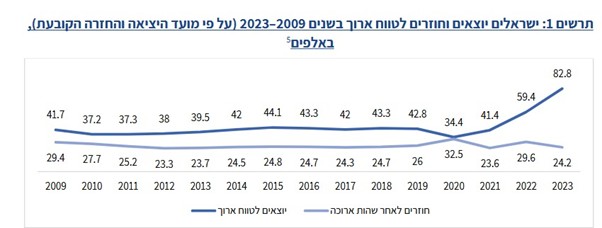
According to recent Times of Israel articles, while aliyah from Western countries has increased since 2023, about 82,700 Israelis left in 2024 — roughly 50,000 more than immigrated. Statistics revealed by the Knesset Research and Information Center show that this trend began before the October 7 attack, and early signs suggest it is continuing in 2025. These numbers do not include those “checking options” abroad, quietly relocating without formally registering as emigrants. While immigration also rose following October 2023, the number of Israelis returning to Israel has declined steadily since 2022.
I have attended over one hundred demonstrations across Israel. I read the signs, listen to the speeches, converse with friends. Among the protesters are many veterans, former military leaders, and parents of active soldiers, some mourning unbearable losses since October 7. Their (our) collective cry is not one of surrender, but a call to defend Israel as a liberal democracy committed to peace and justice, even while standing firm against external threats.

Since January 2022, the focus of the protests may have shifted – from opposition to the weakening and politicization of public institutions, to demanding the hostages’ return, to calling for an impartial State Commission of Inquiry into the October 7 disaster – but the central message has endured: our leaders must abandon corruption and extremism and instead rebuild resilience, unity, and trust through strong, transparent, and professionally-run institutions.
But fatigue has set in. After years of constant protest, a quiet buzz of disengagement is spreading – a sense that the country is a lost cause as each day brings another political saga of corruption and once again Netanyahu and his media choir hit the airwaves to chastise half the country, branding critics as anarchists or Hamas collaborators (or fascists or deep-state, depending on the spin of the day).
Surveys capture this deepening sense of resignation. A July 2024 JPPI survey finds that about one in four Jewish Israelis—and roughly four in ten Arab Israelis—say they would emigrate if they practically could. While JPPI doesn’t report reasons, the Israeli Democracy Index 2024 shows that, among Israelis who hold or are considering a foreign passport, only about 10% cite the security situation, whereas social/political and economic reasons account for roughly a quarter in total, and ‘just in case’ caution accounts for about half.
Trust in leadership has collapsed. According to the 2024 Israeli Democracy Index, only 19 percent of Jewish Israelis trust the government. Trust in the Knesset is even lower. Lack of trust now cuts across every demographic and political camp. The IDF remains one of the few institutions still broadly respected, though here, too, political appointments threaten to erode confidence.
And yet, Israel is not beyond repair. Our armed forces, security services, courts, civil service, universities, and media still hold the capacity for accountability and restraint. They are still staffed by professionals committed to the public good. The public still largely trusts them. They show that the national fabric, fragile but not torn, can be repaired.
The current exodus is not about escaping rockets. It is about leaving a country that no longer feels fair or inclusive, that has lost sight of the public interest, and that lacks a plan for the long-term sustainability and resilience. Israel may survive militarily, but if we abandon pluralism, civic integrity, and mutual respect, what will remain worth defending?
It is not too late to demand better. If we want our children to stay, they deserve a country that earns their love, loyalty, and courage.