
Emma Mogilensky’s Shoah Found testimony about babies left on the Kindertransport
Testimony is one of the most important resources we have for learning about the Kindertransport. In this blog I want to argue that seeing testimony in relation to newly discovered archival material enhances our understanding of testimony and at the same time the testimony helps us to contextualise the archival findings.
On 18th March 2026, for Women’s History Month, the USC Shoah Foundation posted a clip on their social media of Emma Mogilensky’s testimony about how she discovered two infants in a basket on her Kindertransport. She spoke very movingly about their mother’s sacrifice as well as how she cared for the babies throughout the journey. The video (found here: https://www.youtube.com/shorts/zeRCti-ZgRY and here is the longer version of her testimony: https://www.youtube.com/watch?v=DpQmaEcIDM8) was watched by thousands and thousands of people. Most of those who commented wanted to know who the babies were and what happened to them.
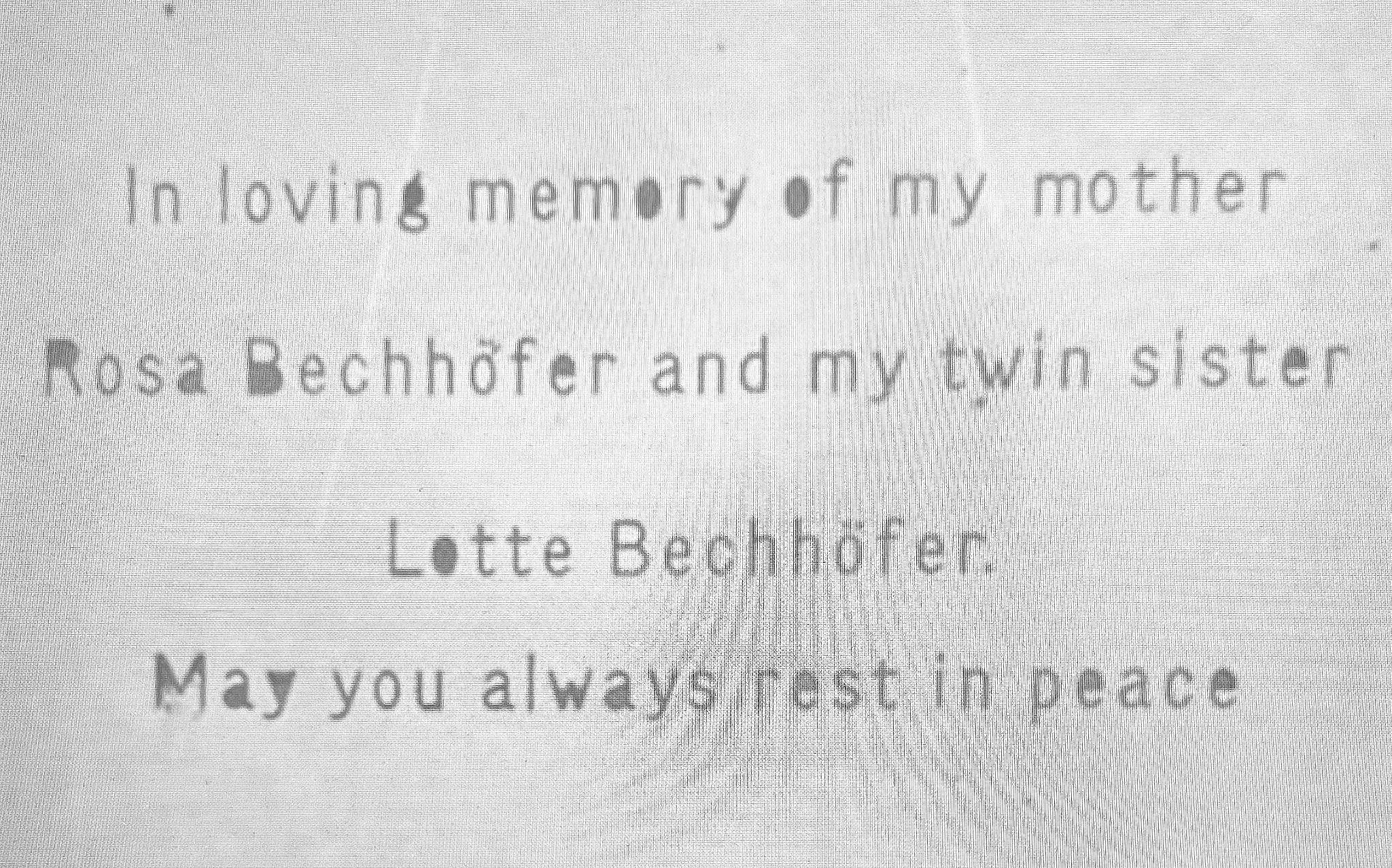
The twins, according to the Kindertransport list, were Susi and Lotte Bechhoefer. Their story is known in the UK and has featured in several books and exhibitions. The twins were fostered by a Baptist minister and his wife in Wales. Lotte was later diagnosed with a brain tumour and passed away at the young age of 35 in 1971. The twins were told that they were their foster parents’ biological children, their names were anglicised and they were raised in the Christian faith. Parts of her story were later used by W.G. Sebald in his novel “Austerlitz”. If you read Susi’s own book you will discover how tragic and complex her experience was. I’m sure that many of those who watched Emma’s testimony would not have known the heartbreaking story of Susi and Lotte because Emma did not know their names. But now we can inform viewers about the details of their Kindertransport as well as the fates of the twins.
To begin, Emma’s maiden name was Hubert, so when I was looking for the Kindertransport list I had to find her name original name. Emma is listed as the twenty-fifth child on her transport. Her Kindertransport number was 5515. Lotte and Susi, who had the numbers 5838 and 5839, are listed sixth and seventh on the list, so they appear on the same page as Emma. There were actually two Kindertransports on 17th May 1939 which passed through the Dutch border. We learn from the Dutch Kindertransport and Dutch Border guard files that one transport crossed the border at Bentheim/ Oldenzaal with 43 children (though 52 are listed on the Kindertransport list) at 2.47pm. The other, which was Emma, Lotte, and Susi’s transport, crossed at Emmerich/ Zevenaar at 4.51pm with 116 on board. We even know the names of their chaperones: Käte Sägmüller, Rosel Kahn, and Erna Maass. There were also several chaperones for the smaller transport. Emma suggested that there were no adults on the train, but she did remember the Dutch women who met them at the border. Remembering their childhoods as adults, many former Kinder did not recall that there were chaperones. Both transports then joined together at the ferry. The ferry they took was the “SS Amsterdam” and the two groups arrived in Harwich on 18th May 1939.
We now also have the train schedules for that day. On the way to the Dutch border the train passed through Munich, Augsburg, Mannheim, Frankfurt, and Cologne. Once the train had crossed the border it journeyed through Arnheim and Utrecht and then either to Amsterdam or Den Haag to Rotterdam and over to the Hook of Holland – there are two routes on the schedule. Also, from the train schedule we learn that the ferry arrived at Harwich around 6.20am. The final destination listed is Liverpool Street Station which would have been reached around 7.53am.
Emma states in her testimony that the twins were brought onto the train before it was about to leave. But as the Kindertransport list makes clear, the twins were placed on the transport in Munich already. Emma joined it in Augsburg, which according to the train timetable was the next scheduled stop after Munich. While the twins were placed on the transport one stop before Emma, they could certainly have been moved around in the carriage, and this is when Emma could have come into contact with them for the first time.
Emma, born on 22.5.1923, was 16 years old when she journeyed on the Kindertransport. Lotte and Susi were born on 17.5.1936 so they were 3 years old. Astonishingly, they were not the only twins on the transports that day. There were two other sets of twins on the smaller transport. They were Jechiel and Channe Weijmann from Breslau who were born on 25.4.1935, and Dorothea and Irene Brauchwitz from Stettin who were born on 10.1.1925. There are clearly other brothers, sisters, or cousins listed on these two Kindertransport lists but Lotte and Susi are definitely the youngest twins listed and they are the only twins to have travelled on Emma’s transport out of Germany.
Lotte and Susi’s mother was called Rosa, and she was a Jewish domestic servant. Their father was a non-Jewish German who left Munich before they were born. Rosa eventually had to give up her children to the local orphanage, but she visited them once a week. She made not one but two brave decisions to send her children away in the hope, firstly, that they would be cared for while she worked, and, secondly, that they would be spared from the horrors of Nazism. Rosa was born on 07.07.1898. We know that she was still living in Munich in 1941, but on 13.03.1943 she was deported to Auschwitz. She did not survive the Holocaust. Emma, in her testimony, reflects upon the “cost” of a mother sending her children in a basket on the train. What she did not know is that Rosa had made a difficult decision before she sent her young children on the Kindertransport.
It is thanks to survivors like Emma who shared her testimony that we can use this resource to uncover the mysteries of the Kindertransport. Sadly, Emma is no longer with us, otherwise we could have informed her about the twins she not only remembered but also memorialised in her testimony. Without Emma to tell us that she journeyed with the twins we may have never looked into these connecting stories. We can now revisit the early Kindertransport testimonies to learn even more from them because we can view them in relation to the newly discovered archival material.
It was not until 1954 that Susi learnt her real name after a teacher told her when she was about take an exam. It was many years later before she was able to face her past. Susi became a nurse and reconnected with family in New York. She then went on to share her testimony in schools. This is where I met her while she gave a talk at a university in the Midlands in the UK. Sadly, Susi is also not here to know about Emma’s recollection of caring for her on the Kindertransport. Without both of their testimonies I would have never been able to reunite their stories over 80 years on.
Thank you to World Jewish Relief for also confirming the arrival date of Emma, Susi, and Lotte.