
Endorsing Violence against Israel at Cornell?
The following was originally written for the Cornell community:
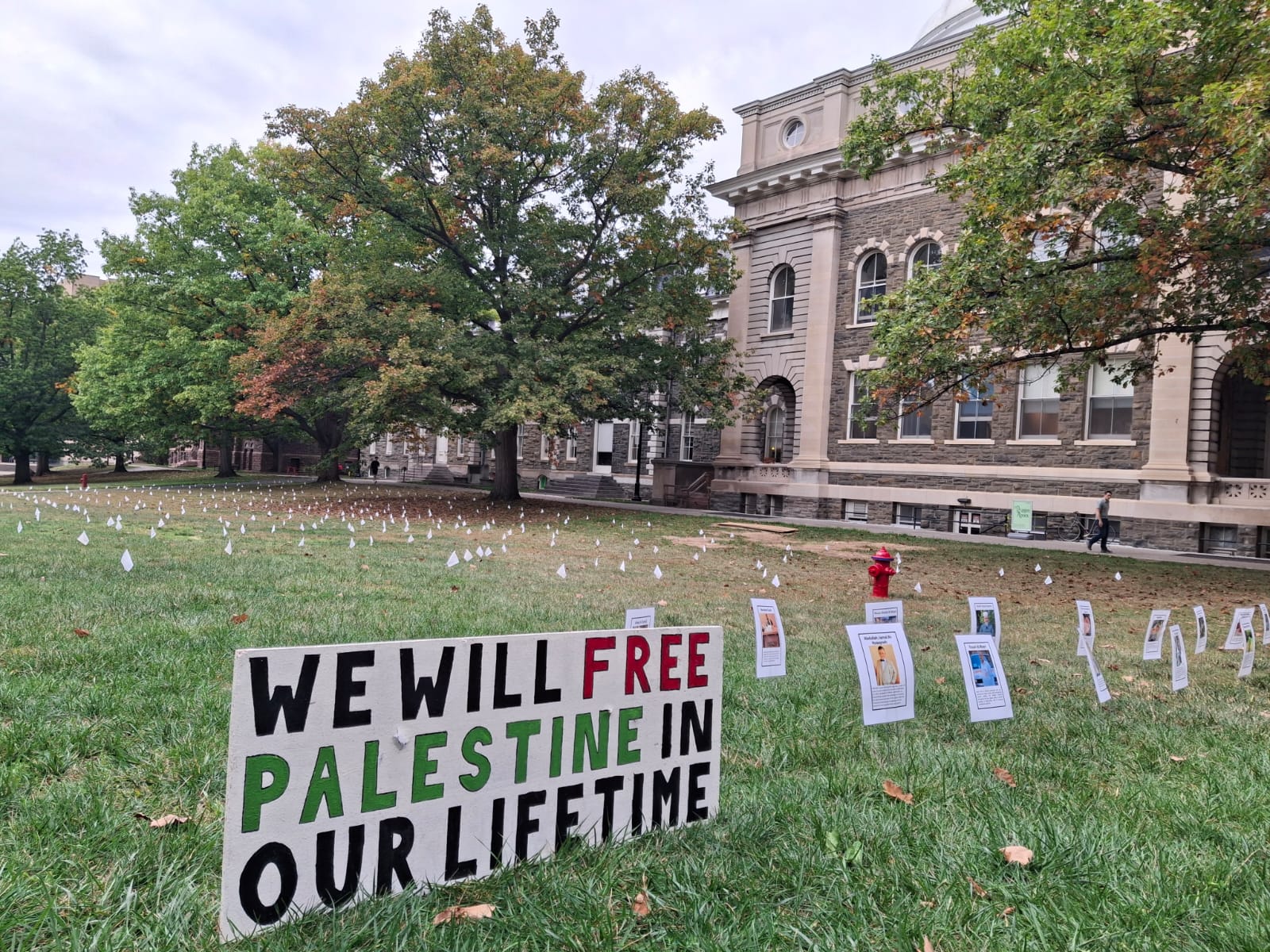
A few days ago, the Cornell Graduate Students Union (CGSU-UE) passed a resolution, under the title “International Solidarity with the Palestinian Liberation Struggle”. However, the resolution goes much further than express solidarity with Palestinians. In its concluding paragraph the resolution endorses support for the historically violent Palestinian struggle against Israel, stating that the union supports the Palestinians’ “unequivocal human right to resist oppression by any means necessary.” For the sake of memory, this struggle includes the intentional killing, kidnapping and injuring of civilians including babies, children and the elderly (in their masses), raids on civilian communities and if you go a bit further in history – also the hijacking of civilian passenger planes, suicide bombings against civilians and much more. The resolution absolves Palestinians (and their supporters) of any responsibility for violence, granting moral license to use “any means necessary” against Israel and Israelis as legitimate exercise of the Palestinians’ human rights. The resolution’s purpose is to align CGSU with the long-standing Boycott, Divestment, and Sanctions (BDS) movement, which seeks to isolate and delegitimize Israel globally for many years now.
This is not a marginal statement. CGSU is the central union body representing Cornell’s graduate students, and all enrolled graduate students contribute financially to its activities by default. According to their website they “represent all 3000+ graduate workers who provide research and/or instructional services to the university.” The resolution harms Jewish and Israeli students on campus by amplifying an already toxic anti-Israel atmosphere—an atmosphere linked to the alarming rise of antisemitism worldwide. Reading the document leaves no doubt: Cornell is not immune to these seductive and destructive sentiments.
The CGSU statement is riddled with distortions and outright falsehoods, presenting dubious claims as unquestionable truths. Consider one glaring example: the assertion that “since October 7th Israel has killed an estimated 680,000 people.” This figure is utterly unfounded. Even Hamas’s own numbers cite roughly 70,000 casualties since the war began. Why would CGSU adopt such a contested figure so nonchalantly? The answer is clear: to sustain the (just as nonchalant) narrative that Israel is committing genocide, a claim presented in the document as self-evident, and beyond any doubt. In many intellectual circles today—especially among younger academics—the “genocide” label has become an article of faith, despite its deeply contested nature. To challenge it openly in the humanities and the social sciences is professionally and personally risky. Let me be clear: I have no intention to defend Israel’s conduct in this war, although I reject the title “genocide” as deceitful and manipulative. This article’s intention is to push back against a decades-long campaign to delegitimize Israel – yes, the only Jewish state in the world and home to almost half of the entire less-than-16 million Jews worldwide – in the eyes of its Western allies. This campaign depends on branding Israel as a “genocidal state” (a label that has been used against Israel, along with “terrorist state” and “settler colonial entity” for many years now, long before 2023). The great success of this long-standing campaign is reflected in the CGSU’s resolution.
Facts matter. The war in Gaza began after Hamas and other Palestinian Islamist militant groups launched a massive, coordinated attack on October 7, 2023. Most victims were civilians, many slaughtered in barbaric and sadistic ways, sometimes filmed and broadcast by their killers, livestreaming their actions on Facebook and elsewhere. It should be clear: These are the “means” the Palestinian leadership in Gaza chose to take to “resist the occupation.” Israel’s military response was not born of blood-thirsty or even territory-thirsty policy, as so many claim today, but of reaction to this attack. Critics may accuse Israel of acting with ruthless vengeance, they may point to Israel’s widespread violent rhetoric of revenge and hate toward Palestinians (now often referred to as “genocidal discourse”) in reaction to the butchery Israel has experienced, but they cannot erase the sequence of events, which should matter in assessing intent.
The CGSU document contains too many distortions to address fully here, but its closing remark deserves attention: “Workers around the world are building power through the belief that we free Palestine and Palestine frees us.” This utopian slogan (in its worst version), evoking romantic revolutionary rhetoric, reveals the ideological core of the anti-Israel movement. It speaks not of Palestinians as people but of “Palestine” as an abstract ideal—a promised land to be “freed” from Israel and Zionism. Zionism, let us recall, is the Jewish national movement that established Israel as part of a global wave of self-determination in the mid-20th century (that saw, among others, the official establishment of Lebanon, Syria, India and Pakistan). The 1947 internationally-endorsed “partition plan” that preceded the establishment of Israel after the British 30-year rule has ended, envisioned two states—Jewish and Arab—side by side. Israel accepted; Arab leaders rejected, refusing to recognize any Jewish political presence in the region, a refusal that persisted for decades.
The CGSU statement portrays Israel as a global obstruction to freedom, a singular “clog” in the machinery of justice. Remove Israel, it suggests, and “liberation” will follow—not only for Palestinians but for humanity at large. This worldview, echoed in other parts of the document (such as linking Israel to “anti-labor interests” and the “ruling class” in the US), smacks of classic antisemitism: presenting Jews’ political existence as the cause for the world’s deepest problems and injustices.
For all these reasons, the CGSU resolution is not merely misguided. It fosters division, legitimizes violence, and perpetuates antisemitic tropes under the guise of social justice.
—
Rhona Burns is currently teaching the undergraduate course “Israel: History, Culture, Society” at Cornell University. In the upcoming Spring semester, she will offer “Zionism and Other Jewish Nationalisms.” She may be reached at rb949@cornell.edu.