
England’s Double Standards
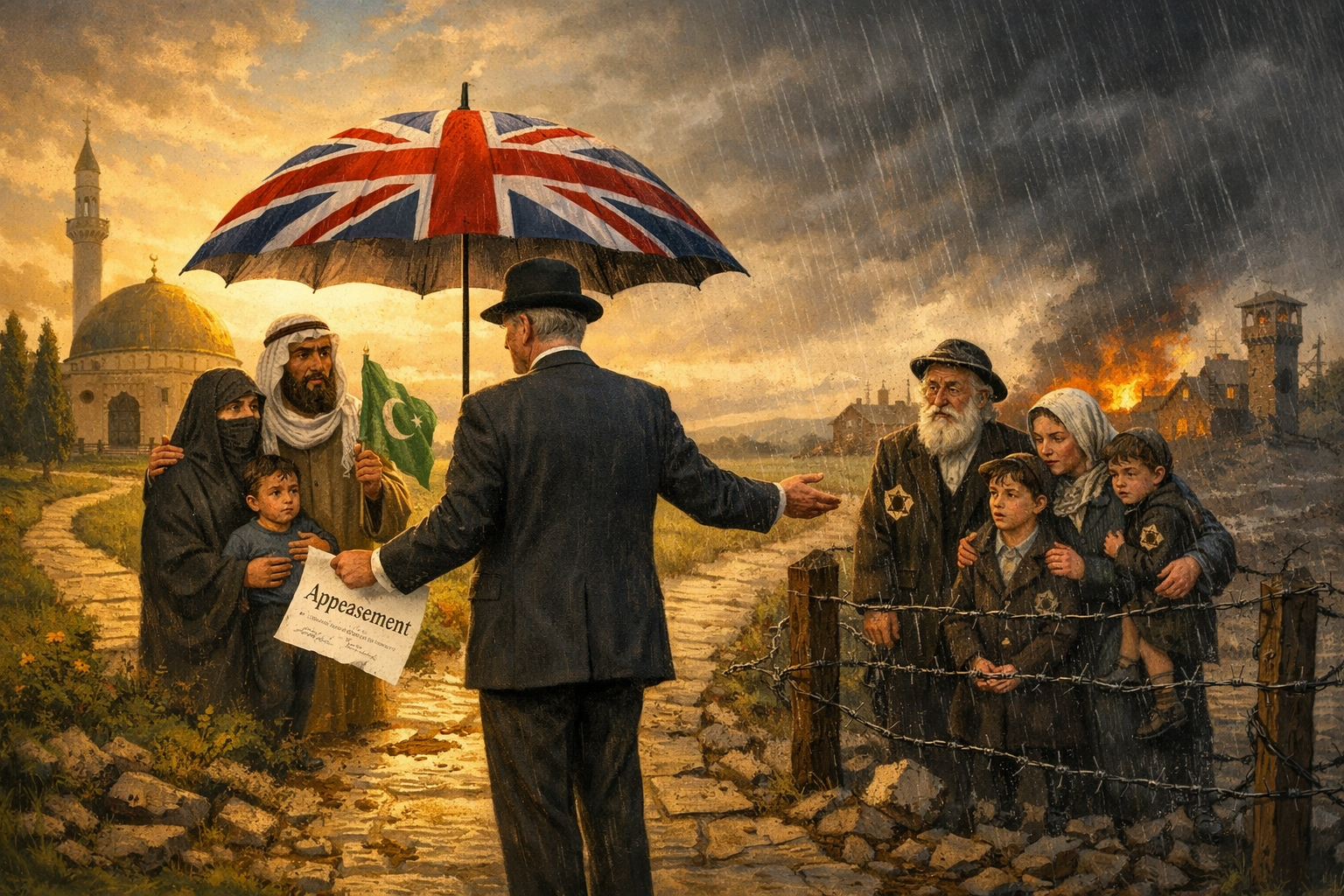
Antisemitism has exploded over the last 2+ years throughout the West, especially in England. For example, in some places people are being asked if they are a Zionist, as if supporting the Jewish state is a great evil.
Former British soldier, Andrew Fox, wrote:
“I heard exactly that question last night over a pint with a friend who had attended a Jewish cultural event. The barman…demanded of my friend, “Are you a Zionist?” The implication was clear that support for the Jewish state now carries a moral price tag. It is a litmus test for belonging, for acceptability. That is not political disagreement; it is a modern shibboleth meant to mark Jews for social exile.”
On Oct 2, 2024, a jihadi attacked a Synagogue in Manchester, leaving two dead and three injured.
While antisemitism increases in England, the authorities seem to be more concerned about not offending Muslims and Palestinians. For example, England recognised a Palestinian state, which a Hamas official celebrated as a fruit of Oct 7.
Further, Home Office figures from the UK now reveal that “[h]ate crimes targeting the Muslim community are nearly twice as likely to result in prosecution as antisemitic offences.” This is despite the fact that while “the number of reports involving Muslim victims was larger, offences targeting Jews were significantly higher when measured per head of population.”
The Community Security Trust raised concerns about “consistency in the criminal justice response to hate crime,” as “Jewish communities experience disproportionately high levels of antisemitic incidents,” but are less likely to get justice.
This is to be expected, considering the fact that England has been appeasing Muslim migrants at its own people’s and culture’s expense for some time.
British Cultural Capitulation
To begin with, there have been numerous instances in Great Britain, where British heritage and culture has been erased to appease Muslims. For example, in 2008, councillors “in the Labour-led borough of Tower Hamlets were instructed to not consume any refreshments during council meetings that take place during Ramadan “until after the Iftar refreshments are served”.”
Why should non-Muslim councillors have to refrain from eating in front of Muslims who are fasting? If Christians fast during Great Lent, Muslims are not required or asked to stop eating in front of Christians.
As one non-Muslim councillor, Stephanie Eaton, then complained:
“Our community consists of a huge number of different religions, all of which should be valued, and no[t] one religion should be accorded more status or influence than others.” (p. 59)
In 2008, the Telegraph reported that two schoolboys were given detention for refusing to participate “in a practical demonstration of how Allah is worshipped.” In December 2019, a British primary school told students to say ‘Baby Boy Jesus’ instead of ‘Lord Jesus’ while singing Away In A Manger so “that pupils of all faiths can join in.”
In 2017, two men were arrested “on suspicion of racial hatred” due to a video of them burning the Quran. As one analyst has noted, even though burning Qurans may be disrespectful, Quran burnings like this were a reaction to the jihad violence then taking place in England. Indeed, three days after these men were arrested, police found an English Quran opened on a page about martyrdom when they raided a safe house of jihadis who’d killed eleven people at the London Bridge (p. 62).
Another anecdote, which best summarises the West’s cultural capitulation, is the case of England’s St. George flag. Some patriotic Brits fly it whilst others condemn it as a symbol of xenophobia and hostility to Muslim migrants. When one examines the history of the flag, they see what this anecdote reveals about Britain’s situation.
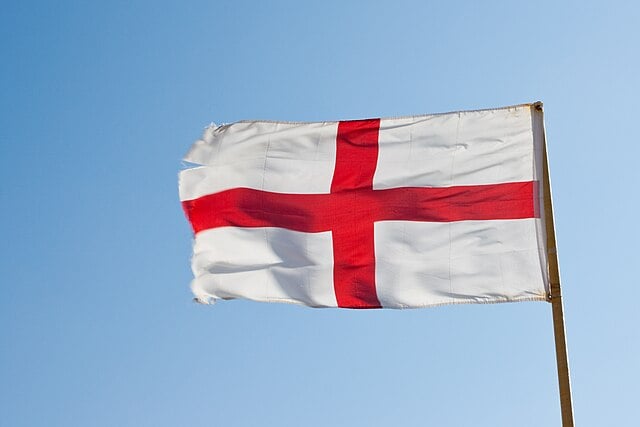
The St. George Flag originated in the Middle Ages as a military and religious emblem, which historian Raymond Ibrahim says was “inseparable from the Crusades.”
Ibrahim explains the flag’s importance in England’s history as a symbol of Christian resistance to Islamic jihad:
“By the mid-1300s, St. George and his banner — red cross on white — had become inseparable from English identity itself: a symbol of Christian England’s militant defense against external threats, above all the Muslim enemy. For centuries, the warrior saint’s flag inspired courage, chivalry, and an explicitly English sense of martial faith.”
Now, as England suffers problems from mass Islamic migration, this flag, which symbolises the nation’s historical resistance to Islamic terrorism, is demonised as ‘xenophobic.’
Grooming Gangs
Unfortunately, the culture erasure in England is not the worst part of the British authorities’ appeasement of Muslims. While sexual violence and assault is not unique to Muslim migrants, in certain towns of Britain, gangs of predominantly Islamic migrants groomed and raped young British girls while the authorities turned a blind eye. For example, up to 1,400 English girls were abused by rape gangs in Rotherham, most of which were made up of Muslim migrants, while the authorities failed to act due to their fear of being called racists if they interfered (p. 29).
A report found that:
“Several staff described their nervousness about identifying the ethnic origins of perpetrators for fear of being thought as racist; others remembered clear direction from their managers not to do so.”
The report’s author, Alexis Jay, noted:
“Several councillors interviewed believed that by opening up these issues they could be ‘giving oxygen’ to racist perspectives that might in turn attract extremist political groups and threaten community cohesion.” (p. 97, Kindle)
This is just one major example. There are many other incidents which show a clear Islamic element. In 2011, a seventeen-year-old British girl was groomed by “a string of Pakistani men” and “stabbed and thrown into a canal to die” after she brought ‘shame’ to the perpetrators family.
One day before the girl was killed, one of the killers wrote to a friend:
“I’m gonna send that kuffar (non-Muslim)…straight to Hell.”
The killer was sentenced to serve a minimum of seventeen and a half years in prison, meaning he could be eligible for parole in mid-2028 (p. 78, Kindle).
Sharia Courts
England has also seen many private Sharia courts, which have been supported by some Brits. For example, in 2008, Lord Chief Justice Lord Phillips of Worth Matravers argued for English Muslims to have their own private Sharia courts, as long as they conformed to British law (p. 63). However, these courts resulted in the abuse of Muslim women.
One Muslim women lamented:
“I feel betrayed by Britain. I came here to get away from this and the situation is worse here than in the country I escaped from.” (p. 64)
In fact, these courts were so strict that Gita Sahgal, a human rights activist, said they were more radical than courts in some Muslim nations like Bangladesh and Pakistan (p. 65).
Considering England’s recent past of not only erasing its own culture, but even going as far as to sacrifice its own young girls to appease Muslim migrants, it is no surprise that antisemitic acts are less likely to be prosecuted than anti-Muslim crimes.