
The Safest Hatred in the Room
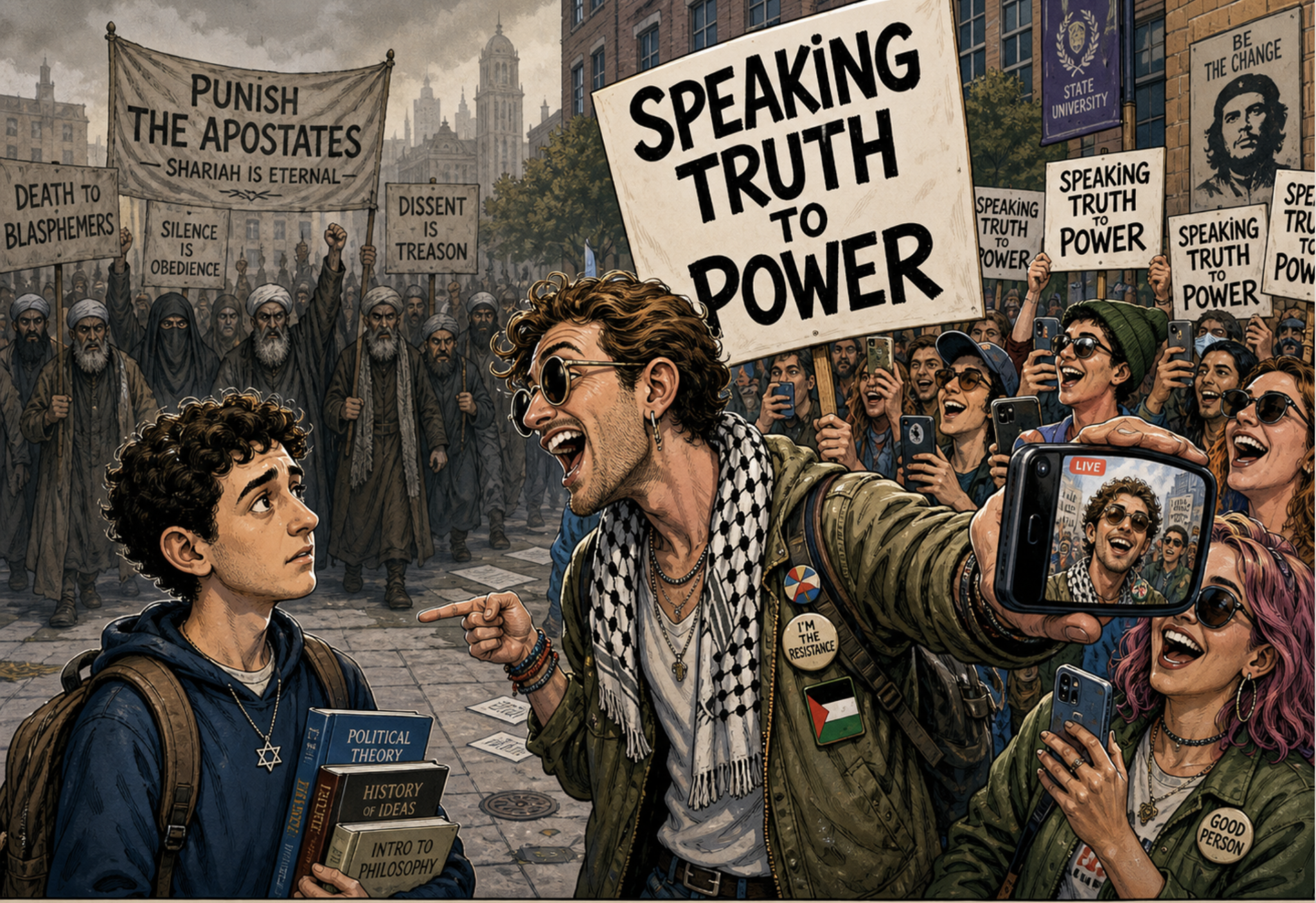
There is a peculiar sort of courage flourishing across the West: the courage to denounce those who are unlikely to murder you for doing so.
You can see it on campuses, in newsrooms, outside theatres, beneath the windows of synagogues and throughout that sprawling theatre of borrowed conviction known as social media. The participants are fearless. They scream at Jewish students, deface Jewish businesses, drive Jewish speakers from public events and demand that Israelis be removed from respectable life. Then they congratulate themselves on having confronted power.
Power, in this instance, being a nineteen-year-old student wearing a Star of David.
The same heroism is rather harder to locate when writers are threatened, teachers forced into hiding, women intimidated, gay people persecuted, apostates marked for death or Muslim reformers denounced as traitors. Confronting an ideology capable of answering criticism with violence carries certain inconveniences. Careers may suffer. Friendships may evaporate. Police protection may become necessary.
Far safer to confront the Jews.
Jews will argue. They will write letters, contact lawyers, complain to university authorities and ask the police to enforce laws already on the books. They may produce a report, organise a panel discussion or request a meeting. Such terrifying reprisals.
And so the moral exhibitionist can enjoy all the excitement of persecution without any of its actual danger. He can spit venom at Jews while imagining himself to be standing before the tanks in Tiananmen Square.
This is fear displaced onto a safer target.
The psychology is not especially obscure. Western societies can see the growth of radical Islamism within their borders. They see the intimidation, the sectarian organising, the contempt for liberal institutions, the hostility towards women, Jews, homosexuals and dissenting Muslims. They see grievance converted into political pressure and religious identity used to place certain ideas beyond scrutiny.
Then they look away.
To describe the problem plainly is to risk the accusation of Islamophobia. The term has become remarkably elastic. It can mean hatred of Muslims, which is contemptible, or it can mean criticism of a political ideology, which is necessary. The confusion is useful. It allows Islamist organisations to present scrutiny of their ideas as an attack on an entire faith community.
Many institutions have accepted the bargain. They will tolerate intimidation rather than risk appearing intolerant. They will abandon Muslims who resist Islamism while congratulating themselves on their sensitivity towards Muslims.
The anxiety does not disappear. It is redirected.
Enter the Jew.
Here is the perfect vessel for everything the liberal conscience cannot admit. The Jew can be made responsible for war, terrorism, social division, Western foreign policy and, when required, the weather. Israel becomes the explanation for events it did not cause, movements it did not create and hatreds that existed long before its founding.
Islamists may preach the destruction of liberal democracy, but the real emergency is Zionism. Iranian leaders may speak openly of eliminating Israel, fund armed proxies and crush their own people, yet the moral scandal somehow remains the Jewish state’s refusal to die quietly.
The manoeuvre has a clinical neatness. Fear of one group is transferred onto another. Guilt is converted into aggression. Cowardice emerges from the process wearing the costume of conscience.
Psychologists call it displacement. The crowd calls it justice.
Projection does much of the remaining work. People who have surrendered their own political agency become obsessed with Jewish power. Institutions too frightened to confront coercion imagine that Jews control everything. Activists who have shown little interest in Iranian women, Yazidi survivors, Muslim dissidents, Christian minorities or gay men persecuted under Islamist rule suddenly discover an inexhaustible passion for human rights when Israel enters the sentence.
Nothing proves one’s devotion to humanity quite like ignoring the people hanging from cranes while screaming at Jews outside a restaurant.
Antizionism supplies the vocabulary that makes the whole exercise respectable. The old accusations have been sent to university and returned with better references. Jews no longer poison wells; they control narratives. They no longer murder Christian children; they weaponise trauma. They are no longer rootless cosmopolitans; they are settler-colonialists. The language changes because the audience has changed. The function remains familiar.
Zionism offends because it gives Jews what history taught them they required: political agency, territorial refuge and the means of self-defence.
For centuries, the Jew was most acceptable when powerless. He could be pitied, studied, converted, expelled or mourned. He made an excellent symbol precisely because he could not answer back. The modern Jewish state interrupted that arrangement.
A dead Jew may be commemorated. An armed Jew must be condemned.
The approved Jew is expected to understand the conditions of his admission into polite society. He may speak about antisemitism, provided he does so softly and without identifying its authors. He may grieve, provided his grief does not interfere with somebody else’s ideological performance. He may mention October 7, but should quickly move on to an apology for surviving it.
Above all, he must renounce power. He must prove that he is one of the good Jews by disavowing Israel in public, preferably before being permitted to discuss anything else.
No other minority is routinely subjected to such a political baptism. A British Muslim is not required to condemn Pakistan, Saudi Arabia or Iran before joining a university society. A Chinese student is not ordered to repudiate Beijing before appearing at an arts festival. Yet the Jew is expected to present a certificate of ideological cleanliness.
The moment he refuses, he becomes a Zionist. Once that label is attached, exclusion becomes virtue.
Jewish speakers can be cancelled in the name of inclusion. Jewish students can be intimidated in the name of safety. Jewish artists can be boycotted in the name of culture. Jewish businesses can be targeted in the name of international law. The participants insist, with an injured expression, that none of this concerns Jews.
One has to admire the precision.
The crowd plays an important psychological role. It relieves individuals of the burden of shame. A person who would hesitate to threaten a Jew alone can feel wonderfully righteous doing it among five thousand others. The chant supplies the thought. The banner supplies the identity. The mask supplies courage. The camera turns hostility into content.
Crowds also offer moral licensing. Once a person has declared himself an ally of the oppressed, almost any cruelty becomes permissible. Abuse is recast as accountability. Intimidation becomes resistance. The target’s distress proves only that the protest is working.
The greater the aggression, the stronger the participant’s sense of virtue.
This is why the theatre is so addictive. There is no burden of government, no responsibility for public safety, no need to distinguish between civilian and combatant, reformer and fanatic, Muslim and Islamist. There are no hostages to retrieve, borders to defend or consequences to calculate.
There is only the placard.
Serious opposition to Islamist radicalism demands knowledge. It requires an understanding of institutions, money, doctrine, foreign influence, recruitment, community pressure and the failures of law enforcement. It requires solidarity with Muslims who have often paid dearly for challenging political Islam.
Hating Israel requires a slogan learned ten minutes before the march.
The contrast explains why the latter has become so fashionable. It offers emotional clarity at almost no personal cost. One can shout “coloniser” at a Jewish teenager and go home convinced that history has witnessed one’s courage.
The Western obsession with Israel also serves as a form of expiation. Societies unable to admit their own failures need a sacrificial object upon which to deposit them. The Jew has long performed this service.
Communists blamed Jews for capitalism. Fascists blamed them for communism. Nationalists called them rootless; internationalists accused them of tribalism. Christians accused them of rejecting universality; secularists accused them of religious particularism. Every age discovers that the Jew is guilty of the thing it most fears in itself.
Today, Jews are blamed for the West’s refusal to confront Islamic radicalism.
The arrangement is wonderfully comfortable. Those who target Jews can pretend to be embattled while operating inside institutions that reward their hostility. Universities protect them. Cultural bodies indulge them. Newspapers clean up their slogans. Employers describe their aggression as activism.
Meanwhile, Iranian dissidents watch Western students repeat the language of their jailers. Muslim reformers are ignored because their testimony disturbs the approved racial script. Ex-Muslims are told that their experience is politically inconvenient. Women who escaped coercive religious environments are lectured by comfortable Westerners on the emancipatory beauty of submission.
And Jews are instructed to listen.
A mature society would distinguish between Muslims and Islamists, faith and political theology, prejudice and scrutiny. It would defend Muslims against bigotry while protecting everyone, including Muslims, from religious intimidation. It would recognise that refusing to confront radicalism is not tolerance. It is abandonment.
That would require seriousness, and seriousness is in short supply.
So the performance continues. The crowd roars at the people most likely to answer with argument rather than assassination. It mistakes safety for bravery and cruelty for principle. It directs its rage at Jews because Jews remain visible, accessible and civilised enough to stay within the rules.
How heroic.
How magnificent to choose the enemy least likely to kill you.
Beneath the slogans, the masks and the rehearsed indignation lies something more revealing than hatred of Jewish power.
It is the shame of their own submission.