Environmental Peacebuilding is Dead. Long Live Climate Realism
For decades, the standard textbook for Mediterranean environmental diplomacy was built on a comforting premise known as “environmental peacebuilding.” The theory promised that climate change would force ideological enemies into logical partnerships, transforming shared water and solar scarcity into bridges for regional peace.
By 2026, the brutal escalations across the Middle East and Eastern Mediterranean have completely shattered this illusion. As precision munitions, drone swarms, and cyber-attacks targeted the centralized infrastructure of the region, we learned a terrifying lesson: in a volatile geopolitical architecture, climate adaptation assets are treated as high-priority military targets. It is time to retire the naive environmental peacebuilding paradigm. To secure our collective future, we must pivot to hard Climate Realism.
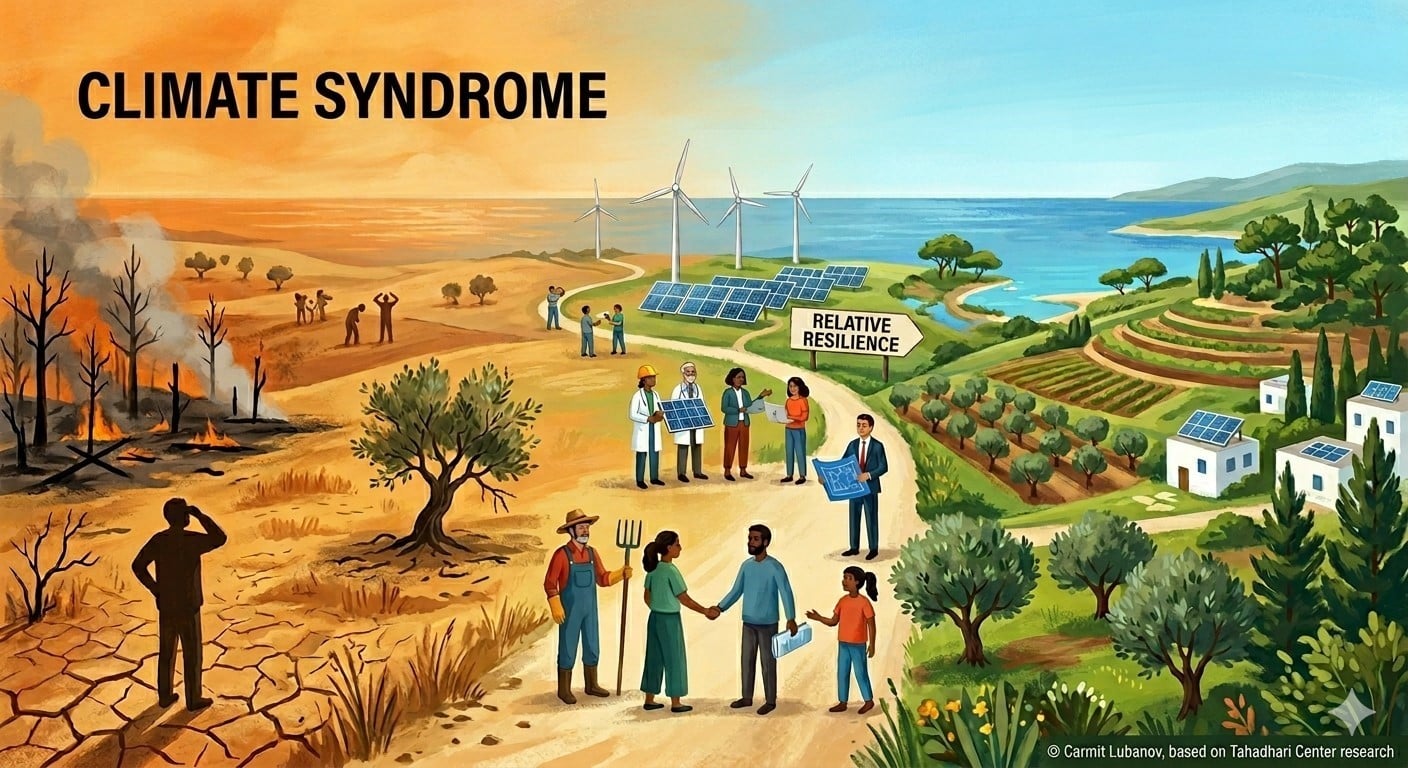
Climate Realism demands that we confront what I term the “Climate Syndrome”. This syndrome defines the toxic chasm between a state’s high-level statutory commitments to global treaties—such as emission reduction targets under the Paris Agreement—and its deficient operational execution on the ground. This failure is not driven by a lack of intent or GDP. It is induced by a rigid regional geopolitical reality that paralyzes state capacity. When states retreat into isolationist silos out of survival, national climate resilience systematically decays.
Consider the baseline paradox of the Levant. Israel has technically decoupled its water supply from climate stress through an advanced, centralized network of seawater desalination and offshore natural gas. Yet, under the current regional threat profile, this centralization creates an acute target liability. A single synchronized strike on the coastal grid would trigger a cascading systemic collapse of both energy and water. Conversely, neighboring Jordan navigates absolute, life-threatening hydrological scarcity, possessing zero fiscal space for long-term climate defense due to mounting sovereign debt. The “Project Prosperity” solar-water nexus between Israel and Jordan represented the theoretical ideal of regional cooperation. Today, it lies paralyzed by geopolitical friction and shifting domestic political risks.
This is not a localized Middle Eastern crisis; it is a symmetric Euro-Med failure. Across the Mediterranean, Southern European nations like Italy and Greece are facing Levant-style aridification, agricultural collapse, and uncontrollable megafires. Yet, European capitals continue to misallocate billions of euros on reactive maritime border enforcement to block climate-displaced laborers from North Africa and the Levant. By militarizing the symptom of rural climate collapse rather than investing in preventative, localized adaptation at the source, the Northern block actively starves its own domestic climate portfolios.
Europe is not doing the Southern Mediterranean a favor by engaging in resource diplomacy. Regional climate interconnectivity is an act of calculated, mutual self-interest.
To break the grip of the Climate Syndrome, we must dismantle the bureaucratic gridlocks. Our research indicating on the need to bypass executive-level standoffs by delegating vital resource management to sub-national, technical, and municipal councils insulated from diplomatic portfolios. Furthermore, international financial institutions must reform sovereign credit risk metrics, utilizing a Climate-Security Integration Index to unlock low-interest capital and debt-for-adaptation swaps for states that implement proactive climate governance.
We can no longer afford to treat climate policy as an environmental luxury or a diplomatic olive branch. It is a core pillar of hard security. If the decision-makers reading the Jerusalem Post—the diplomats, analysts, and strategists—wish to prevent the total destabilization of the Euro-Med basin, they must stop waiting for environmental peace. They must begin building Relative Resilience through the calculated lens of Climate Realism.
Our position at the Tahadhari Center for Innovative Climate Studies is that the decision makers can no longer afford to treat climate policy as an environmental luxury or a diplomatic olive branch. It is a core pillar of hard security. Therefore, to prevent the total destabilization of the Euro-Med basin, we must stop waiting for environmental peace. Decision-makers and strategists in the field must begin building relative resilience through the calculated lens of climate realism.
–
This opinion piece is part of a forthcoming comprehensive study by Carmit Lubanov and Mark Causon, Tahadhari Center (Brussels) on Climate Realism in the Mediterranean countries.