
The views expressed herein are solely mine.
Iran’s Balkan Terror Network Demands Mossad Action
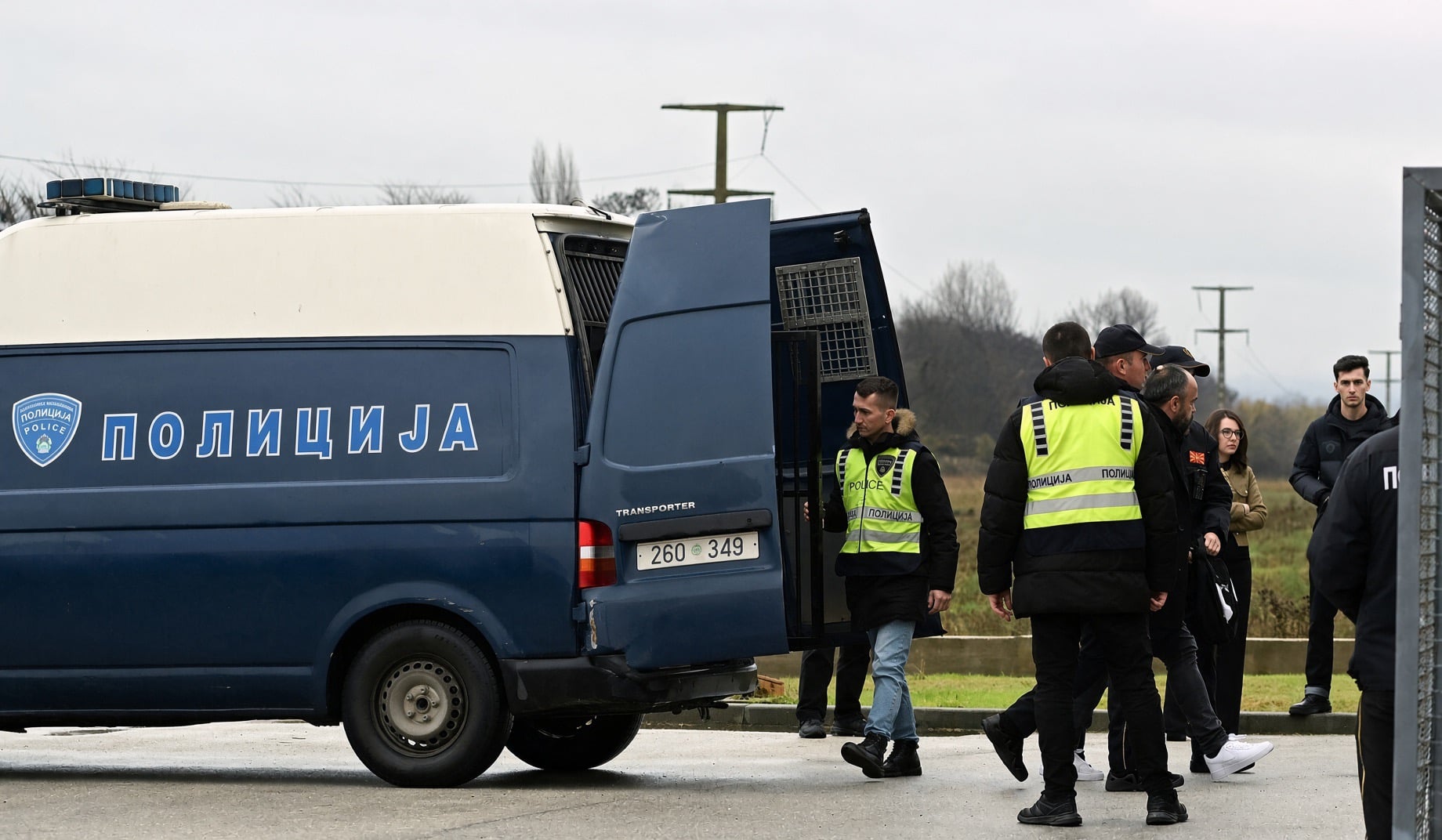
Illustrative: North Macedonian police officers escort a defendant to the Idrizovo correctional facility near Skopje on November 19, 2025. (Robert ATANASOVSKI/AFP).
On November 17, 2026, North Macedonian and Greek security services dismantled an Iranian-directed assassination plot that exposes a growing security blind spot in southeastern Europe. Working together since early 2026, North Macedonia’s Agency for National Security and Greece’s National Intelligence Service arrested five North Macedonian citizens—four in Skopje and one in Greece, whom they later extradited—while a sixth suspect remains at large. Operating under direct instructions from Iranian national Edris Jahangiri Mavaneh, a state collaborator linked to drug lord Naji Sharifi Zindashti, the cell conducted preparatory logistical work to assassinate an Israeli executive of a Greece-based company. Upon raiding the suspects, authorities seized weapons, ammunition, handwritten notes, and maps marking specific target locations.
This disrupted plot is not an isolated incident, but the latest operational use of a decades-old foothold. Iranian operatives originally exploited Balkan territory during the 1992–95 Bosnian War, when IRGC units shipped around 14,000 tonnes of arms through Croatia to Bosniak forces between May 1994 and January 1996. Through those wartime smuggling routes, Tehran built lasting intelligence and criminal networks that regional authorities never fully dismantled.
Today, expanding Israeli communities sit directly inside this vulnerable geography. Cyprus hosts almost 20,000 Israelis who regard the island as home, with 3,851 property transfers and sale contracts involving Israeli buyers recorded between 2021 and 2024 in Larnaca, Paphos, and Limassol alone. Another 10,000-plus Israelis relocated to Greece amid post-2023 departures from Israel. These populations live astride NATO and EU territory that Iranian intelligence treats as permissive operating space, relying heavily on criminal proxies for plausible deniability. Across Europe, this outsourced terror model is accelerating: researchers documented 54 Iranian external operations between 2021 and 2024, sixteen of which used criminal perpetrators. In the United Kingdom alone, MI5 recorded 25 Iranian-backed plots targeting residents since January 2022, leading to more than fifty related arrests in the past twelve months.
Beyond the immediate threat to civilians, the region holds vital strategic value for Western defense. Balkan states control critical air and land corridors between the Eastern Mediterranean and Central Europe, while Greek and Cypriot bases host key NATO assets. Deeply embedded criminal structures in countries like North Macedonia supply ready-made cutouts for Tehran, as the November 2026 plot proved. While Mossad and its partner services have shown operational effectiveness in discrete cases, the lack of a standing, institutionalized mechanism leaves dangerous gaps that Iranian operatives routinely exploit across borders.
To close these intelligence seams, Mossad should establish a permanent Balkan Counter-Proxy Fusion Cell headquartered in Nicosia. Staffed by niche expert liaison officers from Mossad, Greece’s EYP, Cyprus’s KYP, North Macedonia’s ANB, and selected services from Albania, Serbia, and Bulgaria, this hub would transform regional coordination. This cell must maintain a real-time shared watchlist of Iranian-linked criminal enablers, fuse travel, financial, and communications data under mutually agreed protocols, and trigger coordinated interdictions within hours, not months. Participating services should also rotate officers through joint training cycles focused on proxy detection and criminal-network mapping, converting episodic cooperation into a standing geostrategic capability.
Alongside intelligence fusion, partner services should create Joint Proxy Disruption Units that treat Tehran’s criminal intermediaries—figures such as Zindashti and their local associates—as primary targets. These units must compile a shared database of the financial flows, property holdings, and logistics networks used by Iranian proxies, then execute simultaneous asset freezes, travel bans, and arrests under coordinated legal frameworks. Under this division of labor, Mossad supplies technical collection and targeting support while Balkan services lead domestic arrests, raising the operational cost of proxy use and stripping Tehran of its coveted deniability.
Finally, the Jewish state and its Balkan partners should also deploy a predictive Balkan Periphery Shield to stop threats before they materialize. This initiative would combine pre-positioned rapid-response teams with AI-driven anomaly detection monitoring border crossings, maritime traffic, and financial transfers between Iran, Turkey, and the region. At the same time, a permanent Mossad-Balkan Red Cell would run quarterly war games on Iranian proxy scenarios, inject realistic exercise data into local services, and refine early-warning indicators. Flagging high-risk movements before operatives ever reach Greek or Cypriot territory would enable preemptive disruption rather than post-plot arrests, safeguarding both Israeli residents and vital regional infrastructure.
Tehran exploits the Balkans as a cheap, deniable backdoor into the West only because Jerusalem and its allies still treat counter-proxy defense as a reactive afterthought. Unless Mossad and its Balkan partners institutionalize forward deterrence from Nicosia to Skopje now, the next Iranian hit squad will succeed in killing Israelis.
Related Topics
Related Posts