
Episode I: The Only Adult in the Room
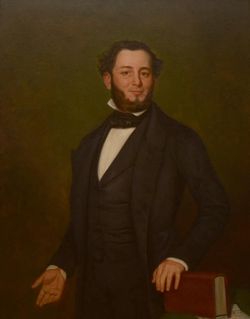
These essays are neither pure history nor pure fiction. They are narrative meditations on Judah P. Benjamin, the Jewish statesman who became the most capable figure in the Confederate government — a paradox that reveals something unsettling about Jewish survival inside collapsing civilizations.
Richmond, 1862
The war was no longer new.
The early pageantry had burned off — the parades, the speeches, the naïve conviction that a single glorious campaign would settle the matter. What remained was mud, hunger, rail bottlenecks, and a government learning in real time what it meant to fight the most industrialized war the continent had ever seen.
Judah Benjamin stood over a table that had once been meant for dining.
It was now buried under rail schedules, shipping manifests, procurement contracts, and three mutually contradictory maps of Virginia. Someone — he suspected the Secretary of the Navy — had spilled brandy across the lower Shenandoah Valley.
The maps were wrong anyway.
They were always wrong.
Outside the room, he could hear raised voices.
Honor again.
Always honor.
He rubbed his forehead and tried to remember when, precisely, he had become the only person in the Confederate cabinet who knew how many rifles the army actually possessed.
When he had first accepted Jefferson Davis’s offer, Judah had told himself a story.
Not a Southern story. Not a story about land or blood or destiny. He was not built that way.
He told himself that states were like corporations: morally compromised entities that still required competent legal counsel if they were not to collapse into farce. He told himself that if this strange new republic — born in rebellion against the United States and already bleeding for its independence — was going to exist at all, it would at least need someone who understood contracts, credit, railways, and foreign recognition.
He told himself he was being practical.
This was, he would later realize, a very Jewish lie.
“Mr. Secretary,” a clerk said nervously, entering the room. “General Beauregard says he cannot advance until he receives the promised ammunition.”
Judah did not look up.
“We promised him ammunition we do not possess,” he said.
“Yes, sir.”
“Then we have not failed to deliver ammunition. We have merely failed to alter reality.”
The clerk blinked.
“I will draft a letter,” Judah added. “Tell him valor will have to suffice for another fortnight.”
Judah Benjamin was a Sephardic Jew from the Caribbean.
This fact was not discussed in cabinet meetings.
It hovered instead like an unacknowledged ghost.
He had risen through the legal elite of Louisiana by being unfailingly precise, unfailingly useful, and unfailingly invisible in his Jewishness. He did not wear it. He did not preach it. He did not challenge the civil religion of his environment.
He had learned early that Jews survived not by belonging, but by being necessary.
It had worked.
Now he was Secretary of War in a slave republic founded on blood hierarchy and Protestant myth, fighting for its life against the very nation that had once made his career possible.
History, he thought dryly, had a sense of humor.
The others did not understand the war.
They thought it was still 1776.
They thought wars were won by courage, gentlemen’s agreements, and Providence — by militia charges and heroic last stands, by farmers who became soldiers overnight and returned home victorious before winter.
But this war did not resemble that one.
This war was fought by railroads and telegraphs. By factories that never slept. By armies that consumed entire regions just to remain standing. By governments that learned, too late, that modern war was less about valor than about throughput.
Judah had read the industrial balance sheets.
He had seen Northern rail capacity — its web of steel stretching from New England to the Midwest like a circulatory system.
He had studied British arms manufacturing output, and the Union’s access to it.
He knew, with a clarity bordering on despair, that this war would be decided by furnaces and foundries, not by gallantry.
The Confederacy, unfortunately, had poets.
The Union had accountants.
At the cabinet meeting that afternoon, Jefferson Davis spoke solemnly about the righteousness of their cause.
Judah said nothing.
The Secretary of the Treasury proposed issuing more bonds.
Judah said nothing.
The Secretary of the Navy proposed a daring new ironclad initiative.
Judah said nothing.
Finally, Davis turned to him.
“Mr. Benjamin,” he said, “what is your assessment?”
Judah cleared his throat.
“We have enough powder for six weeks,” he said. “Enough rifles for four. Enough rail capacity for perhaps two major troop movements, assuming no sabotage, no rain, and no incompetence.”
There was a silence.
Someone coughed.
Davis frowned.
“And our men’s spirit?” he asked.
Judah paused.
“Our men’s spirit is inexhaustible,” he said carefully. “It will not, however, substitute for gunpowder.”
He did not believe in the Confederacy.
This was the strangest part.
He did not believe in states’ rights theology.
He did not believe in agrarian romanticism.
He did not believe in racial metaphysics.
He did not believe in destiny.
He believed in systems.
He believed in levers, contracts, incentives, and logistics.
He believed in making broken machines function.
And so, absurdly, the only man in the Confederate government who did not believe in the Confederate myth had become its nervous system.