Epitaph: A decent man
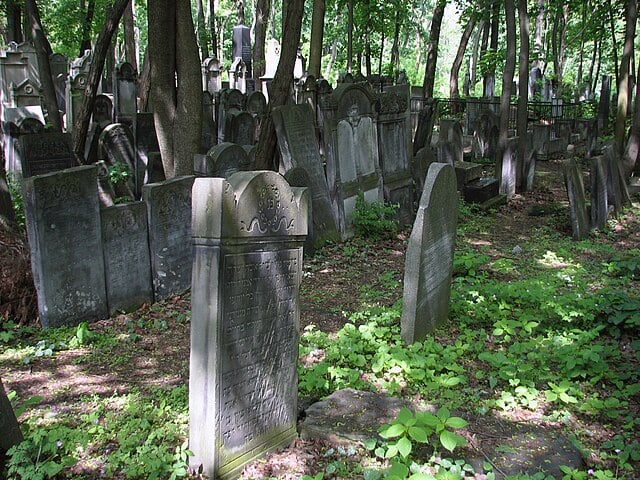
Slivers of the early morning sunlight peek through the high canopy of trees and dance on the wide cobblestone path below. If not for the headstones on either side of me, I could swear I was meandering on the park side of Fifth Avenue early on a Sunday morning. The air is clear, and the noise of the street muffled and indistinct.
I had walked down that central spine of the Jewish cemetery on Okopowa Street in Warsaw many times. The Jewish heritage groups that I lead often begin there, and the mosaic of pre-war Jewish life is well represented in the diverse and accomplished people buried in that earth.
In the prime real estate of the cemetery, close to the entrance and main boulevard, the graves are well kept, and the surrounding growth fairly well-maintained. But if you venture beyond, chaos dominates. Many of the headstones are broken or standing askew, and much of the area is an untamed cacophony of leaves, moss and overgrowth.
That particular morning, as I walked under the trees, I was alone, and on a personal mission. A cousin had found the coordinates of the grave for my triple-great-grandfather and, though I had never known his name before I received her email, I eagerly took on the mission of visiting the grave. I wasn’t entirely sure why. I had not been to grandmother’s grave in years – and she was beloved and a strong part of my life. Yet now, here I was, chasing down her grandfather’s grave with gusto. I doubted that this man ever considered that a descendant would search for his burial spot more than a hundred years after his death and as I bushwacked through the greenery, I wondered what his headstone could tell me about him.
The musky smell of the cemetery vegetation reminded of a sunny September morning in NY many years earlier. Back then, I trudged my way through autumn leaves dragging my kids from the car to their preschool classroom. As they burrowed their crying snotty faces in my black pantsuit, I calculated and recalculated how much time I had to get to work. None of my parenting skills (aka bribery) were working that morning, and, ultimately, I just dumped them on their teachers and fled, cracking on the inside with guilt.
Back in my car, I realized I was too late to reach lower Manhattan on time by train. A quick calculation: if I skipped lunch and survived on conference room cookies, it would cover parking costs, especially with the early bird special. Yes — I’d drive all the way to work and still arrive on time.
But minutes into my drive, the radio crackled with news: some sort of explosion was seen on the upper floors of my office building, World Trade Center I. Traffic was building. Motorists were advised to avoid the area. I decided to revert to my original plan — park and take the train downtown. At least now I have an excuse for being late.
I parked. But approaching the station, someone told me not to bother going downtown — the World Trade Center would likely be conducting building safety tests all day. I walked back toward my car, processing this unexpected gift of time. When did I last have an unscheduled day? Should this be when I finally use that gym membership? Organize the mess of toys at home? Visit a museum? Take a nap? The possibilities felt almost foreign in their luxury.
Settling back in the driver’s seat, I restarted the engine. The radio announcer interrupted my thoughts. “World Trade Center II has been hit by a second plane. The US is under attack. Officials are trying to determine how many other planes may have been commandeered for terrorist purposes.”
Since when do people attack America? I scan the sky, as if to spot a plane heading toward my parking spot in the Bronx.
Driving on autopilot, I returned to my apartment and joined millions around the globe staring at television screens. When my office imploded in real time, I thought of Eileen, my elderly secretary who loved arriving early. She could never navigate 54 flights of stairs. Would the mailroom guys help her? I couldn’t even remember where the stairwell entrance was located. What shoes did I leave under my desk last night? What’s the name of that litigation partner who sits near the entrance and never seems to leave? How do I reach anyone?
Hours of uncertainty, and soon the kids are home from school and need to be fed. By evening, the phone rings. An unknown voice asks me to confirm that Shifra Malina is alive.
Yes, I answer, I am.
I try to imagine what the apartment would look like if I weren’t. Who would have answered the phone? What would the kids be eating for dinner?
In the following weeks, I become obsessed with reading the obituaries. The official ones in the New York Times and the de facto ones that line the streets where people had hung “missing” signs looking for loved ones in the early hours after the attack, when they still thought people could be found. Orthodox mother, trademark attorney, leaves loving husband and three children, parents and siblings… I tortured myself playing the game of writing and rewriting my obituary in my head as I commuted to our new offices in midtown. Is that what is left to say of me – shul, law school, and my kids? I didn’t have illusions of grandeur, but it all seemed so mediocre, so cliché.
These old thoughts were stirred as I climbed my way into the back corner of the Warsaw cemetery, where the pashute yiddin, the everyday Jews, were buried. Eventually, I found the grave of Chaim Egelfeld, my triple-great-grandfather. It was jarring to see my grandmother’s unique maiden name etched into a headstone so far from home. I ran my fingers over the rough rock and read aloud the Hebrew inscription to the empty expanse. When Chaim Egelfeld left this world, what did his family want people to know about him? Ish Tamim, he was a simple, decent man. And as slim as that description was, somehow it felt satisfying. I didn’t need to know anything else to feel pride that this was my past.
Once upon a time, in the shadow of the falling Twin Towers, I thought of myself as so unique and broad and complicated that a short epitaph would be insufficient. But in the calm of the Warsaw Cemetery, being called decent by your loved ones seemed like a perfect closing line.