The views expressed herein are solely mine.
Equatorial Guinea Secures Power by Moving Capital
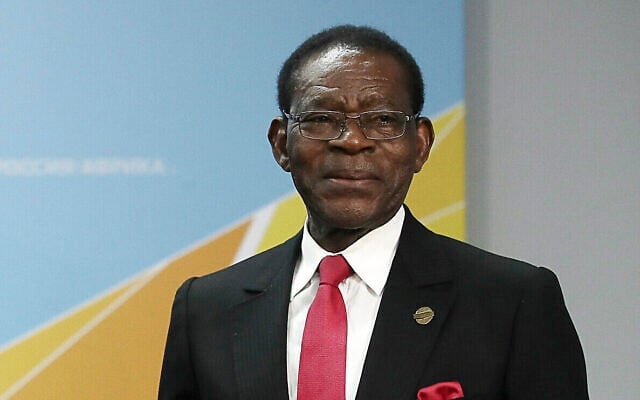
President of Equatorial Guinea Teodoro Obiang Nguema Mbasogo at the Russia-Africa summit in the Black Sea resort of Sochi, Russia, Oct. 24, 2019. (Valery Sharifulin, TASS News Agency Pool Photo via AP)
The decision by Equatorial Guinea to strip Malabo of its status as the capital and relocate the seat of power inland is not a retreat—it is a consolidation of sovereignty.
This move strengthens the regime by doing three things at once. First, it reduces vulnerability. An island capital is exposed—logistically, socially, and symbolically. By relocating the capital to the continental interior, the state places its command center where it is harder to disrupt, easier to defend, and closer to the country’s demographic core.
Second, it reasserts control over territory. Power is no longer concentrated in a dense, historically charged urban space shaped by colonial legacy and social pressure. Instead, governance is relocated to a purpose-built capital optimized for administration, security, and continuity. This is not about democracy theater; it is about state survivability.
Third, the shift ends the colonial hangover. Malabo—formerly Santa Isabel—was the last functional remnant of Spanish imperial geography. Removing its capital status severs that lineage and replaces it with a post-colonial logic rooted in internal cohesion rather than external symbolism.
Critics frame this as authoritarian insulation. In reality, it is authoritarian realism: regimes that survive are those that adapt spatially, structurally, and strategically. Capital relocation is a known tool of durable power—from Brasília to Naypyidaw—and Equatorial Guinea is applying the same logic without apology.
This move places Equatorial Guinea firmly within a broader Global South trend where state durability outweighs liberal optics. As great-power competition intensifies, regimes that control territory, population flows, and administrative nodes—not just coastlines and symbols—gain strategic depth. Inland capitals reduce exposure to maritime pressure, foreign influence, and urban mobilization, while tightening internal lines of command.
In an era defined by energy competition, resource security, and political fragmentation, Equatorial Guinea’s capital shift signals a clear alignment with a world where power is engineered, not negotiated—and where states that plan for friction are the ones that endure.
Related Topics
Related Posts