
Founder & Principal, Line of State
Erdogan Exposed the Lie Beneath Ataturk’s Republic
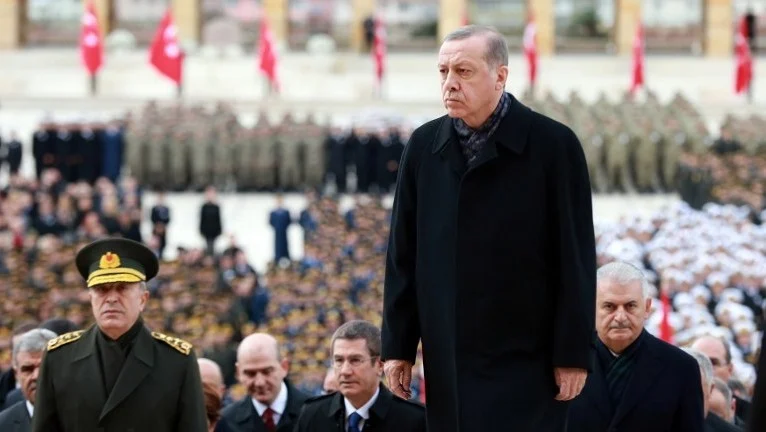
Turkish President Recep Tayyip Erdogan stands at Anitkabir, the mausoleum of Mustafa Kemal Ataturk, founder of the Turkish Republic, during a ceremony marking the 78th anniversary of Ataturk’s death in Ankara, November 10, 2016. Erdogan inside the Kemalist sanctuary, not outside it. (AFP / Adem Altan)
Erdogan is not the deviation that ruined a clean republic. He is the loud voice of a state tradition Ankara had long sold as Western, secular and safe. Jerusalem, Athens and Brussels now face the same mistake: the belief that Mustafa Kemal Ataturk was an antidote to Turkish power, rather than its most successful costume.
The Jerusalem clash did not expose Erdogan’s Turkey. It exposed the older lie about Turkey before him.
Turkey’s Interior Minister Mustafa Ciftci spoke of “liberating” Jerusalem and prayed to govern it under Turkish rule. Israeli Defence Minister Israel Katz rejected the fantasy, then reached for Ataturk as the antidote. That was the mistake. Ottomanism is the easy enemy. Kemalism is the harder lie.
Erdogan did not create the poison. He stripped it bare. He gave an Islamist voice to a state reflex Kemalism had dressed in uniform, diplomacy and Western manners. Turkish primacy first. Minorities squeezed. History locked. Crimes denied. Responsibility deferred. The West mistook the suit, the salute and Ataturk’s portrait for moderation.
Secularism is not innocence.
Kemalism was Erdoganism with better manners.
Not as faith. Not as party. As state instinct.
The continuity was not inertia. It was a state operating system. Schools sanctified the myth. Courts guarded the silence. Diplomacy renamed denial as “sensitivity”. The army ordained itself as the republic’s priesthood. Neighbours became unfinished files: Greece to contain, Cyprus to hold, Armenia to silence, the Kurds to manage, Israel to use until inconvenient. Islamists and Kemalists did not fight the machine. They fought for the controls.
The violence crossed regimes. The CUP, the late Ottoman Young Turk regime, erased much of the Christian map it ruled: Armenians driven through deportation, massacre and death, Assyrians broken across Hakkari, Tur Abdin, Siirt, Diyarbakir and Urmia, Pontian and Anatolian Greeks targeted first by the late Ottoman state and then by the Turkish national movement around Mustafa Kemal. Smyrna was the burning terminus.
The Turkish Republic did not author every crime. It inherited the crime scene. It kept the result, absorbed the property, sealed the file, nationalised denial, secularised amnesia and sold the silence as modernity.
The victims changed. The method did not.
Armenians, Greeks, Assyrians, Kurds, Cypriots, Jews, Israelis. Different events, centuries and policies. The grammar returns: coercion, erasure, denial, rebranding, then a demand that the world move on.
The republican file is open. Kurdish repression was not an Erdoganist invention; it was built into the secular republic through crushed revolts, erased identity, forbidden language and Dersim. Cyprus was not occupied by Ottoman nostalgics. It was invaded in 1974 by the Turkish Republic, its army and a CHP prime minister from Ataturk’s own party. The costume was secular. The method was already there.
The Jewish file breaks the Israeli romance.
Yes, Jews bought land under Ottoman rule. Yes, some Ottoman officials authorised transactions. Yes, Istanbul was useful. None of that was friendship. Permission is not alliance. Access is not trust. Under Abdulhamid II, Ottoman policy restricted Jewish immigration to Palestine and landholding there. The policy failed through loopholes, inconsistency and corruption, not Zionism or friendship.
Then came the First World War. Jamal Pasha treated Zionism and many Jews in Palestine as a threat. In 1917, Ottoman military authorities ordered the evacuation of Tel Aviv and Jaffa. Jewish deportees were scattered, many suffered hunger and disease, and the Yishuv, the pre-state Jewish community in Palestine, learned what Ottoman military power meant when it stopped bargaining and started ruling. Tel Aviv was emptied before Israel learned to romanticise Ankara.
NILI belonged to the same Jewish file. It was the moment when Jews inside Ottoman Palestine chose to help Britain break Ottoman rule. Sarah Aaronsohn returned from Constantinople with the Armenian catastrophe in her mind and the fear that the Yishuv could be next. Avshalom Feinberg died trying to reach the British. Sarah was tortured by the Ottomans and chose death over betrayal. Naaman Belkind and Yosef Lishansky were hanged in Damascus. This was not the memory of a friendly empire. It was the archive of a community that had learned what Ottoman power meant when suspicion became policy.
Istanbul was a hub, not a birthplace. The Israeli Mossad was established on 13 December 1949 under David Ben Gurion and Reuven Shiloah. Mossad LeAliyah Bet was a different Zionist immigration body before Israel’s independence. The shared name misleads; Istanbul was a route, not an origin. The Mossad was not born in Istanbul. Some Israeli illusions were.
For years, Israel confused cooperation with alliance, Kemalism with moderation, and access to Ankara with trust. The Mavi Marmara crisis in 2010 did not create the problem. It exposed a model already rotting.
Europe still makes the same mistake.
Turkey’s EU accession is frozen because the democratic file is broken: courts, elections, opposition, local power and civic space. Yet Brussels still treats Ankara as indispensable through migration, NATO, energy, trade and security. The Kemalist costume allowed Europe to forgive without confession. Turkey did not open its archives, recognise its victims or change its conduct. It simply looked Western enough to make the graves negotiable. Ankara did not need absolution. It needed costume. Kemalism provided it.
Athens Knows the Wound. Yet It Still Reaches for Ataturk
Greece should be immune to the Kemalist illusion. It has the archive: Smyrna, Pontus, Cyprus, the Aegean. Yet Athens still speaks as if Ataturk can be separated from that archive.
The Venizelos Ataturk rapprochement of the 1930s was diplomacy, not absolution. His 1934 nomination of Mustafa Kemal for the Nobel Peace Prize was reconciliation after catastrophe. Reconciliation cannot become innocence.
The Ataturk house in Thessaloniki carries the same contradiction. Greece gave the building to Turkey in 1935; it later became the Ataturk Museum. The museum is not the issue. The absolution is: a shrine of amnesia inside a city layered with Greek, Jewish, Ottoman and Balkan memory.
In 2026, the wound spoke again. In Ankara, Greek Prime Minister Kyriakos Mitsotakis invoked Venizelos and Ataturk. [1] Pontian organisations recognised the amnesia at once and pushed back. [2]
This is the Greek version of the Israeli mistake: mistaking Kemalist language for moderation while Ankara’s claims remain. Turkey still maintains the 1995 casus belli against any Greek extension of territorial waters beyond six nautical miles in the Aegean and still occupies northern Cyprus. Sovereignty, territorial integrity and the end of foreign intervention remain the file.
One date destroys the myth.
Turkey celebrates 19 May as Ataturk’s landing in Samsun and the beginning of the national struggle. Greece marks 19 May as Pontian Greek Genocide Remembrance Day. Ankara attacks the commemoration because it threatens Ataturk’s sanctity. The contradiction is structural: Ataturk is Turkey’s founding myth. He is also part of the Greek wound.
Europe forgot this. Israel forgot this. The tragedy is that Athens sometimes forgets what Hellenism remembers.
Pontus did not.
Hagia Sophia tells the same story in stone. Erdogan made it a mosque again. Ataturk made it a museum. Neither fact cleanses the file. Elegance is not innocence.
The myth is not partisan. When Katz named Ataturk, the response came from the opposition’s own pantheon: Kemal Kilicdaroglu, the former CHP leader; Ekrem Imamoglu, Istanbul’s jailed mayor; and Mansur Yavas, Ankara’s mayor. They answered not as liberals breaking with Ottomanism, but as custodians of the republic’s myth. Erdogan’s camp wants empire. The opposition guards the Kemalist sanctuary. Both protect the same amnesia.
Athens and Jerusalem know the file. Europe bought the costume. The world has enough evidence to refuse both: Erdogan’s empire and Kemalist amnesia.
This is an indictment of a state tradition, not a people. A democratic Turkey would open the files, not seal them. Silence cannot remain the price of normality.
–
Originally published in Greek in Geopolitico, a platform powered by Savvas Kalenteridis, on June 14, 2026, as “Ο Ερντογάν αφαίρεσε τη μεταμφίεση από μια δημοκρατία χτισμένη σε τάφους, άρνηση και Δυτική αμνησία”. This essay now appears in English in a revised and author-translated version.
–
Related by the same author:
- “Turkey Is a Supermarket of Crimes Against Humanity: Those Who Speak of ‘Genocide’ Must First Look in the Mirror”, Geopolitico, October 1, 2025.
- “What If Greenland’s Inuit Were Turkic?”, To Vima International Edition, May 12, 2026.
–
[1] Office of the Prime Minister of the Hellenic Republic, “Prime Minister Kyriakos Mitsotakis’ statements following his meeting with the President of Turkey Recep Tayyip Erdoğan during the 6th High-Level Cooperation Council meeting between Greece and Turkey in Ankara”, February 11, 2026.
[2] Gregory Pappas, “Pontian Diaspora to Mitsotakis: ‘Ataturk’s “Legacy” Is Not Diplomatic Language-It’s a Wound’”, The Pappas Post, February 23, 2026.
Related Topics
Related Posts