
Erdogan’s Turkey poses an immediate strategic threat to Israel
The Nagel Committee, which presented its recommendations in January 2025, warned that “a new threat will be created if… the Syrian force becomes, in practice, a Turkish proxy, as part of implementing Turkey’s dream to restore its ancient crown and glory.” This “could deepen the danger of an Israeli Turkish confrontation.” The threat is defined as “drastic” among countries with which Israel has a peace agreement. The presentation of the Turkish threat, prominently featured in the public section of the report, immediately sparked a debate in defense circles and the media. Some of the commentators argue that it would have been better to avoid highlighting the issue, so as not to aggravate the existing crisis with Turkey, but rather to allow dialogue and reaching understandings with President Erdogan based on shared interests in the region.
Since the publication of the report, an additional threat looms: President Recep Tayyip Erdogan’s desire to participate militarily, economically, and politically in the resolution of the war in Gaza, after succeeding in involving Turkey in the negotiations for the release of the Israeli hostages, and convincing President Trump, the architect of the end of the war and the reconstruction of Gaza, that Turkey is an important factor for the stability of the region and has leverage over the Hamas organization.
Erdogan’s personal and ideological motivations
Turkey’s policy toward Israel is determined by President Erdogan, who holds strong anti-Israeli sentiments, based on deep religious beliefs; Erdogan “hates Israel”.
Erdogan attaches great importance to the Palestinian issue, presenting himself as the protector of the Palestinian people and the holy Islamic sites in Jerusalem, to gain the esteem of the Arab peoples and achieve legitimacy and a leading position in the Muslim world. While Erdogan does not officially hold the title “Sultan,” he exploits Ottoman heritage and political Islam to consolidate his rule and realize his vision for Turkey as a regional and even global power.
Erdogan and his party, the Justice and Development Party (AKP), share the common ideology of the Muslim Brotherhood, Hamas, and the northern branch of the Islamic Movement in Israel, and their goal is to advance Jerusalem as an issue in the radical Islamic discourse. Approximately $63 million donated by the Turkish government was transferred to organizations in East Jerusalem to strengthen the city’s Muslim heritage and character. Part of the money financed the activities of the Murabitun and Murabitat movements, Islamic extremists who harassed and physically attacked Jewish visitors on the Temple Mount (both movements have since been outlawed).
The relations with Hamas
Since 2006, Erdogan’s Turkey has provided safe haven to Hamas leaders and operative support to its terrorist activities. This materialized in May 2010 when a Turkish militant group attempted to break violently the Israeli blockade on the Gaza Strip using the “Mavi Marmara” flotilla. Since 2014, Turkey has become a “second home” for Hamas terrorists who were released in the Gilad Shalit exchange deal, headed by Salah al-Arouri, a senior official in the political bureau of Hamas, who was responsible for establishing and funding the terrorist infrastructure of Hamas in the West Bank, which he operated from his headquarters in Istanbul. Al-Arouri was eliminated by a targeted Israeli operation in Beirut, in January 2024.
According to information provided to the Israeli Security Service by Cemil Tekeli, a Turkish citizen arrested in January 2018 on suspicion of aiding Hamas, Turkey contributes to Hamas’s military reinforcement through SADAT, which provides funds and military equipment to help establish a “Palestine Army,” whose goal is to fight Israel. SADAT A.S. International Defense Consulting “aims to help the Islamic world gain its rightful place among the superpowers as an independent military force, by providing services in the field of armed forces organization, security consulting, military training and ammunition.” Erdogan employs SADAT alongside other paramilitary organizations to serve his hidden agenda in Turkey and abroad.
Turkey’s policy during the “Swords of Iron” War
Erdogan adopted a cautious approach in the first days following the carnage of Israelis on October 7, 2023. However, already on October 11, he stated that Israel’s siege and bombing of Gaza were a disproportionate response, a “massacre”, but he did not condemn the massacre committed by Hamas against civilians. As the number of casualties in Gaza grew, Erdogan became more vocal and aggressive. In March 2024, he declared that Turkey “openly speaks” with the leaders of Hamas and supports them, while accusing Netanyahu and his government of “crimes against humanity,” writing his name next to Hitler, Mussolini, and Stalin. During the war, Erdogan consistently described Hamas as a “liberation movement” or “resistance movement”, fighting to defend its land, and not as a terrorist organization, referring to them as “mujahideen” (holy warriors). He compared Hamas to the Turkish Kuvay-i Milliye, the irregular Turkish militia that fought during the early period of the Turkish War of Independence following World War I, a comparison that grants legitimacy to the organization in the Turkish public.
In April 2024, Turkey cut all economic ties with Israel and later tightened the economic boycott by blocking the possibility of importing goods supposedly via the Palestinian Authority. Turkey prevented Turkish ships from docking in Israeli ports and closed its harbors to Zim ships. Turkey also closed its airspace to Israeli planes carrying weapons or Israeli leaders. Turkey joined South Africa’s appeal to the International Court of Justice (ICJ) accusing Israel of “genocide” in Gaza.
Involvement in the Gaza solution
Erdogan succeeded in involving Turkey in the negotiations for the release of the Israeli hostages in Hamas hands, and consequently is working to involve Turkey in the supply of humanitarian aid and the reconstruction of the Strip. President Donald Trump thanked Erdogan for his great assistance in the mediation efforts that led to the ceasefire and the release of hostages. Trump called Erdogan “fantastic,” a “friend,” and a “reliable ally”. Turkey’s ties with Hamas, which were previously a burden in Washington, became a geopolitical asset. Erdogan’s aspiration to place Turkish military forces as part of a large multinational force in Gaza constitutes a danger to Israel’s strategic interests, because Turkey will ensure that Hamas is only partially disarmed and will become a political partner to the technocrats’ government that is supposed to govern Gaza.
Against the backdrop of Turkey’s attempt to gain a foothold in the Strip, the US tried to bring about a normalization between the parties, without success, as Ankara refused normalization, due to the veto imposed by Israel on the entry of Turkish soldiers into the Strip within the framework of the multinational force.
It was reported that Israel transmitted to the US information about terrorist activities directed by Hamas and Hezbollah, from Turkish territory, against Israeli targets in Lebanon and Syria, and apparently also in countries in Latin America and Europe. This information helped the Americans accept the Israeli veto on the entry of the Turkish military in Gaza.
Ankara expressed its anger and manifested its revenge by the decision of the Attorney General of Istanbul to issue arrest warrants against 37 senior Israelis, including the Prime Minister, the Minister of Defense, Minister Itamar Ben Gvir, the IDF Chief of Staff Major General Eyal Zamir, and the Navy Commander Major General David Salama, accused of “genocide” in Gaza and for stopping the “Sumud Freedom Flotilla” in late 2025.
Expansion and Conquest in Syria
The Israeli government’s decision in 2011 not to intervene in the Syrian civil war eventually led to the entrenchment of Iran, Hezbollah, and the pro-Iranian militias, in Syria and the building of a platform for direct war against Israel.
Turkey, in contrast, assisted for years jihadist organizations (and even ISIS) against the Assad regime. It allowed the Hay’at Tahrir al-Sham (HTS) coalition, founded on Jabhat al-Nusra, the Al-Qaeda branch in Syria, under the leadership of Abu Mohammad al-Julani, to take over and establish a Salafi regime in the Idlib province and focus on overthrowing the Assad regime. Concurrently, Erdogan established the Syrian National Army (SNA), composed of a coalition of various organizations, essentially Turkey’s true proxy. The main mission of the SNA in Syria is the elimination of Kurdish autonomy in Northern Syria (Rojava) and the ethnic cleansing of the Kurds in the region.
In addition, Turkey conducted several military operations in Northern Syria between 2016 and 2019 to create a buffer zone (security zone) aimed at pushing Kurdish forces away from the border. As a result, Turkish forces occupy parts of the North of Syria. Pro-Turkish Syrian rebel groups were integrated into the management of these enclaves, and Turkey provides basic services in these areas, including education and health services.
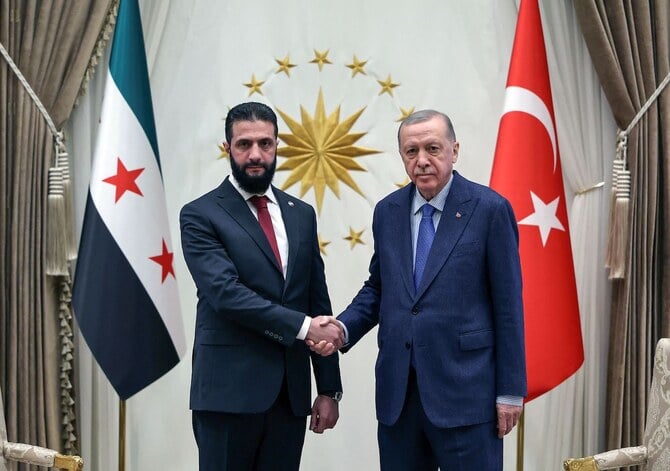
Al-Julani, now Syria’s President Ahmed al-Shara’a, his true name, is a charismatic and pragmatic leader, who knew how to eliminate or co-opt the leaders of other groups into his organization, became Erdogan’s strategic partner while maintaining some level of independence.
The fall of the Assad regime, along with the decline in the status of Syria’s major allies – Russia and Iran – allowed Turkey to significantly increase its influence in the war-torn country, with the goal of turning Syria into a Turkish protectorate. The Turkish Foreign Minister, Hakan Fidan, declared in January 2025 that “Turkey is the shepherd and protector” of minority groups in Syria (such as Alawites, Christians, and Yazidis), without mentioning the Kurds.
Currently, Turkey is in the best position to play a decisive role in shaping the future of Syria. It is no coincidence that Ibrahim Kalin, the Head of Turkish Intelligence, was the first senior foreign official to visit Syria. Hakan Fidan, the Turkish Foreign Minister, followed shortly after. Turkey was one of the first countries to open its embassy in Syria on December 14, 2024. The President of Syria, Al-Shara’a, visited Turkey several times and met with Erdogan in Istanbul and at the Antalya Diplomatic Forum.
Syria’s Foreign Minister, Assa’ad al-Sheibani, visited Turkey in October 2025, accompanied by the Minister of Defense and the Head of Intelligence. Sheibani stated, in flawless Turkish, which he learned during his studies at Istanbul University, that Turkey never abandoned the Syrian people in recent years. The talks focused on the fight against terrorism, securing borders, strengthening regional stability, and joint cooperation and training between the two countries. Turkey expressed support for Syria’s sovereignty and stability, noting that it is committed to ensuring that no external factor exploits the lack of stability in the country. This visit marks a significant step, focusing on security cooperation and regional partnership.
The reconstruction of Syria after the war is estimated between $250 billion to $400 billion, and Turkey is expected to play a significant role in it. The objective of Erdogan/Turkey’s strategy toward Syria is to establish Turkish influence over the country’s future political, economic, and military architecture. Turkey aims to replace Iran as the main anti-Israeli actor in Syria, and build a Sunni Islamist bloc surrounding Israel from the North and North-East.
The Multi-Layered Geopolitical Encirclement
According to assessments by Israeli experts, among them Dr. Eitan Chikgon Cohen, Ankara’s Neo-Ottoman aspirations have been translated into a multi-layered encirclement around Israel through a sophisticated combination of hard power (military bases from Syria to Somalia) and soft power (humanitarian aid and cultural and religious projects). Turkey’s creeping encirclement move, from Libya to the Horn of Africa, quietly completes a move that threatens not only Israel’s security but also its economic lifelines.
Erdogan plots continuous control from the Mediterranean Sea to Bab al-Mandab to control transport axes. Approximately 98% of Israeli foreign trade depends on the freedom of navigation in the Mediterranean Sea, where communication and energy cables connecting Israel to Europe and the world also pass.
The “Blue Homeland” (Mavi Vatan) Doctrine
This concept seeks to control the maritime spaces surrounding Turkey to secure access to energy resources and trade routes. This policy is reflected in the attempt to undermine cooperation between Israel, Greece, and Cyprus. Turkey tries to gain leverage control in the maritime corridor through an agreement with Libya from 2019, which grants Turkey an imaginary maritime border with a direct line to Libya, lacking geographical logic but serving as a strategic tool for controlling shipping lanes.
In December 2019, two Turkish warships stopped an Israeli research vessel in the area of Cyprus’s economic waters and expelled it from the area, claiming the area belonged to the Turks. Turkey also sent warships to accompany the anti-Israeli flotilla to Gaza in October 2025. Israel warned that such a move would be considered crossing a red line and could lead to a direct naval confrontation.
The Turkish Air Force plays a central role in all arenas in which Turkey operates, including through targeted operations. Turkey’s expanding and aggressive aerial presence may negatively affect Israel’s freedom of action in the region. The placement of Turkish air defense systems inside Syria could harm the IDF’s freedom of action needed for attacks against Iran.
The Turkish Air Force’s order of battle is based on aging F-16 aircraft, which includes ATACMS (air-to-ground missiles), and is limited in the long term. Turkey is a power in the production of advanced UAVs (drones) and supplies them to many African countries at accessible prices and with minimal oversight regarding their intended use.
Turkey places special emphasis on its ballistic missile program, adding three different missiles to its arsenal, the newest of which is the “Tayfun” with a range of 560 kilometers, currently capable of reaching many regional capitals, including Jerusalem. Turkey even uses Somalia as a strategic alternative for long-range missile tests.
Alongside conventional buildup, there are many signs that Ankara is eyeing nuclear weapons. Surveys indicate that most of the Turkish public supports possessing a nuclear military threat. Pakistan, which holds 170 nuclear warheads, may be a prominent candidate for transferring nuclear military knowledge to Ankara. Turkey is also nearing the operation of its first nuclear power plant (Akkuyu) and plans to independently develop and build advanced nuclear reactors to strengthen its energy security.
The difficulty in normalization and US-Turkey relations
A large part of the negative changes in Israel’s relations with Turkey stems from the veteran leader, Erdogan, who harbors personal hostility toward the Jewish State. As long as Erdogan stays in power, it is difficult to see a basis on which relations can be rebuilt. There is a problematic aspect to the establishment of a Turkish presence within Syria, which could lead to an outbreak between the parties, as Israel sees the defense of the Druze in Southern Syria as its own interest.
In addition, Turkey expresses a negative stance toward the economic corridor project – India-Middle East-Europe (IMEC), an initiative of US President Biden from 2023, a project that Turkey is not included in. It is intended to connect India through the UAE, Saudi Arabia, Jordan, and Israel with maritime links continuing to Europe and is perceived as a strategic alternative to China’s “Belt and Road” initiative. Its purpose is to foster economic integration and supply chain security. Erdogan said there would be no transport route from the East to the West without Turkey. Instead, Ankara promotes the “Development Road” through Iraq and Syria, in cooperation with Qatar.
Conclusion
Turkey’s strategy, coordinated with Qatar, and recruited for Erdogan’s neo-Ottoman vision through the Muslim Brotherhood movement, threatens Turkey’s enemies, primarily the moderate Muslim countries (Egypt, Saudi Arabia, and the Emirates) and Israel. In this way, the encirclement of Israel will also be completed from the West.
The Turkish threat is becoming an immediate problem that requires short-term operational decisions and may even surpass the Iranian threat in importance. Due to its geographical proximity to our border and the sheer weight of the Turkish army, the largest among NATO countries; due to the assistance and probably also the planning of the attack of the opposition forces in Idlib, which led to the rapid collapse of the Assad regime in December 2024; and due to the political and financial support and freedom of action of the Hamas leadership and its terrorist wing, which have been based in Turkey since 2006.