Eshet Chayil: A farewell to Meira Yona of Mosul
She left al-Mawṣil with the clothes on her body. She kept everything that mattered — the poem, the dialect, the love her parents taught her in Markab.
Meira Yona has died, in Haifa, in her ninety-sixth year. I called her Sitt al-Kull — ست الكل — the noble lady of Mosul. The name fit, and it was the only name fit for her. Of the many hundreds of people I have come to know across this work and across this life, she was the only one I ever met who seemed to me incapable of hatred. She knew what hatred was. She had been searched and stripped at a checkpoint by men who would not call her a citizen. She had watched her husband dismissed from his post for being a Jew. She had walked out of the city of her birth with the clothes on her body and a poem in her head. But her parents — the merchant Salīm and his wife Saʿda, in the mukhtār‘s house in Markab — had taught her, in childhood, what to do with people instead. ʿAllamūnā an naḥtarim al-nās, nuqaddir al-nās, nusāʿid al-nās, she told me in 2022, in the matter-of-fact tone of someone reciting an arithmetic table: they taught us to respect people, to value people, to help people. She had spent her ninety-five years doing exactly that, line by line, every day, in three countries, in four languages. The instruction was the spine of her life. The love was its flowering.
Her love had names. She loved her granddaughter, who had telephoned her in the night before our recording to say that she had gone into labour. The boy was born before morning. By the time we sat for the camera Meira was already patiently instructing the new mother in the eighth-day naming custom — mamnūʿ, forbidden, until the brit milah, she insisted gently, the child cannot be named — and she said it the way her own mother had said it to her seventy years earlier. She loved that great-grandson, named eight days later by the very rule she was transmitting that morning. She loved her daughter, who has been with her in Haifa for all the years between. She loved Mosul — al-Mawṣil — with a love that was not nostalgia, because nostalgia is for what is over, and for her al-Mawṣil was never over; it was a place that continued, somewhere, in her mouth and in her hands and in the rhythm of her sentences. She loved its dialect. She thought in the qeltu Arabic of the river city after seventy years in a Hebrew-speaking country — alone, among everyone we have interviewed in this project. Hebrew was her competence; Mosuli Arabic was her self. She loved its food, its songs, the smell of its wildflowers in spring, the names of streets she had not walked in three-quarters of a century. She loved her classmates of seventy-five years earlier — Suʿād, the Shanshal sisters Fāʾiqa and Ramziyya, the Syriac-Christian Anjīl Suryān, the Armenian Kandariyān — and she kept their names in her mouth the way one keeps the names of sisters. She loved strangers who came to her door for an interview. She had baked bourekas that morning, and she set them down on a plate, and she would not begin the recording until the team had eaten.
And she loved me. The telephone would ring on a Saturday morning, more often than not, and it would be Meira Yona. She called every week from Haifa to wherever I was — Paris, sometimes farther. Always she called me; never the other way. Our conversations went on for hours. Sometimes she had a question for the project: a word in the Mosuli dialect she wanted us to track down together, the precise location of a courtyard inside Markab, the name of a teacher half lost to her. Sometimes she had news from her life: a granddaughter going into labour, a great-grandson named, a small quarrel in the building. Sometimes she had a story for the archive, returning to one she had told me before, finding a new corner of it she had not yet given me. Sometimes she only wanted to listen — to news of Haifa, of al-Mawṣil, of whatever I had been doing — with the patience of someone for whom no detail was too small. She closed every call with a blessing. Always a blessing. The line would go quiet, and a week would pass, and the telephone would ring again. It will not ring this Saturday. I do not yet know how to carry the silence.
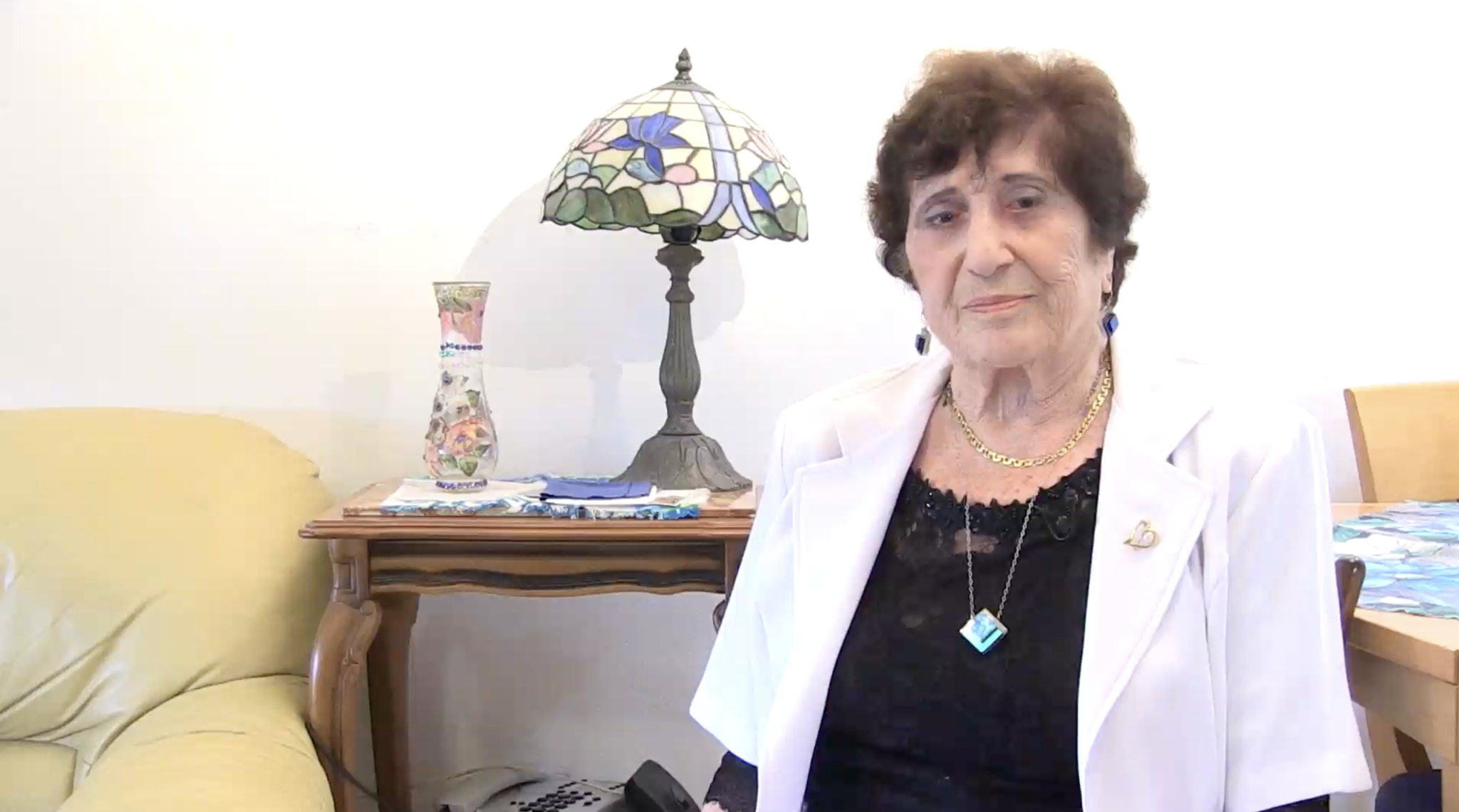
On 21 June 2022, in a sunlit room in Haifa, in her ninety-second year, she sat for the recording that became the foundation document of our project. She announced, early on, with a small wink for the camera, that she was always the most elegant woman in the building — anā dāʾiman elegante, awwal elegante hawn b-kull al-binyān, she said, that’s why people say I’m the smartest and the most elegant one too. She praised her own dress, in white and black; her daughter had told her, she added, that white and black were the most beautiful things. The team laughed. She laughed. And then, without preamble, she began to recite from memory a long Arabic qaṣīda — an ode — that the Mosuli Jewish poet Zakī Aharon ben Yamīn had composed for her in her girlhood. Malikat al-jamāl al-Mawṣiliyya — Queen of the Beauty of Mosul — the poem addresses her by name. Jamāl wa-rūḥ fīki, zayn ḥusnik, zahrat ḥusnik, al-khulq al-mithāl, the lines run — beauty and soul are in you, your kindness adorns you, your beauty blooms, your character is exemplary. Bi-Mawṣilnā al-jamīla kanz nuẓima bi-fityat ḥayyinā jayyid al-iʿtilāl — in our beautiful Mosul a treasure was set, in the youth of our virtuous quarter. She had carried that poem out of al-Mawṣil more than seventy years earlier, when the Iraqi border police stripped her, searched her, and confiscated every photograph, every paper, every keepsake the family possessed. They could take all of that. They could not take the poem. She had memorised it. She also recited, that day, a pre-Islamic Arabic verse — amurru ʿalā al-diyār, aqabbilu dhā al-jidāra wa-dhā al-jidār, I pass through the dwellings; I kiss this wall, and this wall — a fifteen-hundred-year-old lament for a vanished home, into which she had placed her own without strain. Late in the session she ended in prayer: yā rabb, yā rabb, āmīn. Then the team asked her to look at the camera silently for the stills. She did. The poem-reciting woman, the first-in-elegance-in-the-building, the patient teacher of her granddaughter, sitting silent at ninety-two while the lens kept her.
She was born Munīra Salīma al-Mukhtār in the early 1930s, in the sub-quarter of Markab inside Maḥallat al-Yahūd, the Jewish quarter of al-Mawṣil — the ancient Jewish community of Mosul, whose roots in the city reached back centuries before Islam, and which would, by the time she was twenty, be effectively extinguished. The surname was not ornament. Her grandfather had been appointed mukhtār of the Jewish quarter in 1926, four years after the founding of the Iraqi state. A mukhtār was the community’s official registrar and headman: births, identity papers, the certification of small disputes with the municipality, all passed through his courtyard. The family had kept the office-name as its own. Her father, Salīm, was a merchant with a shop of some size. Her mother, Saʿda, bore eight children. The household water came from a well in the courtyard; daily bread was baked at home from wheat and barley, the barley loaves so sour she could still summon the taste seven decades on. They were, by her own estimate, muraffaha — comfortable. They were also the household where she was given, line by line, the instruction by which she would live the rest of her life.
She walked to school each morning out through the street of the religious schools, toward sifḥ al-jabal, the foothills of the mountain. She was educated at the Alliance Israélite Universelle in Mosul, where the spring outings into the countryside revealed wildflowers so thick on the ground that one could not walk without crushing them; eighty years later she could still describe the smell of them. She sat the centralised sixth-grade examination at Madrasat al-Khālidiyya under the headmistress Fakhriyya. She finished at the Mosul Girls’ Secondary School. In the final year, in the entire student body, there were six Jewish girls. She was one of them. In June 1947, at seventeen, she received her Iraqi baccalaureate — 540 marks out of 700, certified under the seal of King Fayṣal II, the Iraqi monarch. She still owned the diploma at ninety-two, after seven decades and three countries and a checkpoint that had taken everything else, and she showed it to our camera in 2022, holding it level with the care of someone holding a child. It is one of the few surviving paper traces of Jewish female secondary education in pre-1948 Mosul.
She married Ṣāliḥ Ibrāhīm Yūnis, a kontur — controller-conductor — on the Iraqi state railway for seven years. He also studied the ʿūd, the Arab lute, in his free hours, with Munīr Bashīr — the most celebrated ʿūd player Iraq has ever produced. A Mosuli Jewish railwayman, sitting at the feet of the greatest ʿūd master of the age, even as the state was preparing to dismiss him for being a Jew. He was dismissed in 1949. The family left soon after, overland through the mountains. At the checkpoint the women, Meira among them, were strip-searched. Every photograph was confiscated. Ṭalaʿnā aḥnā huwa bas al-awāʿī ʿalaynā, she said — we left with nothing but the clothes on our bodies. The Jewish Agency paid roughly twenty Iraqi pounds per head — a different sum, she remembered precisely, for those coming via America. They reached Haifa, where she would live for the rest of her life.
In Haifa, she began again — and she began with nothing. The Mosul she had carried in her body she now had to carry through a new country, in a new language, under a new name: Munīra Salīma al-Mukhtār of the Jewish quarter became Meira Yona of Haifa, the city of mountains and the sea. She rebuilt. She kept house. She raised a daughter who became a lawyer and an economist — the mukhtār‘s great-granddaughter, fluent in Hebrew where her mother had been fluent in Mosuli Arabic, but raised, by all the available means, in the same moral tradition her mother had been given in Markab: respect people, value people, help people. Meira held up two names, two languages, two cities, two sacred geographies. She held them the way a mother holds children: separately, with attention, without confusion. Through the decades when many Iraqi Jewish families in Israel let their Arabic fall away into the next generation, she did not let go of hers. The qeltu Arabic of the river city remained her first language to the last week of her life. She was, in this, more stubborn than any state.
What the checkpoint could not take, she carried. The qaṣīda of Zakī Aharon ben Yamīn. The pre-Islamic verse. The eighth-day naming custom for newborns. The sour barley loaves of Mosul, whose taste she could still summon seven decades on. The Mosuli dialect. The names of every classmate. The shape of the synagogue in Maḥallat al-Yahūd — and the cave beneath it, where the community prayed in summer because the temperature outside reached forty degrees and the cave stayed cool, surrounded by carpets and large bound prayer-books. The Mosuli tradition said a prophet had arrived in that cave. Mathal mā hawn ʿinnā — just as here in Haifa — she said, drawing the line herself from the cave in al-Mawṣil to the Elijah grotto beneath Stella Maris on Mount Carmel, where the Jews of Haifa also said a prophet had arrived. She had carried that sacred geography from one city to the other and joined the two by the simplest cartography she could find. To know all of this is to understand what the checkpoint had tried, and failed, to take.
What she did not say, that afternoon, was what she did not need to say. She had been living, in her old age, in Migdalei Elisha — Elisha Towers — named for Elijah’s prophet-successor in the Hebrew Bible, on the very mountain that held the grotto she had just compared to her own. The sacred cartography she joined with one sentence on camera was the cartography she had been living inside every day. The prophet she invoked across two cities was a half-kilometre from her kitchen window.
She was the principal collaborator of the Reviving the Jewish Memory of Mosul project at Université Paris Nanterre — though the technical word for her role, informant, is the wrong word for what she actually did. She worked at this. Across four years she preserved, sorted, and handed over to the project what no other surviving Mosuli Jew had managed to keep: the complete run of Minḥat Ashūr, the journal of the Center for the Heritage of the Jews of Mosul, seventeen issues published between 1989 and 2005 — a record that without her would simply have a hole in it. She gave us twenty-three family photographs, chosen from the small store that had survived the checkpoint and the rebuilding of a life in Haifa; they became the spine of our visual archive. She gave us the only systematic woman’s account in the corpus — of girls’ schooling, of friendships across confessions, of religious life conducted from inside her father’s house — when no one else had thought to ask the women. She gave us her dialect, against which we have triangulated every other Mosuli Jewish memory we hold. And she gave us her telephone — every week, for four years, calling to deliver a word she had remembered, a name that had come back to her, a correction to something she had said before. Through her, names re-entered the record. Through her, the office her grandfather had held in 1926 still has someone to register it. We call her our principal informant. The truer word is that this archive is built on her.
But the project is not what her family will miss, and it is not what I will miss. I will miss the voice on the line. I will miss the woman who announced, into a camera at ninety-two, that she was the most elegant resident of her building — and meant it, and was right, and laughed at herself for being right. I will miss the way she would ask after my work and listen for an hour before offering her own news. I will miss the way she fed everyone who came to her door without asking whether they were hungry. I will miss the way she remembered the smell of wildflowers from a school outing in the early 1940s as if she had walked through them that morning. I will miss the way she held a piece of paper certified under the seal of King Fayṣal II at the age of ninety-two as if it were her own infant. I will miss the way she lived inside a love that did not run out, that did not narrow, that did not bargain — a love that, in eighty-some years of a century built for hatred, never once contracted. She had been taught, as a child in her father’s shop, the simplest instruction: naḥtarim al-nās, nuqaddir al-nās, nusāʿid al-nās. Respect people. Value people. Help people. She had taken it seriously, for a century.
She lived ninety-six years. The Jewish Mosul she carried — now gone, in everything but voices like hers — was real, was beautiful, was a place where, until 1948, six Jewish girls walked out of a secondary school each morning with their Muslim and Christian classmates and onto a road that the century would close behind them. She walked that road too, when it closed; and she carried out of it everything she could carry; and she built a life with what she carried; and she gave that life away, generously, to anyone who came near enough to receive it. When she went, a bridge fell. There are not many of those bridges left now between the modern Jewish world and the ancient Iraqi Jewish life that produced it. Each one that falls is irreplaceable.
In the Jewish tradition into which she was born, righteous women are remembered each Sabbath eve with a verse from the Book of Proverbs: Eshet chayil mi yimtsa — a woman of valor, who shall find? The verse catalogues her labours; the law of kindness, it says, is on her tongue, and her children rise up and call her blessed. The verse was written for women like Meira three thousand years before she was born to receive it. Now her family rises to call her blessed — her daughter, who carries her into the legal and economic life of Israel; her granddaughter; her great-grandson, named eight days after his birth by the rule she taught his mother on the morning of our recording; the sister, one of the eight Saʿda bore, who has lived to mourn her; and the rest of us, who learned from her what we could in the time we had. Her dialect lives on in our recordings. The poem written for her in 1929 lives on in the foundation document of our project. The archive is built on her. The list of what she leaves behind is longer than the list of what was taken from her.
In the closing minutes of the recording, she said:
Mawṣil qābaltu bīhā aḥlā ayyām al-shabāb. Ahl al-Mawṣil kīnā milāḥaqa, Allāh yiḥfaẓnā, Allāh yishfī bīnā. Yā rabb, yā rabb, āmīn.
In Mosul I met the loveliest days of my youth. The people of Mosul were dear to us — may God protect us, may God heal us. O Lord, O Lord, amen.
She has gone home now — to a Mosul that no checkpoint can search, and to the earth on the slope of the Carmel above the city she had made her second home, in the old military cemetery overlooking the sea, on the eighteenth of Iyar 5786, Lag BaOmer, the day that breaks the Omer’s mourning with bonfires and light. Allāh yirḥamhā — may God have mercy on her. Zikhronah livrakha — may her memory be a blessing. And to her daughter, her granddaughter, her great-grandson, the sister of hers who survives, and to all who loved her in Haifa: in the language of the city she carried with her, al-baqiyya fī ḥayātikum. May her remainder be added to your years.