
A minority is compelled to think
Featured Post
Europe after the illusion of permanent peace
Europeans may be surprised that war has returned to the continent, but make no mistake: Antisemitism never left it
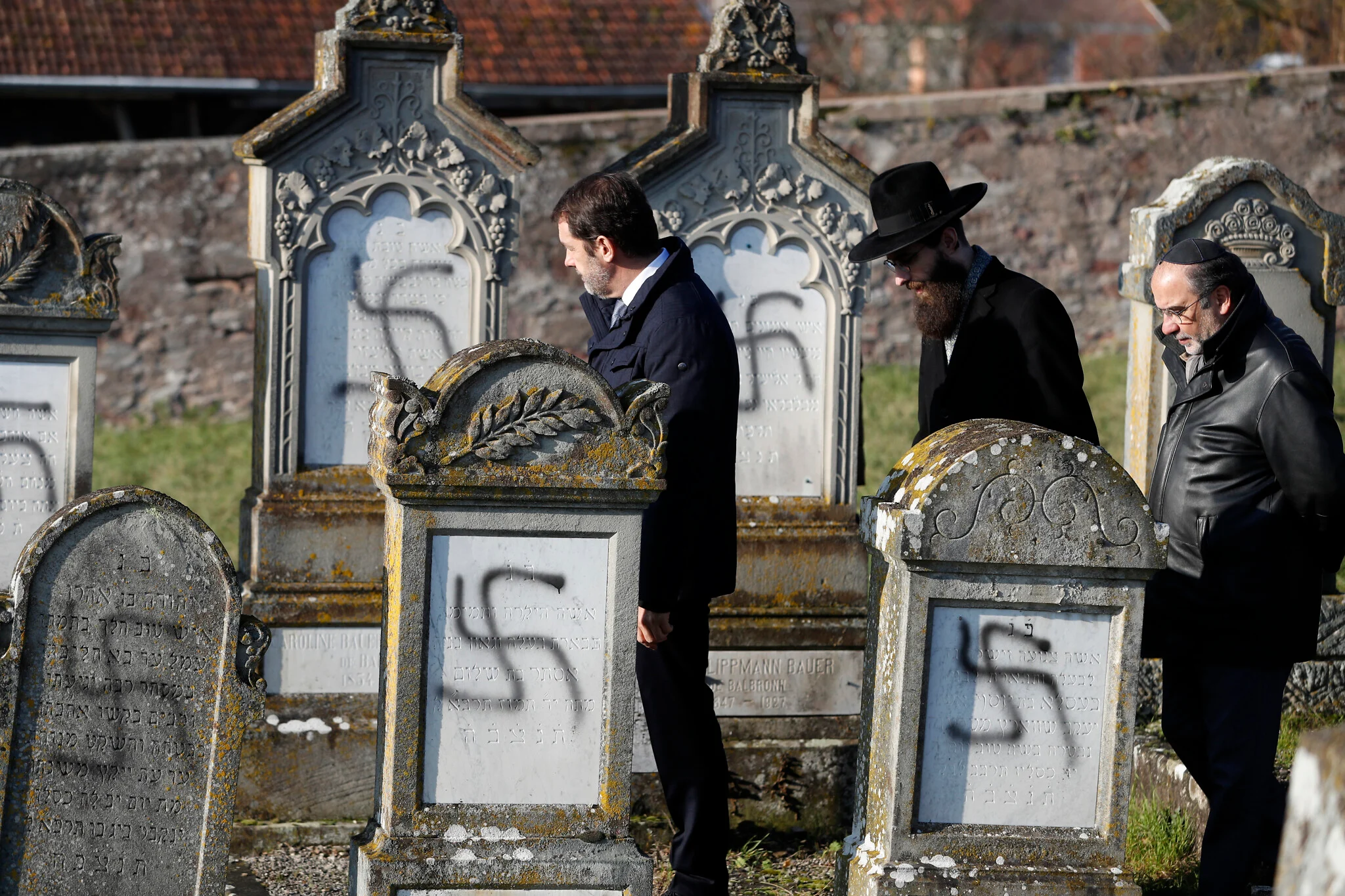
Illustrative: French Interior Minister Christophe Castaner, center, followed by Strasbourg Chief Rabbi Harold Abraham Weill, second right, walk amid vandalized tombs in the Jewish cemetery of Westhoffen, west of the city of Strasbourg, eastern France, December 4, 2019. (Jean-Francois Badias/AP)
For at least 70 years, Europe has lived within a historical exception, mistaking it for normality.
From 1945 onward, the continent experienced an unprecedented phase: prolonged peace, economic growth, political integration, the gradual expulsion of war from everyday language. A span of time long enough to make us believe that history had changed its nature, that violence had become a residue of the past, that conflict belonged to other places and other peoples.
Today, we know this was not the case. That phase was not the rule, but a parenthesis. And like all historical parentheses, sooner or later it closes.
War has returned to the European continent, security has fractured, and the categories we thought we had filed away — border, enemy, rearmament, alliance — have re-emerged with a speed that caught many unprepared. Yet what is striking is not only the return of conflict; it is our difficulty in recognizing it. We have continued to read the present with the tools of the recent past, not with those of the long durée.
Something analogous has happened to European Jews. For them as well, from the postwar period onward, a historically exceptional phase opened up: decades of emancipation, full citizenship, cultural integration, religious freedom, the absence of systematic persecution. A period long enough to suggest that antisemitism had been definitively confined to history textbooks, neutralized by the memory of the Shoah, rendered unviable by civil progress.
Here too, the mistake was to mistake a temporary condition for permanent normality.
In recent years, the Jewish condition in Western Europe has ceased to resemble that of an integrated minority and has begun once again to resemble that of a tolerated, conditioned, observed presence. This is not — at least not yet — persecution in the historical sense of the term. It is something more subtle and, precisely for this reason, harder to name: a progressive narrowing of social and symbolic space.
As with Europe as a whole, for Jews the issue is not the abrupt irruption of danger, but the end of the illusion of permanent security. Antisemitism has not “returned”; it has simply ceased to be repressed by the context. It has found new languages, new justifications, new moral legitimations. It has adapted, as it always has throughout European history.
The parallel is not accidental. The Europe that believed it had left war behind forever is the same Europe that believed it had left antisemitism behind forever. In both cases, this confidence did not rest on a profound transformation of cultural structures, but on a political, economic, and symbolic equilibrium that today shows all its cracks.
When that equilibrium fractures, what had been temporarily contained resurfaces.
It is no coincidence that the rise in hostility toward Jews occurs precisely as Europe experiences the fragility of its order. Minorities become, as always, the surface onto which broader fears are projected: loss of control, decline, the end of certainties. History teaches that antisemitism does not require great moral crises; it suffices that a stability taken for granted comes to an end.
The problem today is not only political. It is conceptual. We continue to think in terms of exception when the exception is over. We continue to speak of “drifts,” “resurgences,” “temporary tensions,” as if the overall framework remained intact. But the parenthesis has closed. And the world that is emerging does not resemble the one we had internalized as normal.
For Europe, as for European Jews, the challenge is not to go back — an impossible task — but to recognize the new historical time we have entered. Only in this way can the gravest mistake be avoided: interpreting the signs of the present as anomalies, rather than as symptoms.
Peace, like the absence of persecution, is not a natural state of history. It is a fragile, reversible, always provisional construction. Forgetting this was understandable. Continuing to forget it today is dangerous.
Related Topics
Related Posts