Journalist & Researcher | Politics, Culture, and Society
Europe Must Not Be Afraid to Defend Secularism
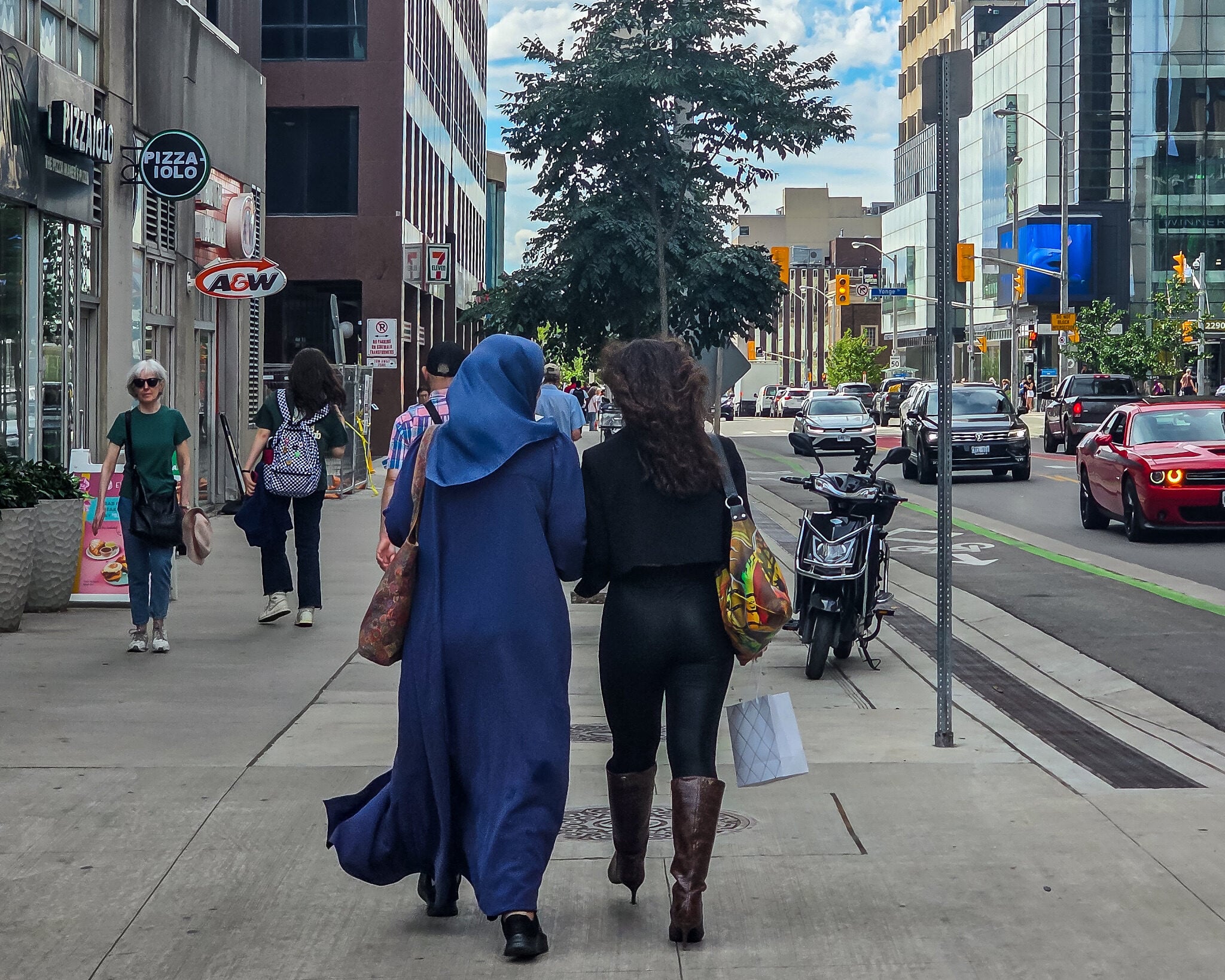
Toronto, Ontario, Canada Septermber 10th, 2026 Photographer: Pouria Afkhami (used with permission)
Growing up in the Islamic Republic of Iran taught me a lesson Europe should not ignore: when religion becomes an instrument of political power, individual freedom is often the first casualty. Defending religious liberty is essential to any democracy, but it must never mean turning a blind eye to ideologies that challenge equality, freedom of conscience, and secular democratic values. Europe must learn to distinguish between protecting people’s right to believe and allowing any religious ideology to dictate how society should live.
Iran’s experience demonstrates how religious ideology can threaten individual freedoms. Europe must protect religious liberty without allowing political Islam to undermine its democratic and secular values.
I grew up in a country whose government claims to represent Islam. Yet living in the Islamic Republic of Iran taught me that a society cannot be defined solely by the official religion of its state. Iran, with its millennia-old history, literature, art, ancient traditions, and cultural diversity, is far more than the image a religious regime seeks to project.
This experience raises a fundamental question for Europe: Does defending religious freedom mean accepting, without reservation, the influence of political Islam in European societies? And in its efforts to combat discrimination, does Europe sometimes risk confusing respect for individuals with a reluctance to criticise ideologies that challenge liberal values?
Being Iranian Does Not Necessarily Mean Being Muslim
Many Iranians, both inside the country and in exile, define their identity through Iranian history and culture, the Persian language, national traditions, or secular values. Some are Muslims, others belong to different religions, and still others profess no faith at all. Iran’s experience demonstrates that a government can turn religion into an instrument of power without necessarily representing the society as a whole.
For those of us who grew up under the Islamic Republic, this is not merely a theoretical issue. We have witnessed restrictions on individual freedoms, legal discrimination against women, and the repression of dissent in the name of religion. Therefore, when we discuss the spread of political Islam in Europe, our concerns do not necessarily stem from individuals’ personal faith, but from the experience of a system that has sought to subordinate every aspect of social life to its official interpretation of Islam.
Europe Must Not Become Indifferent to Threats Against Tolerance
Religious freedom is one of the fundamental achievements of European democratic societies. But it must coexist with freedom of expression, equality between men and women, minority rights, the rule of law, and individual freedom of choice. No religion, ideology, or tradition should be exempt from criticism, particularly when it seeks to restrict the rights of others.
Europe has both the right and, indeed, the responsibility to engage in open debate about whether certain currents of political Islam are compatible with democratic principles. Defending these principles does not mean being Islamophobic or hostile to immigrants. It means protecting precisely those freedoms that allow people to practise a religion, change their faith, or choose not to be religious at all.
The problem arises when tolerance becomes a one-way principle: when, in the name of respecting cultures, society turns a blind eye to discrimination against women, pressure on individuals to conform to religious norms, or attempts to impose religious rules on society as a whole. A genuinely free society cannot ask its citizens to regard as untouchable something that is used elsewhere to restrict their rights.
Immigration and Integration: A Real Challenge Requiring Concrete Responses
Many immigrants from Muslim-majority countries have arrived in Europe to escape war, repression, poverty, or social restrictions. Some are seeking precisely the freedoms denied to them in their countries of origin. Nevertheless, we cannot ignore the fact that some individuals may also bring authoritarian attitudes, religious prejudices, or views on women’s and minority rights that are incompatible with the principles of liberal societies.
Escaping a repressive regime does not automatically mean abandoning the values and beliefs that sustain it. Genuine integration requires recognition of the rule of law, equality among citizens, and fundamental freedoms. This responsibility belongs both to those who arrive in Europe and to European states, which must invest seriously in language learning, social participation, and respect for shared laws.
Simply living in Europe does not mean embracing the principles on which its institutions are founded. Integration should not be measured solely by physical presence or employment, but also by the ability to participate in society while respecting its democratic rules.
At the same time, it would be unjust and counterproductive to attribute these tendencies to all Muslims or all immigrants. Many European Muslims are law-abiding citizens whose values are fully compatible with democracy. Criticising political Islam is not the same as opposing Islam or Muslims.
Defending European Identity Without Discrimination
Europe must be able to distinguish between protecting its cultural identity and discriminating against others. Preserving its historical traditions, its Christian and pre-Christian heritage, and the achievements of the Enlightenment and secularism does not require denying equal rights to Muslim citizens or residents. However, equality of rights cannot be interpreted as a right to impose one’s religious convictions on others.
Secularism is not an attack on religion. It is the principle that no religion should hold a monopoly over public life or determine the rights and obligations of everyone. The state must guarantee freedom of worship while also protecting those who do not believe, those who leave a religion, and those who criticise religious authorities. This distinction is essential. A democracy that protects religious freedom must be equally determined to protect freedom from religious coercion.
What Can Iran Teach Europe?
Iran’s lesson is that no ideology, whether religious or non-religious, should monopolise national identity or dictate the rules of public life. The Islamic Republic demonstrates how individual freedoms can be sacrificed when a particular interpretation of religion becomes the official foundation of political power.
Europe still has the opportunity to learn from this experience—not by excluding Muslims, but by firmly defending secularism, freedom of conscience, equality before the law, and the right to criticise any belief.
As someone who grew up in the Islamic Republic, I would not want Europe to repeat the same mistake that has shaped my country’s recent history: confusing a nation’s identity with an ideology that claims to represent it in its entirety.
Europe can remain a pluralistic society without abandoning its fundamental principles. It can welcome people of different cultures and religions without relinquishing its democratic and secular traditions. And it can defend minority rights without granting any community the power to restrict the freedoms of others.
Coexistence is possible only when no one is forced to sacrifice their freedom to be accepted, and no one is permitted to restrict another person’s freedom in the name of their own culture or religion.