
Russian-American-Israeli Palestinian. Palestine is Israel.
Bye-Bye Eurussia
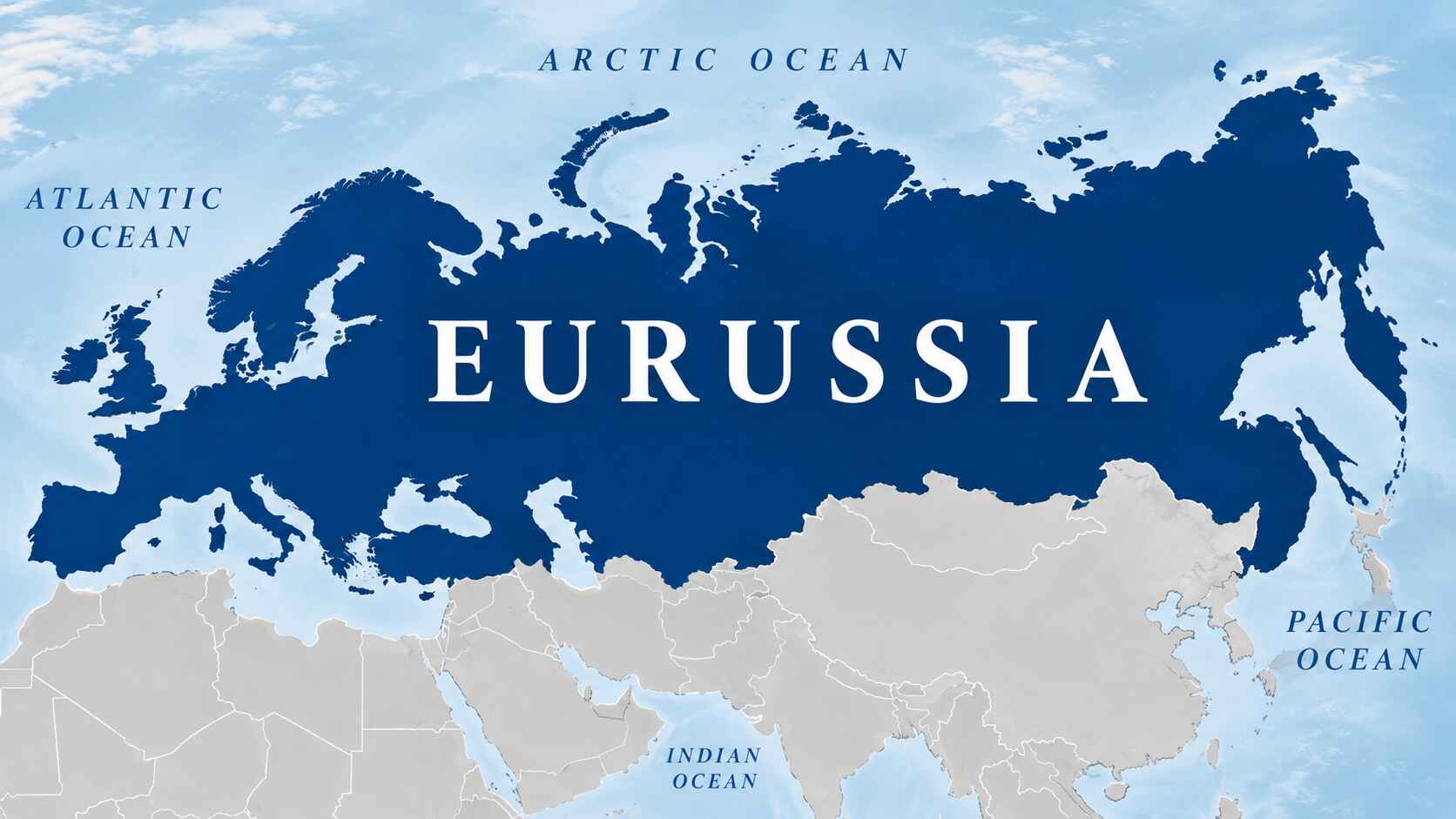
Eurussia: One geographical space. One geopolitical disappointment. Image © Ivan Bassov, 2026. Licensed under CC BY 4.0.
I Don’t Care About Eurussia Anymore
First, a clarification. Eurussia is part of Eurasia. I use Eurussia to designate the geographical space encompassing the whole of Europe and the entire territory of the former Soviet Union, extending from the Atlantic to the Pacific.
It is a geographical term, not a reference to an economic partnership, political alliance, or historical relationship between Europe and Russia. Think of it as a redefinition of Eurasia — Eurussia rather than Eurasia.
It is also my designation for a geopolitical disappointment.
And I have a rather unusual reason for saying goodbye.
The Great European Experiment
Back in 2015, when the European migrant crisis reached its peak, Angela Merkel opened Germany’s doors to hundreds of thousands of migrants, many arriving from Arab and African countries. The decision triggered alarm across Europe. Commentators warned about demographic replacement, the disappearance of European identity, the erosion of national cultures, and the eventual transformation of the continent beyond recognition.
I wasn’t one of those smart people.
Quite the opposite. I actually supported the transformation.
My reasoning was rather unusual, to put it mildly. I regarded European history as one long succession of atrocities: the Roman conquests, the Crusades, the Inquisitions, colonialism, slavery, fascism, Nazism, two world wars, and, ultimately, the Holocaust. Europe had repeatedly demonstrated an extraordinary capacity for organized cruelty.
And Germany was the most troubling example.
Only eighty years had passed since the Holocaust. Had the Germans really changed? Had Europe fundamentally changed? Or had the same societies, cultural foundations, and historical instincts simply been temporarily restrained by defeat, occupation, and the postwar political order?
If you think I’m Germanophobic, you’re right. I’ve visited many European countries, but never Germany, and have no intention of doing so. I don’t buy German products either. No amount of time can erase what the Germans did.
I wasn’t convinced that the old European instincts had disappeared.
I entertained a hypothesis: perhaps Europe needed a new population, a new cultural mixture, a new demographic reality. Perhaps introducing people from outside Europe would dilute the old European gene pool and make another European catastrophe less likely.
I even entertained the thought that Merkel might have understood this herself. Perhaps, deep down, she knew her country’s history better than anyone and was consciously trying to prevent its repetition.
In retrospect, was I really wrong?
Perhaps not entirely.
The Transformation Didn’t Heal Europe
I had imagined demographic transformation as a kind of historical vaccination. Introduce enough new elements into the European system, and perhaps the old European disease would finally disappear.
But the experiment produced something quite different.
Europe did change. Its demographic composition, cultural landscape, and social tensions all changed. The Europe I had known was disappearing.
Yet the transformation did not eliminate the continent’s historical problems. It did not usher in a new era of tolerance, enlightenment, or universal understanding.
Instead, a different set of problems emerged, while some of the old ones returned in new forms.
Most notably, antisemitism and ziophobia once again found fertile ground in the new European environment.
The irony is difficult to miss. A continent that once produced the Holocaust is now witnessing the normalization of rhetoric that demonizes the Jewish state, accompanied by the familiar language of collective Jewish guilt, conspiracy, and dehumanization.
The vocabulary has changed. The targets and political circumstances have changed. But the willingness to single out Jews and Israel remains remarkably recognizable.
I had hoped that changing Europe’s population might change its historical trajectory.
Apparently, changing a population does not change the underlying problems of a civilization.
Welcome to the New Europe
Consider Denmark.
Somali-born Islamic preacher Mohamed Abdi Kahn, who reportedly moved to Denmark with his wife and six children, has articulated a particularly revealing attitude toward his adopted country.
Those who dislike seeing veiled women on Copenhagen’s streets, hearing the muezzin, or encountering demands for Sharia law can simply leave. Denmark, in this worldview, is no longer what it once was, and there is no reason to expect a return to the past.
A country cannot remain a coherent political community if its inhabitants increasingly disagree about what that country is, what rules govern it, and whose authority ultimately matters.
There is an additional complication.
In traditional Islamic political terminology, the world is divided into two broad realms: Dar al-Islam (“Realm of Peace”), the realm under Islamic rule, and Dar al-Harb (“Realm of War”), the realm outside it.
This historical distinction raises an uncomfortable question: what happens when religious-political movements regard secular European societies not as legitimate homes deserving loyalty, but as territories whose laws and institutions should submit to Islam?
If Europe becomes a place where competing political and religious loyalties undermine the common civic framework, what exactly holds it together?
A passport? A residence permit? A welfare system?
None of these creates a shared civilization by itself.
And telling native Europeans that they can simply leave their own countries if they dislike the transformation is hardly a recipe for social cohesion.
The Old Europe Is Not Coming Back
Meanwhile, Europe’s native populations are undergoing their own ideological transformation.
Traditional national identity, patriotism, and cultural continuity increasingly compete with a political culture that treats them with suspicion. European societies are encouraged to embrace ever-expanding ideological definitions of identity, while traditional concepts of nationhood and collective belonging are portrayed as inherently dangerous.
The LGBTQ+ movement, including the increasingly prominent politics surrounding gender identity, has become part of this broader cultural transformation.
There is nothing inherently wrong with protecting individual rights or allowing people to live their lives as they choose. But there is a difference between protecting individual freedom and turning an entire society into an ideological experiment.
The question is not whether people should have rights. They should.
The question is whether a society can maintain a coherent identity when nearly every traditional institution, cultural norm, and inherited value is treated as something that must be dismantled or reinvented.
Perhaps this, too, is another European self-preservation mechanism.
Perhaps the continent has decided that the safest way to prevent another Germany is to make sure Europe can never again mobilize itself as a unified historical force.
If so, the experiment is working rather well.
Europe may have become less capable of repeating its twentieth-century military catastrophes. But it has also become less capable of defending its own interests.
A Continent That Won’t Fight for Itself
A country is more than territory, infrastructure, and an economy. It is a community whose members believe that the country is worth defending.
That belief cannot be manufactured by bureaucrats in Brussels, nor can it be created through citizenship paperwork.
It requires a shared sense of belonging.
What happens when that sense of belonging disappears?
Who will be willing to sacrifice their lives to defend Germany, France, Spain, or Denmark?
A society that cannot agree on what it is will struggle to agree on what is worth defending.
And a society that has lost its sense of national purpose may discover, when confronted with a serious external threat, that its sophisticated economy and impressive military equipment are not enough.
Russia: Another Lost Hope
I remember the late 1980s and early 1990s.
The Soviet Union was collapsing. The Cold War was ending. There was hope that Russia might finally become a normal country and abandon its imperial ambitions.
For a while, it seemed possible.
That hope is gone.
Russia invaded Ukraine and demonstrated that its imperial instincts were very much alive. The old geopolitical reflexes returned, accompanied by nationalism, militarism, repression, and a willingness to sacrifice enormous numbers of people for nothing.
And Europe?
Europe issued statements, imposed sanctions, held summits, and expressed outrage. The war exposed Europe’s dependence, fragmentation, industrial limitations, and difficulty translating political declarations into strategic power.
There is an interesting contrast here.
Russia has chosen militarization and authoritarian social discipline. It has also banned what it officially describes as LGBT propaganda, treating the LGBTQ+ movement as incompatible with its preferred social order.
One might observe that Russia is preparing its society for war while Europe is still arguing about what kind of society it wants to be.
Neither model offers an attractive future.
But the contrast illustrates how differently these societies understand power, identity, and national purpose.
Israel: The Exciting Exception
And then there is Israel.
A country surrounded by enemies, repeatedly threatened with destruction, and constantly subjected to international condemnation has demonstrated remarkable political, social, military, and institutional resilience.
Israel’s resilience is particularly striking when compared with Europe’s increasingly fragmented societies. The very country that European political circles so frequently lecture about morality, international law, and human rights currently possesses something that much of Europe is struggling to preserve: a strong sense of national belonging and a willingness to defend its existence.
And the irony becomes even greater when one considers how normalized anti-Israel rhetoric has become in Europe.
Europe can be extraordinarily vocal against Israel while increasingly uncertain about its own future.
Perhaps Europe should spend less time explaining how Israel ought to survive and more time figuring out how Europe intends to survive.
The Lost Continent
I once had hopes for Europe.
I once had hopes for Russia.
I even supported the grand European demographic transformation, thinking it might prevent the continent from repeating its darkest chapters.
I was wrong about the outcome.
Europe has not been healed. Russia has not been transformed into a peaceful country. The space between them has become increasingly associated with war, instability, ideological confrontation, and political exhaustion.
Perhaps Eurussia is the appropriate name after all.
Both a continent in the geographical sense and a geopolitical and civilizational space that cannot reconcile its past, cannot agree on its present, and cannot articulate a credible future.
I don’t know what could heal Europe. I don’t know what could heal Russia. And I certainly don’t see what could restore the promise of a Eurussian future.
I once thought changing Europe and Russia would save them from themselves.
Now I suspect that nothing can. Eurussia is rapidly losing its relevance.
I don’t care about Eurussia anymore.
Bye-bye Eurussia.
Related Topics