Eurovision Song Contest 2026: United By Music, After All
A few weeks have passed since the confetti was swept from the arena floor in Vienna, which hosted the 70th Eurovision Song Contest, the world’s biggest live televised music event, drawing more viewers annually than the Super Bowl.
Each year, countries from across Europe, plus Israel and Australia, send a single entry to compete on one stage, performing original songs live. No lip-syncing. No major backing tracks. Just voices, instruments, brilliant staging, and the kind of unscripted drama that almost no other event on earth can replicate. Past winners include ABBA, who went on to become one of the best-selling music acts in history, and Celine Dion, who launched her global career from that very stage when she won the contest for Switzerland in 1988.
This year, however, the contest was also overshadowed by significant political controversy. Five European countries (Spain, Ireland, the Netherlands, Iceland and Slovenia) withdrew from the competition in protest of Israel’s inclusion, making it one of the most politically charged editions in the contest’s 70-year history. As the dust from that storm begins to settle, a fascinating picture of the contest’s true global impact has emerged.
Last Friday, the European Broadcasting Union (EBU), the world’s foremost alliance of public service media organizations and the body that produces and owns the Eurovision Song Contest, released its official viewership and engagement data. The headlines focused on what was lost: with five countries absent, total viewership dropped by around 20 percent.
But look past the top line, and a different story emerges, one that matters far more, I think, to anyone who cares about what Eurovision actually does in the world.
Young people watched in record proportions. Engagement across digital platforms reached new highs. And crucially, even in the five countries whose broadcasters withdrew, audiences still found ways to tune in. The contest’s hold on the generation that needs human connection most did not weaken. It grew.
As a PhD student in Happiness and Flourishing Sciences, that is the finding I cannot stop thinking about. And it is where I want to begin.
Why Young People Watching Eurovision Is a Bigger Story Than the Boycotts
We are living through what researchers now call the loneliness epidemic. The 2025 and 2026 World Happiness Reports paint a consistent and sobering picture: nearly one in five young people globally, between the ages of 13 and 29, reports having no one they can count on for social support. Despite widespread hope that connection would rebound after COVID-19, youth loneliness never returned to pre-pandemic levels. The U.S. Surgeon General declared it a public health epidemic.
The finding that matters most here is simple: happiness is not built on passive consumption. It is built on shared, meaningful, live human experience. Real connection is what heals loneliness. Not scrolling. Not spectating alone. Belonging.
That is precisely what Eurovision offers.
The EBU data confirms that in 2026, despite the political storm surrounding the contest, young people found it anyway, in Vienna, in Eurovision gatherings all over the world, and in living rooms across countries whose broadcasters had walked away. The boycott did not sever the audience. It could not, because the bond between Eurovision and its community runs deeper than any broadcaster’s decision.
Martin Green CBE, Director of the Eurovision Song Contest, said it plainly in Friday’s release: the contest has a unique ability to bring people together live at scale. This is not a marketing line. It is a description of one of the most powerful mechanisms we know for combating isolation.
It is also, in essence, the contest’s official motto.
“United by Music” is not just a tagline printed on banners and broadcast graphics. It is Eurovision’s stated mission. And this year, with five countries staying home over Israel’s participation, many commentators argued the opposite was true: that the contest was less “United by Music” than “divided by politics.” I understand why people feel that way. But I think they are missing something important.
History has shown, time and again, that the arts and music, much like sport, can bridge divides that politics cannot. The Olympic Games gather nations in open conflict. A World Cup stadium holds fans from countries whose governments will not share a diplomatic table. Eurovision was founded on this same premise. Born in 1956 in the shadow of the Second World War and at the height of the Cold War, its mission was to use shared culture to forge genuine human connection across a divided continent.
Boycotting the contest may make a political statement, but it also removes one of the few remaining stages where that connection can actually thrive.
Five Countries Away. The Friendships Still There.
Before a single note was sung in Vienna, the public broadcasters of Spain, the Netherlands, Ireland, Iceland and Slovenia withdrew because Israel was permitted to participate. It was the largest political boycott in Eurovision history, in what should have been a purely celebratory year.
As an Israeli, the decision felt bittersweet. I was relieved Israel was allowed to participate, but heartbroken to see five countries absent. And my heartbreak was not political. It was personal.
After attending Eurovision in person 22 times, I have friends from every single one of those five countries. I thought of Kiko from Spain, Dermot and Keith from Ireland, Ralf and Dennis from the Netherlands, and Flosi from Iceland. I knew how much each of them would have loved to be there, to cheer for their artists, wave their flags, and take part in a historic anniversary, a show they love as much as I do. Knowing they could not share that with me made me genuinely sad. That is what happens when politics enters a cultural space meant for shared joy. It does not only separate governments and broadcasters. It separates people from one another.
But here is what gave me hope. The decision to withdraw belonged to the broadcasters, not to the fans. And as the EBU data confirmed, it did not belong to many of their fans at all. Plenty tuned in anyway, and some even traveled to Vienna to attend the live shows and events during Eurovision week. The broadcasters made a choice. Their citizens, in large numbers, made a different one.
On Voting, Emotion, and Eurovision’s DNA
A major article published by The New York Times during contest week questioned whether Israel’s public voting support in recent years had been fairly earned. The piece focused on a striking discrepancy: in both 2024 and 2025, professional juries who cast 50 percent of the votes placed Israel 14th, while the general public voted Israel second and first respectively. The Times did not accuse Israel of technical manipulation. The reporters explicitly noted there was no evidence of bots or covert interference. Instead, they questioned whether highly organized mobilization campaigns had exploited vulnerabilities in the voting system.
But voting is not a science. It is human nature. And Eurovision’s history is full of moments that remind us of that.
In 2022, Kalush Orchestra from Ukraine won only months after Russia’s invasion began. “Stefania” was a worthy winner, musically distinctive and emotionally powerful, but the historic public vote it received was also a clear expression of solidarity with a country under attack. No serious commentator called that unfair. It was called human.
This is part of Eurovision’s DNA. People do not just vote for songs. They vote through emotion, memory, identity and empathy. Sometimes because a song is brilliant. Sometimes because a country’s story touches them. Sometimes out of solidarity. When audiences across Europe support Israel, that should not be automatically treated as manipulation. Eurovision has always made room for emotion. It always will.
This year, the contest delivered one of those classic moments that remind us why we love it. Bulgaria’s DARA won magnificently with “Bangaranga,” earning 516 points and giving her country its first-ever Eurovision victory in a photo-finish finale that had the entire Stadthalle holding its breath. Israel’s Noam Bettan, representing his country with the heartfelt song “Michelle,” finished second with 343 points.
It is also worth noting that, after two years in which some professional jurors publicly suggested they would not vote for Israel because of the war, this year felt different. To me, that mattered. A jury’s role should be to evaluate the song, the performance, the vocals, the staging and the artistic package, not to punish an artist for the actions of a government.
The music delivered. The contest delivered.
Vienna: It Feels Great to Feel Safe Again
Here is what I want to say that I have not seen written anywhere else.
Vienna was the first time since 2023 that I felt genuinely safe being openly Israeli at Eurovision.
That sentence should not need to exist. But it does, and I want to be precise about what I mean. Malmö in 2024 and Basel in 2025 were, in purely physical terms, among the safest places on earth during those contest weeks. The security services in both cities did an extraordinary job, and I say so without reservation. But physical safety and psychological safety are not the same thing.
You can be surrounded by barriers and hundreds of officers and still feel exposed, especially when, as happened to me personally in 2024, you have received death threats online for supporting Israel. The security kept us safe. It could not make us feel safe.
Vienna was different. The ceasefire agreement between Israel and Hamas that ended the war in Gaza last October had changed the atmosphere in ways that were hard to quantify but impossible to miss. The acute anger of the previous two years had not disappeared, but it had shifted. There was more room to breathe.
There was still booing when Israel performed, including a protester screaming during the first semi-final. There were still fans who turned their backs. I want to be honest about that. I also want to say something that may surprise people: I believe in the right to peaceful protest. I do not enjoy being booed, and I do not think it belongs in a music contest. But turning away, holding a sign, choosing silence, that is legitimate.
What is not legitimate is threatening someone’s safety.
In Vienna, for the first time in years, it felt like that line was being held.
When Noam Bettan’s “Michelle” rang out across the Stadthalle, the vast majority of people listened and sang along. Fans from across Europe came up to me and my fellow Israeli supporters to express their love of Israel’s Eurovision history and their hope that the contest could remain what it was always meant to be.
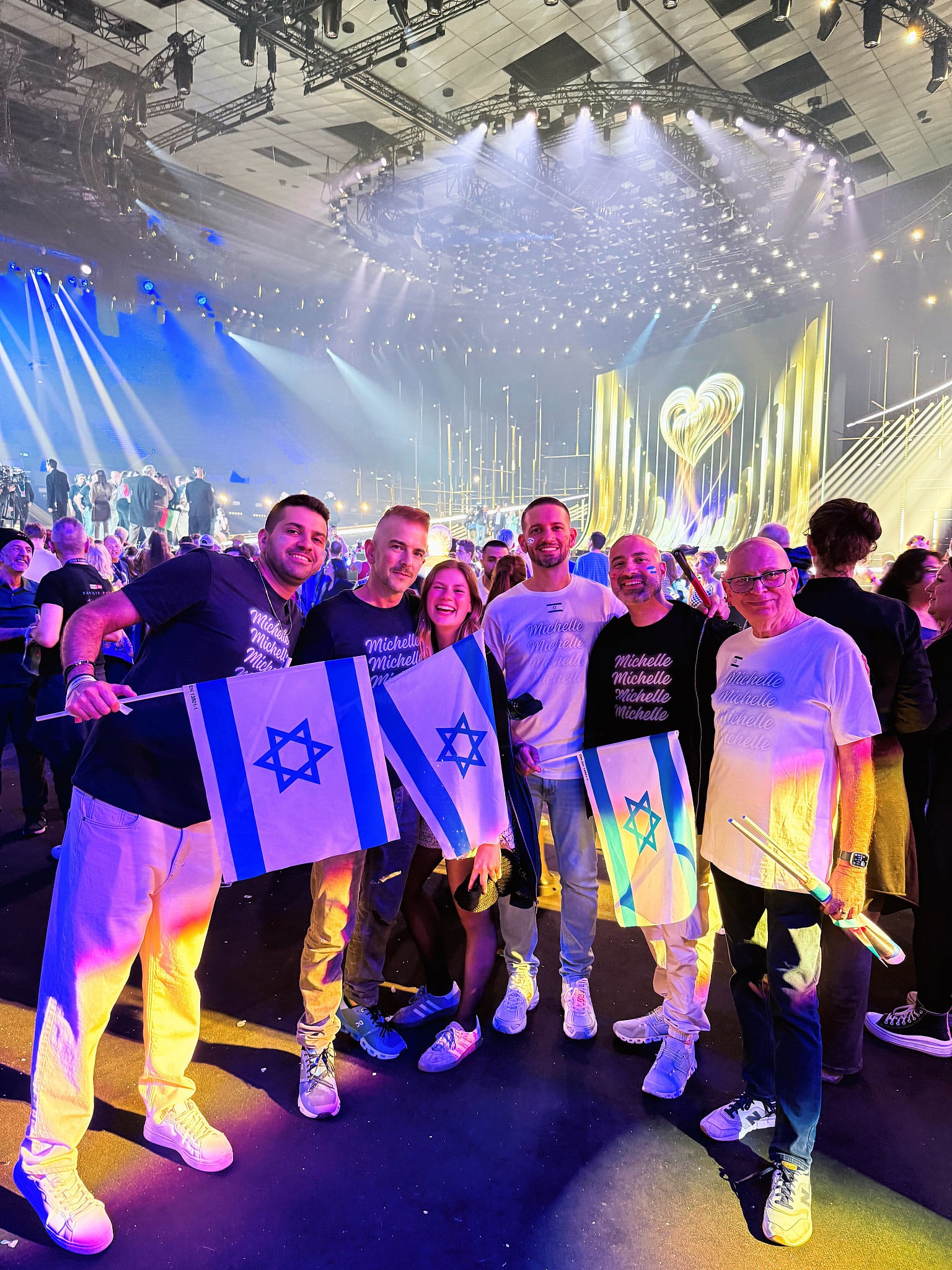
For the first time in years, I let myself be fully visible. I wore the T-shirt we designed in support of Noam and his entry. I waved the Israeli flag. I had the flag painted on my face. For an Israeli Eurovision fan in 2024 or 2025, these were not ordinary things. This year, they felt like reclaiming joy.
I stood in a crowd of thousands, openly and proudly myself, and felt met not with hostility, but with music.
That moment, small and enormous at once, is what I came to Vienna for. And it is what the political coverage of Eurovision 2026 will almost entirely miss.
United By Music, After All
Much of the commentary around this year’s contest leaned into the “divided by politics” framing I mentioned earlier. I understand why. But I was there, with a flag painted on my face, surrounded by people from 75 countries who had all chosen to show up. I watched young audiences across Europe, including in countries whose broadcasters had walked away, find and celebrate the music anyway. I watched Israeli fans feel welcomed in a way we had not felt in years.
That belongs in the record of what Vienna 2026 was.
When we look back at this year, we should not remember it as a contested edition defined by empty dressing rooms. We should remember it as the year the contest proved its resilience. Boycotts operate on the assumption that cutting ties is the only way to navigate a complex world. What I witnessed confirms the exact opposite: real connection is built through continued presence and dialogue, not through absence.
Eurovision is about the friendships. The ones formed in arena queues, at Eurovision parties and in hotel lobbies at five in the morning. The ones that cross borders, languages and political divides. The ones with Kiko and Dermot and Keith and Ralf and Dennis and Flosi, friends I was missing this year, whose broadcasters made a decision that was not theirs to make. Those bonds did not fracture. They never do. Because we choose, every May, to prioritize human connection over political alignment.
As someone who studies happiness and flourishing, I can say with confidence that what Eurovision produces goes well beyond a contest and a good time. It generates positive emotion, meaning, ritual, identity, shared joy and lasting friendship. These are the building blocks of wellbeing, precisely what the World Happiness Reports are urging us to rebuild in a world growing lonelier by the year. Human connection is not a luxury. It is the single strongest predictor of happiness we know. Eurovision, at its best, is one of the most powerful engines for creating it.
So was Eurovision 2026 United by Music after all?
For me, yes. Not perfectly. Not without complexity. But yes, in the friendships, in the young people across the world who watched and voted and gathered, in the Israeli fans who finally felt safe enough to wave their flags and simply be themselves, and in the hope that Spain, the Netherlands, Ireland, Iceland and Slovenia will walk back through the door next year.
When we meet again in Bulgaria in May 2027, I believe there will be more flags, more songs, longer lines at the Eurovision parties, more friendships, and more reasons than ever to keep believing in the mission.
United by Music. After all.