
Evangelical Civil Society Diplomacy: Advancing Cooperation with Israel
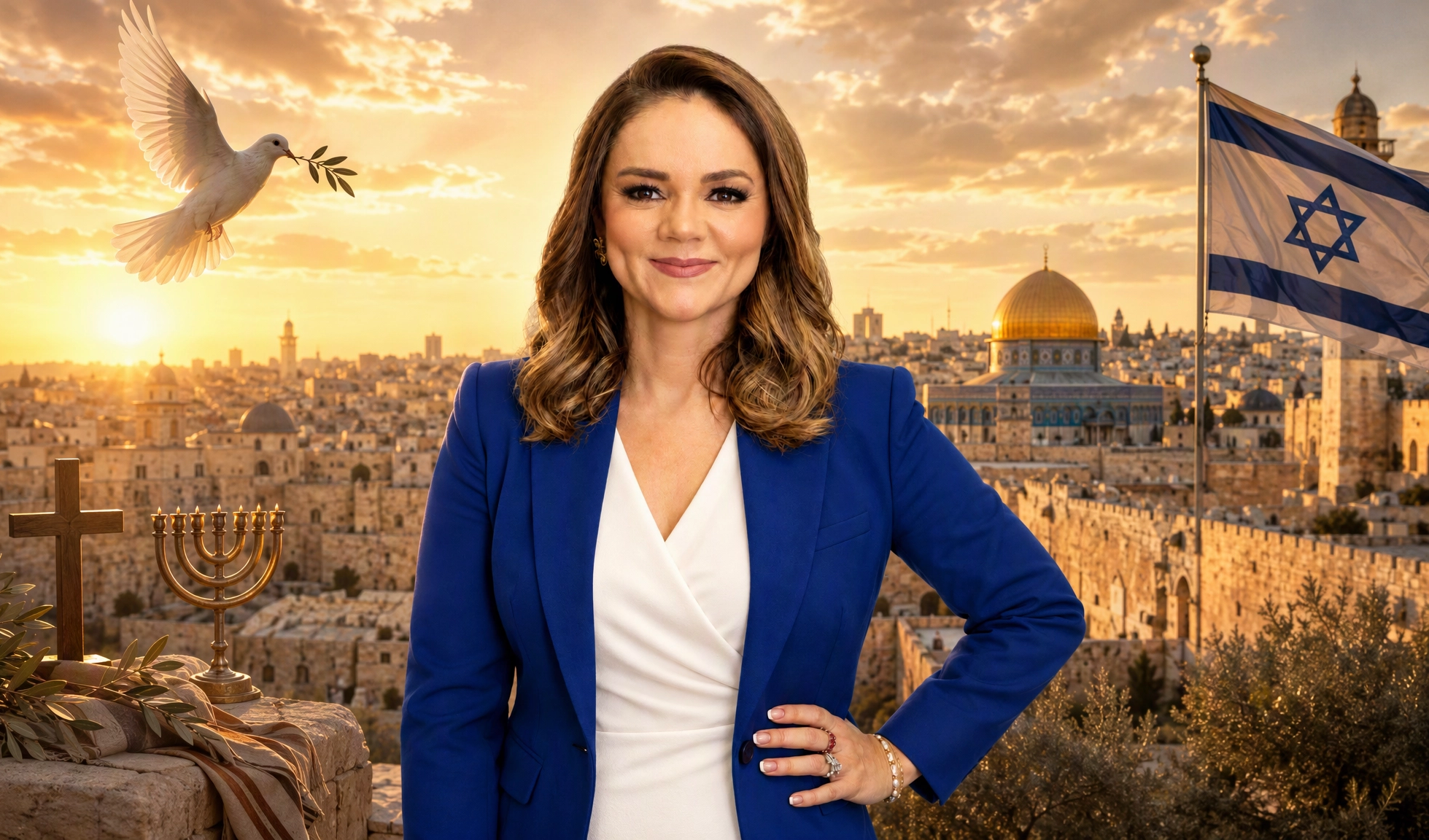
In a special lecture, Maria Alessandra da Silva—president of Shabat ITAN and Club Shalom in Brazil—will share her perspective on the relationship between evangelicals and Israel. Recognized as a prominent voice in advancing peace and fostering cooperation among nations, she leads international networks dedicated to prayer and development. In her remarks, she will highlight the profound spiritual and historical bond evangelicals maintain with Israel, viewing the nation not only as a strategic ally but also as a biblical symbol of promise and faith. Her insights aim to strengthen bridges of dialogue and solidarity, showing how this connection continues to shape both spirituality and contemporary diplomacy.
About Maria Alessandra da Silva
Maria Alessandra da Silva is president of Shabat ITAN, an international network of women who pray and work for the peace of Israel and the nations. She also presides over Club Shalom—the Association of Former Fellows of the State of Israel in Brazil—affiliated with the cooperation network of MASHAV, Israel’s Agency for International Development Cooperation, and is vice president of the Latin American Network of Israel Alumni, headquartered in Lima, Peru.
Evangelicals and Israel: A Dialogue of Faith and Diplomacy
Relations between peoples are sustained by more than the formal diplomacy of states. Their continuity also depends on the bonds forged by civil society, bonds capable of outlasting changes of government, withstanding political fluctuations, and lending permanence to commitments that transcend the circumstantial interests of any given administration.
In this context, the diplomacy of evangelical civil society constitutes an asset of particular importance to relations between Brazil and Israel. Its strength derives from the religious and historical affinities that draw these communities together, but also from a commitment embraced out of a sense of duty, moral responsibility, and awareness of a shared mission. Its potential lies, above all, in its capacity to translate these affinities into lasting initiatives, giving concrete expression to solidarity.
One of the most significant manifestations of this rapprochement is religious tourism, which accounts for a considerable flow of visitors and for successive opportunities for exchange between Brazilian and Israeli society.
According to a survey by Israel’s Ministry of Tourism, evangelicals represented approximately 13 percent of foreign visitors in 2019, or some 590,000 people. A study covering 2018 found that 54.9 percent of international tourists were Christian, of whom 30.6 percent identified as Protestant, while 24.3 percent of all respondents cited pilgrimage as the purpose of their visit.
Brazil occupies a prominent place in this movement. According to data compiled by Statista, the number of Brazilian tourists in Israel rose from 62,700 in 2018 to 82,100 in 2019, an increase of roughly 31 percent. In 2022, as international tourism was recovering from the pandemic, 64,800 Brazilian visitors were recorded. A study published in 2023 in the journal Ciencias Sociales y Religión, drawing on Frossard (2013), cites a historical estimate according to which approximately 80 percent of Brazilian tourists visiting Israel were evangelicals. Although it is not an up-to-date official statistic, the figure illustrates the traditional importance of this segment to Israeli religious tourism.
The pandemic and, subsequently, the terrorist attacks of October 7, 2023, and the war that followed profoundly disrupted this exchange. Yet the decline in tourism also underscored the importance of preserving ties that do not depend solely on the movement of visitors or on political circumstances.
The value of these pilgrimages, after all, extends beyond their economic or spiritual dimension. Contact with Israeli history, culture, society, and institutions can serve as the starting point for broader relationships of trust and collaboration. For this rapprochement to yield lasting effects, however, individual experiences must find continuity in networks of cooperation.
My conviction on this matter has matured over the years in which I have served as president of Club Shalom—the Association of Former Fellows of the State of Israel in Brazil—within the framework of the cooperation promoted by MASHAV, Israel’s Agency for International Development Cooperation, founded in 1958 out of Golda Meir’s vision.
The MASHAV experience offers a particularly valuable lesson: international cooperation achieves greater depth when it invests in training people capable of multiplying the knowledge they acquire. Upon returning to their countries, participants disseminate skills, develop projects, train new leaders, and extend the reach of these initiatives. Cooperation thus ceases to be confined to the experience of those who received it and begins to benefit entire communities.
This conception of influence is especially relevant in an age in which digital visibility is often mistaken for the capacity to mobilize. Social media are valuable instruments of communication, but the breadth of an audience does not, in itself, guarantee the depth of the bonds created or the permanence of the results achieved.
MASHAV’s method proposes a different measure of impact: not how many people follow an initiative, but how many become capable of carrying it forward. True influence is measured not by the visibility of those who lead, but by their ability to cultivate others who will sustain, advance, and carry their work forward.
This perspective brings into view an often underestimated dimension of the Brazilian evangelical presence: the leadership exercised by women within their communities.
According to data from the 2022 Demographic Census, released by the Brazilian Institute of Geography and Statistics (IBGE) in June 2025, approximately 47.4 million Brazilians aged ten or older identified as evangelical, corresponding to 26.9 percent of the population in that age group. Of this total, 55.4 percent were women—roughly 26 million Brazilians.
The significance of these women, however, is not limited to their demographic weight. They are leaders who organize networks of solidarity, lead ministries, develop charitable initiatives, take part in religious education, and transmit values across generations. Many exercise decisive influence without occupying the most prominent spaces of public life. Their standing is born of trust; their authority is consolidated through presence, commitment, and service. They thus represent an extraordinary reservoir of social capital, whose importance remains insufficiently recognized by traditional politics and diplomacy.
Recognizing this potential and transforming it into organized cooperation is one of the inspirations behind Shabat ITAN, an international network of women for the peace of Israel and the nations and for cultural cooperation.
Our purpose is to bring together Christian, Jewish, and Muslim women through interreligious dialogue, the promotion of peace, the fight against antisemitism, and the pursuit of joint initiatives. The name itself expresses this vocation: in Hebrew, eitan evokes steadfastness and perseverance—virtues we seek to embody in sustained action, capable of turning affinities into shared commitments.
Launched in Brasília in September 2024, Shabat ITAN brought together women leaders from diverse religious traditions, civil society representatives, and public officials, laying the foundation for sustained dialogue, mutual understanding, and interfaith cooperation. On its first anniversary, we held an interreligious celebration in the Chamber of Deputies, with the support of legislators from both houses of the National Congress.
In March 2026, more than seventy Jewish, Christian, and Muslim women leaders took part in a new gathering in the federal capital. On that occasion, the movement formally adopted the Working Definition of Antisemitism of the International Holocaust Remembrance Alliance (IHRA), joining the more than 1,300 organizations worldwide that had endorsed this instrument.
This same disposition toward dialogue informed our participation, on July 8, 2026, in the presentation of the document Manifesto e Compromissos (Manifesto and Commitments), promoted by evangelical leaders in partnership with Casa Apostólica and addressed to the Jewish community and to Brazilian society, which was formally submitted to the Chamber of Deputies and the Federal Senate.
These experiences confirm that rapprochement between religious communities acquires greater meaning when it is translated into recognizable commitments, networks of collaboration, and initiatives capable of outliving the encounters that gave rise to them.
Diplomatic relations between Brazil and Israel may go through periods of greater closeness or distance, depending on the orientation of each government. The bonds built between their societies, however, need not mirror these fluctuations entirely. On the contrary, they can provide a dimension of continuity and trust precisely when political dialogue becomes more difficult.
The most enduring contribution of civil society diplomacy lies in its capacity to strengthen bonds, cultivate leadership, and expand opportunities for cooperation. Its legacy is measured not by the individual prominence of those who advance it, but by the strength of the institutions and initiatives they help establish, the continuity of the commitments they inspire, and their ability to entrust future generations with the responsibility of sustaining and advancing that work.
This is the diplomacy we wish to strengthen between evangelical and Jewish communities, and between Brazil and Israel.