
Nothing is ever just one thing.
Zionism Begins in the Bible
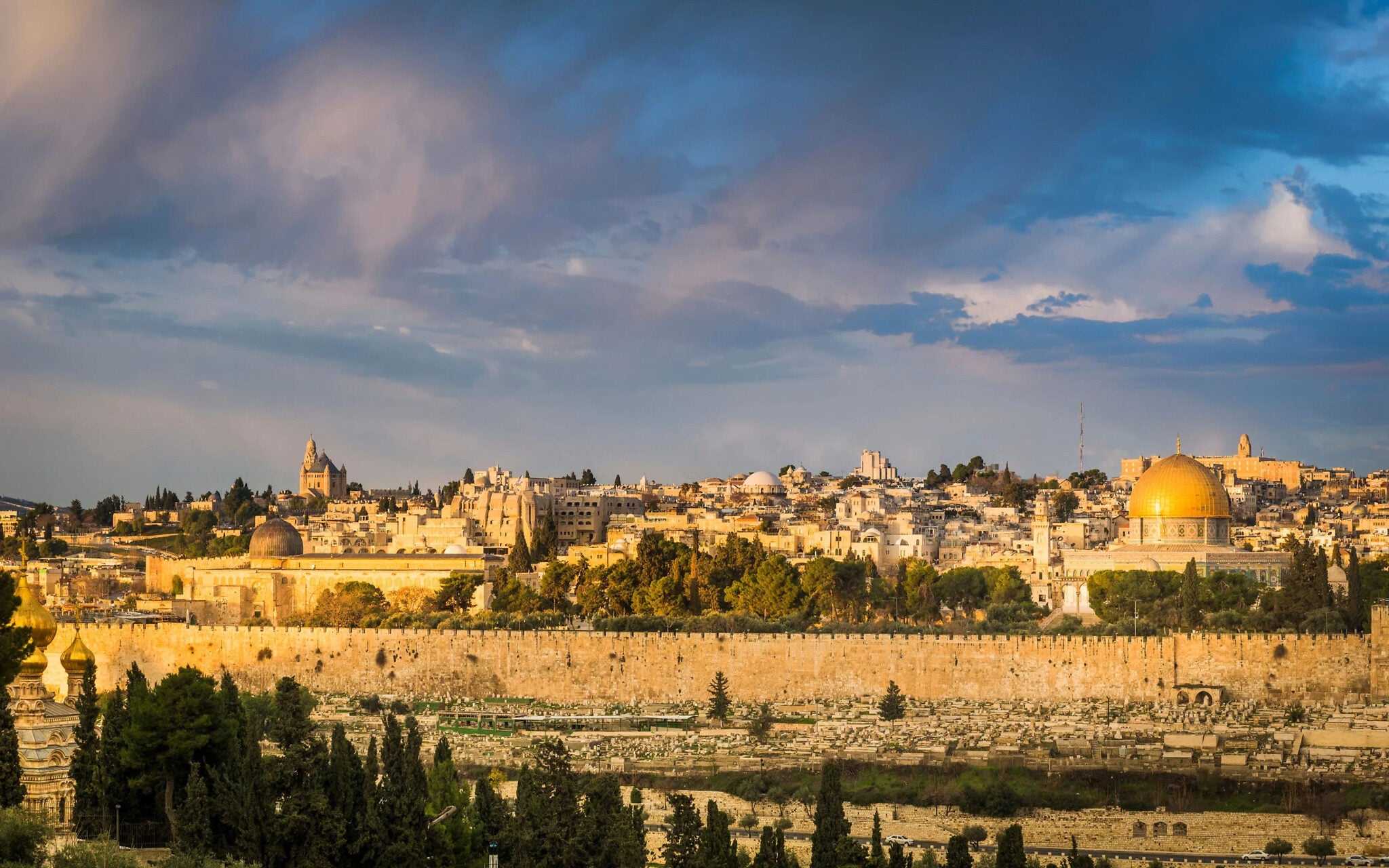
Jerusalem from the Mount of Olives, where the disciples asked Jesus whether he would now restore the kingdom to Israel.
In late October 2025, Tucker Carlson sat down with Nick Fuentes and called Christian Zionism a heresy and said Christian Zionists were seized by a brain virus. He said he dislikes Christian Zionists more than anybody, “because it’s Christian heresy and I’m offended by that as a Christian.” He later apologized for saying he despised them, calling them some of the nicest people he knows. He kept the heresy charge.
Weeks before that interview, in early October 2025, Carlson had already given the theology behind it. He said the chosen people are those who choose Jesus, and he called it the oldest Christian heresy to believe God prefers anyone by their DNA.
Christians have been having versions of this argument for nearly two thousand years. There is a name for the theology that transfers Israel’s covenant promises to the church: replacement theology. It has a long history, and I’ve spent much of the past week writing about what happened when Christians adopted it.
Heresy is a theological word. It deserves a theological answer.
Why Did God Choose Israel?
Before we get to Zionism, we need to go back to Abraham. In Genesis 12, God calls a man out of his homeland and promises to make a great nation of him. Through him, all the families of the earth will be blessed. Five chapters later, God establishes an everlasting covenant with Abraham and his descendants and promises them the land of Canaan (Genesis 17:7–8).
By the time we reach Deuteronomy, Abraham’s descendants are standing on the other side of the Jordan River, preparing to enter that land. Moses tells them why God chose them. The LORD set His love on Israel because He loved them and was keeping the oath He had sworn to their fathers (Deuteronomy 7:7–8).
The reason God gives for choosing Israel is His own love and His own promise. Election tells us something about the character of the One who chooses.
Paul understands it the same way. In Romans 11, he is writing to Gentile Christians about the Jewish people, including those who have yet to embrace Jesus as Messiah. He describes them as beloved for the sake of their forefathers and explains why: “For the gifts and the calling of God are irrevocable” (Romans 11:28–29).
Paul is writing after the crucifixion, after the resurrection, and after the message about Jesus has begun spreading throughout the Gentile world. He still grounds Israel’s election in the promises God made to their ancestors.
Carlson’s question about DNA leads us to look for an explanation in human biology. Moses and Paul lead us to look for it in God’s character.
Three Hebrew Phrases
There are three Hebrew phrases I wish every Christian knew: Am Yisrael, the people of Israel; Torat Yisrael, the Torah of Israel; and Eretz Yisrael, the Land of Israel. Christians study the second one for a lifetime and leave the other two alone. Learn all three and the Bible reads differently.
Follow the story from Genesis to Deuteronomy. God calls Abraham and promises him descendants and a land. Those descendants eventually find themselves enslaved in Egypt. God brings them out, gives them His Torah at Sinai, and leads them toward the land He promised their fathers. At the covenant ceremony described in Deuteronomy 27:9, Moses tells Israel that on this day they have become the people of the LORD their God.
The people, the Torah, and the land belong to the same story. God establishes His relationship with a particular people, gives them instructions for living as His people, and gives them a place in which to live out that relationship.
Centuries later, when the Babylonians destroy Jerusalem and carry its inhabitants into exile, the prophets speak of a day when God will gather His people and bring them home. Ezekiel 36 describes that restoration in extraordinary detail. God promises to gather Israel from the nations, bring them into their own land, cleanse them, and give them a new heart and a new spirit (Ezekiel 36:24–28). The spiritual and the territorial promises sit within the same passage.
Here is what changes. A Christian who studies the Torah alone meets a set of instructions and the God who gave them. A Christian who holds all three meets a covenant God made with a particular people, in a particular place, that He intends to keep. The land promises stop reading as scaffolding the New Testament took down, and start reading as part of the same covenant as the promise of a new heart.
Zionism gets used as a cuss word now. The word is young. Nathan Birnbaum coined it in his Vienna journal in 1890, and he first used it in public in January 1892. Zion is another thing. It stands in 153 verses of the Hebrew Bible, most of them in the Psalms and the prophets. The movement has a founding date, and the hope it was named for runs back through those verses.
In its modern political sense, Zionism concerns the right of the Jewish people to national self-determination in their ancestral homeland. For Christians, there is also a theological question underneath it. What do we believe about the promises God made concerning that people and that land?
My support for Jewish national self-determination begins in the pages of Genesis. Borders, governments, and policy are a separate argument, and I hold opinions there like any citizen. What I believe about this people and this land starts in the covenant.
Truly God and Truly Man
Gabriel Gordon is a theologian trained in early Greek and Syriac Christianity. In an interview with Israel365 News, he takes the people, the Torah, and the land further than most Christians do, connecting them to a doctrine Christians have confessed for centuries: the full humanity of Jesus.
The early church spent much of its first four centuries working through what it meant to confess Jesus as both God and man. Some teachers claimed that Jesus only appeared to be human. Others gave him a human body while assigning the functions of the human mind to the divine Word. Still others understood him as a being inferior to God. Every one of those teachings changed what happened at the cross. A Jesus who only seemed human only seemed to die.
In 451, the Council of Chalcedon affirmed that Jesus was truly God and truly man, possessing a rational soul and a human body, sharing our humanity in every respect apart from sin.
Those are the arguments the church actually called heresy. Each one concerned what Jesus was.
The biblical ground for that confession is familiar to most Christians. The first chapter of Hebrews describes Jesus as the radiance of God’s glory. In the second chapter, the writer explains why Jesus had to be made like his brothers in every respect (Hebrews 2:17). Both descriptions belong to the same person.
Gordon asks us to follow that second chapter where it leads. Every human being comes into the world through a particular family, belongs to a particular people, and inherits a particular history. What did that look like for Jesus?
Paul opens his letter to the Romans by describing Jesus as a descendant of David according to the flesh (Romans 1:3). In Galatians 4:4, he tells us that Jesus was born of a woman and born under the law. Luke tells us about his circumcision, his presentation at the Temple, and his family’s annual journey to Jerusalem for Passover. The adult Jesus continues to observe the festivals of his people and goes to Jerusalem to celebrate them.
These are some of the details the biblical writers give us about what the incarnation looked like. When God took on human flesh, He entered the history of the people with whom He had made a covenant.
Christians tend to file the Jewishness of Jesus under biography. His argument moves it under doctrine.
A People and Its Land
This is where Gordon brings us back to the relationship between the Jewish people, the Torah, and the Land of Israel. If Jesus’ full humanity includes his membership in the Jewish people, Gordon argues, then we have to ask what that membership entailed.
The passage he leans on hardest comes from Isaiah 62. The prophet is speaking about the restoration of Zion and Jerusalem. The land has been described as desolate, and its people as forsaken. God promises that both will receive new names. The name given to the land is Beulah, meaning married.
Follow what Gordon does with that name. Isaiah describes the bond between a people and their land as a marriage. Gordon reads that alongside Genesis 2:24, where a husband and wife become one flesh. A marriage makes two into one, so the land is part of who this people is rather than property they happen to hold.
That is what brings him back to Jesus. If belonging to the Jewish people includes the land, and if Jesus’ humanity includes his membership in that people, then the land belongs to the human life God took on. This is the step where most Christians will want to slow down.
The early church’s answer to those teachers gives Gordon his starting point. The Hebrew Bible gives him the grounds for taking the argument further.
There is something else I would add. In Acts 1, Jesus spends forty days with his disciples after his resurrection, teaching them about the kingdom of God. When they gather with him before his ascension, they ask whether he will now restore the kingdom to Israel (Acts 1:6). Jesus answers their question by telling them that the Father has established the times and seasons by His own authority (Acts 1:7).
Forty days of teaching from the risen Messiah, and his disciples are still expecting the restoration of Israel. Jesus corrects their timing and leaves their expectation standing. The restoration they asked about is still ahead. Their expectation belongs to the world of the prophets they had been reading all their lives.
A Christian who wants to know the human Jesus should read the books his friends had been reading all their lives.
Where I Stop
Gordon takes one further step. He concludes that a Christian has to be a Zionist.
His sentence means one of two things. It can mean that reading the Bible honestly brings a Christian to the covenant God made with the Jewish people, the land included. That is Zionism in the sense I have used it all through this essay, and I believe it. It can also mean that a Christian who believes otherwise has left the faith. I stop there.
The first claim is about a book. The second is about a man. Gordon’s argument is strong enough to change minds on its own, and the verdict attached to it will keep some of those minds from ever hearing it. A Christian who has spent his life being taught that the church replaced Israel reads “you are not a Christian” and closes the tab. The sentence that might have taught him is the one that sent him away.
Gordon is right that Jesus’ Jewishness belongs in the doctrine, not the footnotes. He is right that the covenant between God and Israel stands, land promises included.
He reaches that conclusion partly by reading Israel alongside indigenous peoples around the world. My ground is the covenant itself. God promised this land to this people, and the promise holds because God made it, rather than because a pattern repeats elsewhere.
Salvation is a different question with a different answer. Paul says it comes as a gift of God’s grace, received through faith (Ephesians 2:8–9), and the faith he means is faith in Christ.
Christians ostensibly spend their lives growing in their understanding of Scripture. We encounter passages we’ve misunderstood, discover connections we’ve overlooked, and sometimes revise beliefs we’ve held since childhood. That work continues for as long as a Christian lives, and the church has always received people at the start of it rather than at the finish.
What I Would Rather Hand Him
A Christian who believes the church replaced Israel is wrong, and I leave his standing before God to God. Being wrong here costs other people. Jews absorb most of that cost, and the church absorbs the rest.
Go back to the sentence that opens the covenant. God tells Abraham, “I will bless those who bless you, and him who dishonors you I will curse,” and in the same breath promises that all the families of the earth will be blessed through him (Genesis 12:3). The blessing of the nations and the charge to bless Abraham’s offspring arrive in one sentence. A church that writes the Jewish people out of the covenant has put itself on the wrong side of the verse it claims as its own charter.
Paul gives Gentile believers the same warning in a picture they could see. They are a wild branch grafted into a tree they did not plant, and he tells them the root carries the branch, not the other way around (Romans 11:18). A branch that holds the root in contempt is cutting off what feeds it.
Christians who lost Israel lost more than they knew. They got a Bible whose Hebrew Scriptures had to be turned into allegory, and a Jesus who floated free of the people he was born to. That second one is the Jesus the fathers spent four centuries refusing.
The answer to all of this is teaching. We can examine a man’s theology, show him where we believe he has misunderstood Scripture, and invite him to read it again. God knows the man and the condition of his heart. Keeping those two tasks apart leaves me free to argue with a Christian about Israel for as long as he will sit with me, because the argument concerns his reading rather than his standing. I have a high view of Scripture, knowing it doesn’t contradict itself.
Jesus said as much about the Law. Until heaven and earth pass away, he said, not an iota, not a dot, will pass from the Law until all is accomplished (Matthew 5:18). Christians read the Torah closely and love it. The promises about the people and the land sit in those same books, and a Christian who takes Jesus at his word there owes those promises an answer.
Rabbi Pesach Wolicki is one of the people who showed me what I was missing. I listened to him and watched him on YouTube, an Orthodox rabbi opening texts I had read my whole life and had been reading past. He writes here at the Times of Israel, and he has spent more than a decade teaching Christians. I thank God for him.
I would rather hand a Christian the three phrases he has never learned than hand him a verdict.
What It Cost Us
I’ve spent three essays (one, two, three) examining what happened when Christians lost sight of the Jewish world of the New Testament.
Jesus and his disciples increasingly appeared in Christian teaching as members of one religion, while the Jews with whom they argued appeared as members of another. Words spoken by a Jewish teacher to his fellow Jews became accusations Gentile Christians directed at the Jewish people. Those readings helped sustain the doctrine of inherited Jewish guilt and a religious culture in which the blood libel and accusations of well poisoning could flourish. The men who burned the Jews of Strasbourg in 1349 belonged to that culture.
Christians have spent centuries learning theology, and Jewish people have sometimes paid for our mistakes with their lives. That history ought to give us some humility when we begin throwing the word heresy around.
Carlson’s charge against Christian Zionism gives us an opportunity to return to the Scriptures. Start with the promises God made to Abraham. Follow those promises through Moses and the prophets. Then read the New Testament with those pages still open. Pay attention to the particular humanity of Jesus, the Jewish Messiah Christians confess as Lord, and to what Paul says about the people from whom he came.
Moses told Israel why God had chosen them as they stood ready to enter the land. The reason was His love for them and His faithfulness to the oath He had sworn to their fathers.
Christians are trusting that same God to keep His promises to us.
Scripture quotations are from the ESV® Bible (The Holy Bible, English Standard Version®), © 2001 by Crossway, a publishing ministry of Good News Publishers. Used by permission. All rights reserved.
Related Topics
Related Posts