CEO of Time to Stand Up for Israel
Even the Hummus Has Become Political
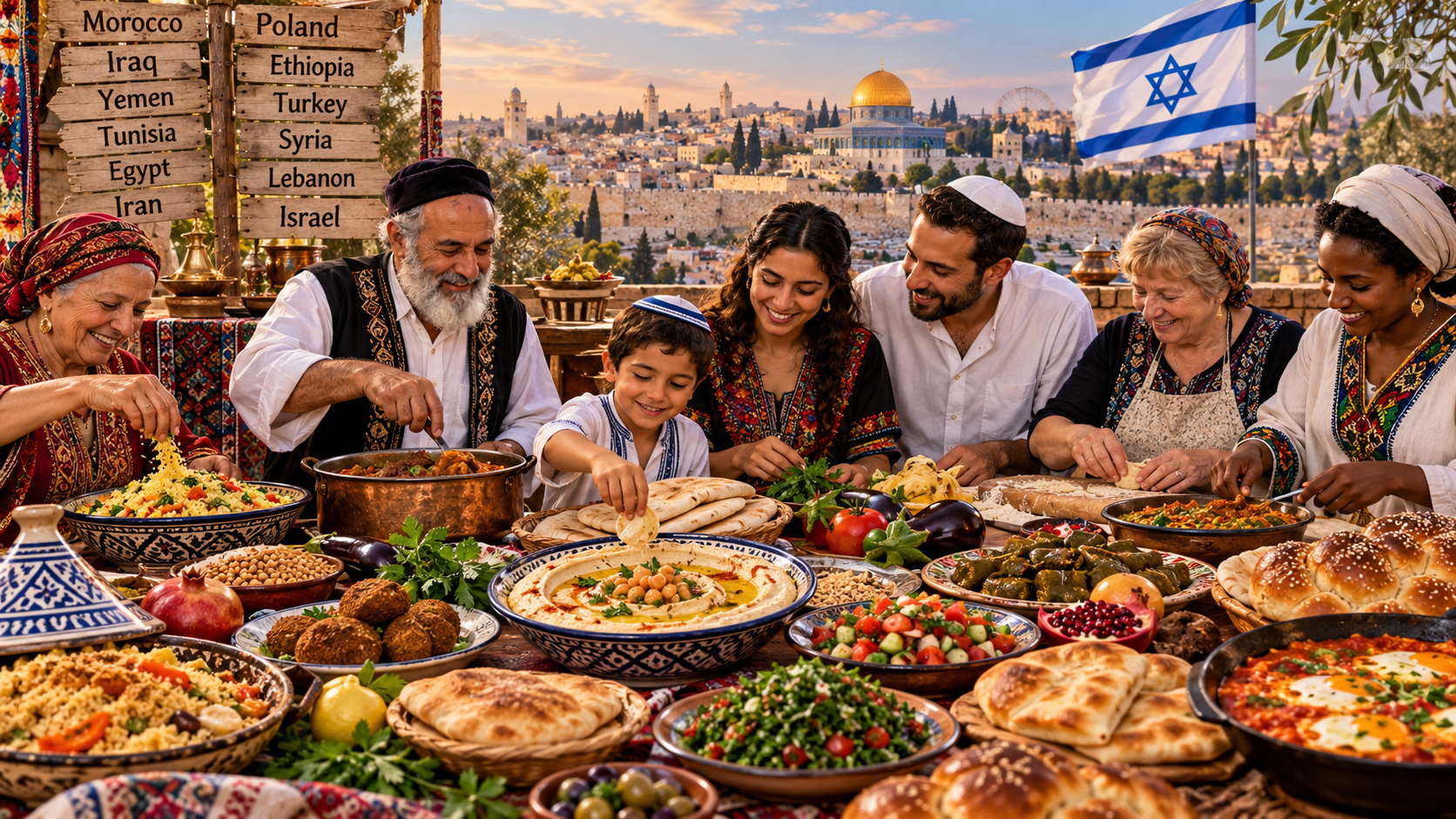
Photo Credits: Sabine Sterk (AI)
Even the Hummus Has Become Political
There are few things in life that should be less political than food. Food is memory, family, migration, survival, celebration and culture served on a plate. Yet somehow, when Israel is involved, even hummus, falafel, shakshuka and a bowl of chopped tomatoes and cucumbers can become the subject of an international argument. Israeli cuisine is sometimes portrayed as if Israelis simply arrived, looked at the food of their Arab neighbors and decided to claim it as their own. That version of history is remarkably simplistic because it ignores one of the most important facts about Israeli society. Israel is an extraordinarily multicultural country, built not only by Jews whose families came from Europe, but also by Jews whose families lived for centuries in Iraq, Yemen, Morocco, Tunisia, Libya, Egypt, Syria, Lebanon, Iran, Turkey, Central Asia, Ethiopia and many other parts of the world.
This matters when discussing food because cuisines do not develop inside modern political borders. The Middle East and North Africa have always been regions of movement, trade, conquest, migration and cultural exchange. Hummus, for example, has deep roots in the broader Middle East and is eaten throughout the Levant. Falafel has similarly contested origins and exists in several regional traditions. Calling such dishes exclusively Israeli would therefore oversimplify their history, but insisting that they cannot genuinely be Israeli is equally misleading. A dish does not cease to be part of someone’s culture simply because other peoples eat it too. Pizza crossed borders. Coffee crossed borders. Pasta developed through centuries of cultural exchange. Nobody expects every modern nation to prove exclusive ownership of every ingredient on its dinner table before being permitted to call something part of its national cuisine.
The story becomes even more complicated when Jewish communities from Arab and Muslim majority countries are considered. Jews lived in Baghdad, Aleppo, Sana’a, Fez, Tunis, Alexandria and countless other cities long before the establishment of the modern State of Israel. They spoke Arabic, Judeo Arabic, Persian and other regional languages. They cooked with chickpeas, eggplant, sesame, rice, herbs, spices and olive oil because those were ingredients belonging to the culinary environment in which they lived. Iraqi Jews did not suddenly discover Iraqi food when they reached Israel. Moroccan Jews did not leave their couscous at the border. Yemenite Jews brought traditions such as jachnun, malawach and kubaneh. Iraqi Jewish families brought dishes such as kubbeh and sabich, traditions developed within Iraqi Jewish communities. North African Jews brought couscous, fish dishes, spicy condiments and countless family recipes. These traditions became part of Israeli cuisine because the people carrying them became part of Israeli society.
At the same time, Jews arriving from Europe brought their own culinary memories. Ashkenazi communities brought challah traditions, kugel, gefilte fish, schnitzel adaptations, soups, baked goods and foods shaped by life in Central and Eastern Europe. Jews from Ethiopia brought injera, stews and distinctive spice traditions. Jews from the former Soviet Union brought another enormous culinary heritage. Persian Jews brought rice dishes, herbs, stews and sophisticated combinations of sweet and sour flavors. Then these traditions encountered one another in Israel. Children grew up eating dishes from several communities. Restaurants experimented. Families intermarried. Recipes changed. Local agricultural products influenced what people cooked. New dishes and combinations emerged. That is precisely how national cuisines are created.
There is also an older Jewish connection to the foods of the land itself that should not disappear from this discussion. Jewish religious texts and traditions contain repeated references to bread, wine, olives, figs, dates, pomegranates, grapes, wheat and barley. Olive oil and wine were central elements of ancient Jewish life, agriculture and ritual. The connection between Jews and the agricultural products of the Land of Israel therefore did not begin in 1948. Modern Israeli cuisine is obviously not identical to the cuisine of ancient Judea, nor should anyone pretend that it is, but Jewish culinary identity has roots in the region stretching back thousands of years.
None of this requires denying Arab culinary heritage. Palestinians, Lebanese, Syrians, Jordanians, Egyptians and other peoples of the region have genuine food traditions of their own, and many dishes are legitimately shared across cultures. Recognizing Jewish history does not require erasing Arab history, just as recognizing Arab contributions does not require pretending that Jews arrived in the Middle East without a history, cuisine or cultural memory of their own. The obsession with deciding that a dish must belong exclusively to one people misunderstands how culture actually works. Neighboring peoples influence each other. Minorities influence majorities. Migrants carry recipes across borders. Empires spread ingredients and cooking techniques. Families adapt whatever grows locally. After generations, determining who first placed a particular combination of chickpeas, sesame and spices on a plate can become almost impossible.
Israel makes this culinary exchange particularly visible because the country brought Jewish communities from vastly different backgrounds into an unusually small geographical space. Walk through an Israeli market and you can encounter influences from Eastern Europe, North Africa, Iraq, Yemen, Persia, the Levant, the Mediterranean, Ethiopia and the Caucasus within minutes. Add the culinary traditions of Israel’s Arab citizens, Druze, Bedouins, Christians, Muslims and other communities and the result becomes even more diverse. Israeli cuisine is therefore difficult to define precisely because Israel itself is difficult to squeeze into a single ethnic box. Its kitchen is a meeting place.
Perhaps that is why arguments about Israeli food become so emotional. They are rarely only about food. They become arguments about identity, history and belonging. When people insist that virtually everything Israelis eat has simply been stolen from somebody else, the implication can become larger than a debate about hummus. It can suggest that Israelis themselves possess no authentic regional identity. Yet the family histories of millions of Israelis tell a much more complicated story. A Jewish grandmother from Baghdad preparing the food she learned from her mother is not stealing Iraqi culture. A Moroccan Jewish family preserving recipes carried from Morocco is preserving its own family heritage. An Israeli family combining those traditions with European, Persian or Levantine influences is doing what cultures everywhere have always done.
Maybe the better answer to the endless food wars is therefore surprisingly simple. Hummus does not need a passport. Falafel does not need to pass a border checkpoint. Couscous does not become illegitimate when prepared in Tel Aviv, Haifa or Jerusalem. Food can belong to several cultures simultaneously, while particular communities can still have their own versions, histories and traditions. Israeli cuisine should be understood for what it actually is, a constantly evolving kitchen created by people who brought their memories, recipes and histories from across the Jewish world and combined them with the ingredients, traditions and influences of the region in which Jewish civilization itself has ancient roots.
Israel’s kitchen is multicultural because Israel is multicultural. It contains the stories of Baghdad and Warsaw, Sana’a and Casablanca, Tehran and Addis Ababa, Moscow and Jerusalem. Those stories sometimes overlap with the cuisines of neighboring peoples because human history overlaps. Instead of treating that overlap as evidence of theft, perhaps we should recognize it as evidence of something far older and much more interesting. Peoples can fight over borders, history and politics, but kitchens have never been very good at respecting borders.
And perhaps that is one lesson worth remembering the next time somebody starts an international argument over a plate of hummus.
Related Topics
Related Posts