
Geopolitical & Defense Analyst
The Turkey-Libya Accord: Threat to Israel
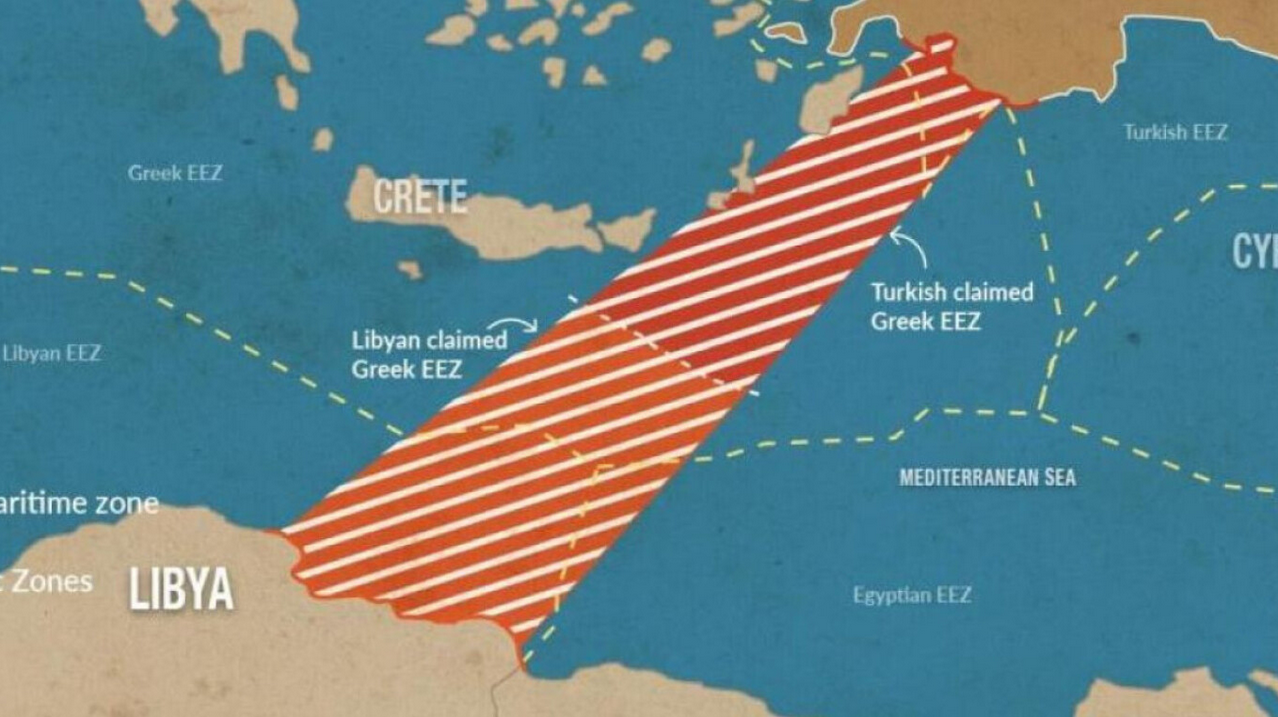
Visual representation of claims and maritime zones in the Eastern Mediterranean. Source: ProtoThema English
The geopolitical architecture of the Eastern Mediterranean is fracturing. With the Libyan Parliament’s recent moves to ratify the controversial Turkey-Libya maritime memorandum, the threshold of regional stability has been breached. Analysts routinely frame this as a technical bilateral dispute over hydrocarbons. That is a dangerous illusion. In reality, this accord is a de jure fiction engineered by the close cooperation between Ankara and Tripoli to establish a de facto strategic encirclement—one that directly threatens regional security, critical maritime commerce, and Europe’s southern energy lifelines, while directly violating Greek and Cypriot sovereign rights.
To understand the magnitude of this threat, look strictly at the naval balance. While the Turkish Naval Forces pursue an aggressive quantitative expansion toward a blue-water fleet, the Hellenic Navy—alongside Israel’s elite, technologically advanced forces—maintains critical qualitative superiority and unmatched tactical readiness in the region. Israel’s navy remains an elite force tailored for localized defense, and while Turkey expands its hull count, the combined deterrence of regional allies counters unhindered hegemony. Consequently, any institutionalization of Turkish maritime hegemony—pushed through legally void instruments like the Turkey-Libya memorandum—directly shifts the balance of power, posing an existential risk to Israel’s unhindered access to the open seas.
The Encirclement of Egypt and the Mecca Pact
The shockwaves of this accord strike directly at Cairo. A stable, sovereign Egypt is indispensable to Middle Eastern security and serves as Israel’s vital western strategic anchor. Yet, the memorandum aims to choke Egypt from the west, squeezing it out of its legitimate maritime zones and forcing it into a position of acute vulnerability.
This unfolds alongside shifting regional architectures, most notably the emerging dynamics of the Mecca Pact—an axis heavily steered by Turkey, alongside Saudi Arabia and Pakistan. For Jerusalem, the prospect of Egypt being slowly pulled into an Ankara-centric orbit is a strategic nightmare. A neutralized or constrained Cairo shatters the contiguous wall of moderate, Western-aligned states, leaving Israel exposed to a coordinated geopolitical clamp from the north and southwest.
The Indispensable Athens-Nicosia Axis
In this grand chess match, Greece and Cyprus are far more than friendly neighbors. They are Israel’s absolute strategic buffers and the gateway to the European Union. Europe depends on Eastern Mediterranean stability for energy diversification and secure supply chains. By attempting to sever the maritime link between Greece and Cyprus through artificial lines on a map, Ankara seeks to enforce a modern mare clausum—a neo-Ottoman lake.
If regional stakeholders and the international community tolerate de facto realities built on illegal foundations, the damage will be permanent. Israel’s strategic depth in the Mediterranean will vanish, its sea lanes will become hostages to foreign coercion, and its European allies will see their sovereign rights fractured.
The time for passive observation is over. The maneuvers in Tripoli and Ankara demand an immediate, resolute counter-strategy from Jerusalem, Athens, Nicosia, and Cairo. In modern geopolitics, ceding an inch of maritime sovereignty today guarantees the loss of strategic survival tomorrow.
Related Topics
Related Posts