
Every year anew
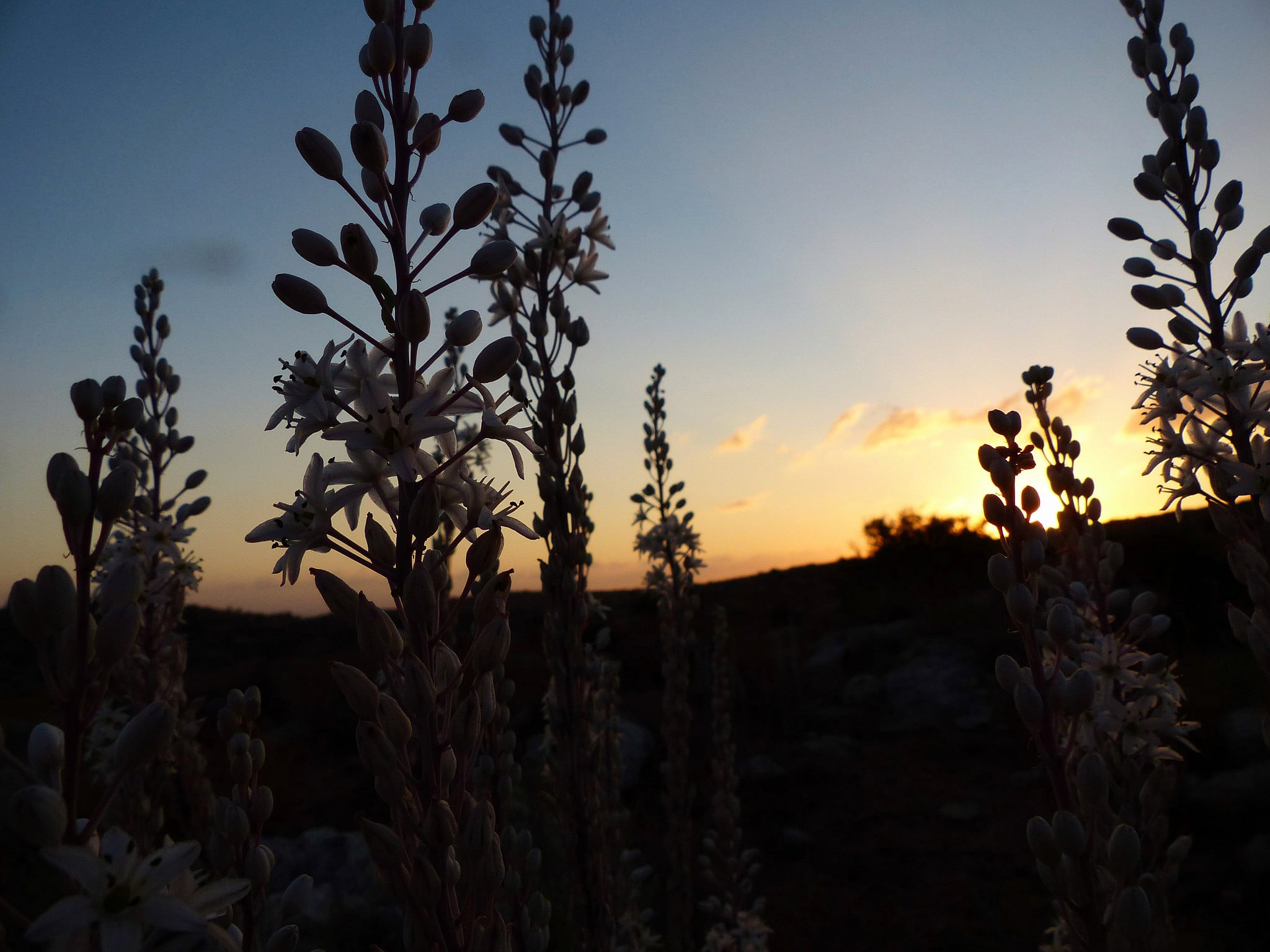
Every year, anew, we mark endings and beginnings. The summer ends and the autumn rains begin. The chatsavim send out their shoulder-high spikes of flower buds, spiraling up to the sky from large bulbs hidden in the still-dry ground. The flowers open and close consecutively from bottom to top until, after a few weeks, there are no more buds and, soon, no more chatsav flowers. Until next year.
The sun rises and sets. The moon wanes until a darkened sky heralds in the first sliver of a new moon and the New Year.
Despite Tishrei’s new moon, this New Year seems especially dark (the past year, as a whole has been dark). Current events indicate that it will likely get darker still before, hopefully, returning again to light.
It seems that we have again entered a period of epic struggle. Forces well beyond of the control of mere individuals swirl around us. In this time of darkness and pain, we are challenged by basic questions of what is one to do? How is one to act against historical currents that don’t merely threaten to overwhelm, but seemingly assure that they will? What space exists — is there space? — for an individual to make the slightest difference at all? For what can we possibly hope?
 Foundational Myths and a Painful Reality
It is with these questions that I approach the foundational myths that accompany us through this holiday season. Every Rosh Hashana, anew, we read in the Torah portions accompanying the holiday how Sarah laughs at giving birth to Isaac in her old age This myth exemplifies how our freedom as humans is so intimately connected to our capacity for natality in action – of giving birth, creating things that are new even when conditions make them seem unexpected. The story also reminds us of how human laughter can serve as a great equalizer, challenging and even destroying the “what is” with the “what can be.” We experience and are bound within our realities, but we each carry with us the ability to interrupt reality: to surprise. This, to a great extent, is the creative essence of our freedom: our ability to act in seemingly miraculous ways, thereby creating something new. With the natality of our actions — including with our laughter — we surprise others and sometimes even ourselves. (These notions of freedom, action and natality are not mine, but come to us from Hannah Arendt.)
And again, every year, anew, we move straight from the joy of Abraham and Sarah birthing Isaac to the sorrow and pain of Hagar, Sarah’s handmaiden, who is sent away together with Abraham’s and her son, Ishmael. All this because of Sarah’s jealousy and sense of scarcity. Will there be enough inheritance for her Isaac as well as for Ishmael?
Is it even possible that Hagar is Abraham’s true love?
Every year, anew, Hagar is sent off into the desert alone with her son and a single waterskin. She weeps and cannot bear the crying and impending death of her thirsting son once the water is gone. Every year, God hears Ishmael’s crying and Hagar’s distress and a life-saving well appears from which she and her son can drink.
And every year, anew, this story is followed on the second day of Rosh Hashana with the tale of the binding of Isaac. Isaac asks his father — in either naivety or trepidation — “Here are the fire and the wood, but where is the lamb for the burnt offering?” And every year, Abraham proves his willingness to sacrifice his son, until at the last minute and, with his knife poised over his son, an angel calls out to restrain Abraham. “Do not stretch forth your hand to the lad nor do the slightest thing to harm him.” A ram appears, caught in a tree by its horns, and is sacrificed in Isaac’s stead.
Every year, anew, these tales showcase actions that demonstrate fidelity to heroic values — the heroic values upon which we can build great epic tales. Our heroes obediently play their roles. And, miraculously, every year, anew, the children come through unscathed.
This year — especially this year, though possibly in all other years as well — these tales grate painfully against the reality all around us. All around us children thirst and there is no well. All around us children are bound to notions of duty to country and yet no angels appear to protect them. We seem to be trapped within a dystopian story and in a land that devours its inhabitants.
The Deeply Flawed Hero
It is not until we read the story of Jonah and his misadventures on Yom Kippur that we are directly given a different kind of hero and a different kind of story — and perhaps one more suited to our particular moment.
This is because it is Jonah’s very human flaws that are at the very center of the story. Every year, anew, at every step of the way, Jonah tries to avoid carrying out the task he was given and he fails at multiple points to demonstrate a basic compassion to his fellow humans and other living things.
Every year, anew, Jonah is told by God to journey to the great city of Nineveh to warn them to change their ways or suffer destruction. And every year, Jonah leaps into action and rushes instead to Tarshish to avoid the burdensome task he was assigned.
Instead of being able to slink away to Tarshish quietly, a great storm threatens to break apart the boat that Jonah is on. Even when it is discovered that the storm is because of him, the sailors — those whose lives Jonah has put in danger through their unknowing association with him — at first refuse to throw him into the sea, trying instead to row furiously to safety (such a contrast to Jonah’s efforts to avoid doing what he must: the sailors’ efforts against the wishes of God are not for their own benefits, but for Jonah’s).
Every year, anew, Jonah is swallowed by a great fish, inside of which he spends three whole days and nights — enough time, in short, to reconsider his actions and to repent, begging to complete his original mission.
Granted a reprieve, he notes, “Those who keep worthless futilities abandon their kindness.”
Lo and behold, when Jonah makes his way to Nineveh to warn them that their great city will be destroyed in 40 days because of their iniquities, there is not the slightest mention of it being difficult for Jonah to convince them. He tells them of the message he has received from God and they believe him. The king hears of this message, and he believes it as well. All repent, fast and sit in sackcloth — which apparently used to be a thing.
God sees that the people of Nineveh have repented and relents.
Jonah, at this point, is exceedingly upset. He claims that he knew all along that God would have second thoughts about destroying Nineveh, saying, “You are a gracious and merciful God, slow to anger, with much kindness.” This, Jonah disseminates, is why he did not heed God’s command. What, after all, was the point of his stretching himself, if, in the end, God is just going to forgive the people of Tarshish?
Quite annoyed and feeling sorry for himself, Jonah retreats a safe distance from the city to see what is going to happen. Will he get to see fireworks or not? Has God really decided not to destroy Nineveh?
This attitude displeases God greatly.
Every year, anew, the myth has God teaching Jonah a painful lesson in compassion. God remonstrates with Jonah, “Now should I not take pity on Nineveh, the great city, in which there are many more than 120,000 people who do not know their right hand from their left, and many beasts as well?”
As William Blake wrote in one of his Songs of Innocence, “Cherish pity, lest you drive an angel from your door.” It is up to each of us to be compassionate and to act on this compassion.
Every year, anew, we are reminded that we have agency.
Every year, anew, we are confronted with our ongoing failures to cultivate our compassion for the pain felt by others and to rise to the challenge of trying to change our received reality.
And every year, anew, we are challenged, like Jonah, to try to face the swirling reality around us, to imagine a different one, and to act decisively with the aim to bring it about. It is up to each of us to build on our compassion and our agency — our ability to step up as needed. Success is not insured if we do. But failure certainly is if we do not.
Unlike the previous myths I mentioned, the Book of Jonah, while featuring a God who is all-powerful, is truly focused on the potential — not fully realized in the story — of Jonah, himself.
We don’t find out what Jonah learns from his experiences and, every year, anew, we are challenged to ask ourselves what we have learned.
Wishing all those marking this period and Yom Kippur meaningful days of reflection.
May we all, together, succeed in bettering ourselves and in making it a good year forward for all.
 —
—
Note: The above was written in 2024 but seems just as relevant now. It was edited for The Times of Israel. The images are from September 2025.