
Everything Depends on the International Stabilization Force
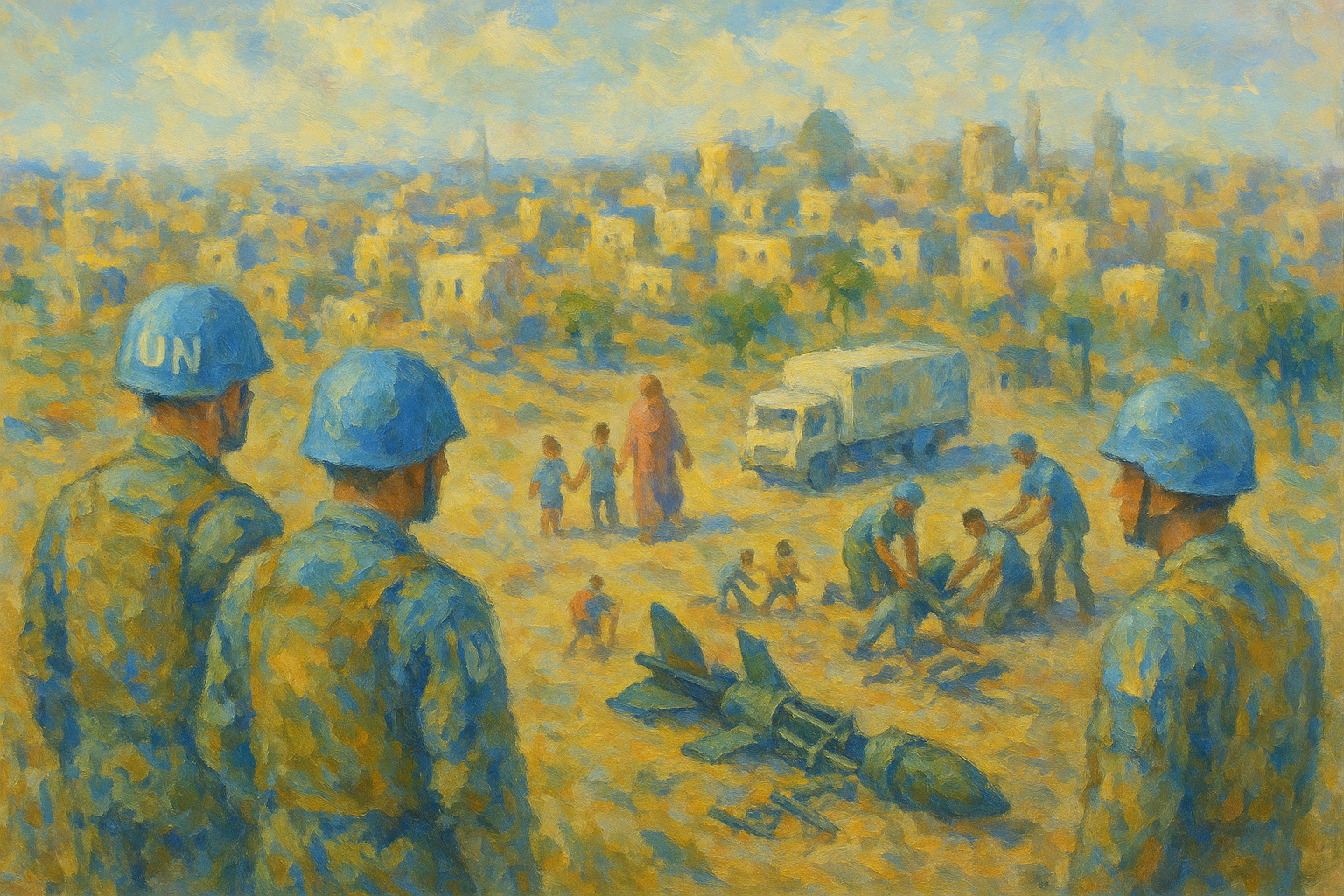
The Gaza Peace Plan Rises or Falls on the International Stabilization Force
When the UN Security Council approved Resolution 2803 this week, it didn’t just bless Donald Trump’s 20-point Gaza peace plan. It created something much more concrete: a legally mandated International Stabilization Force (ISF) charged with demilitarizing Gaza and securing the Strip during a fragile transition.
Everyone is talking about hostages, statehood language, and the Trump-chaired Board of Peace. But the entire architecture of this deal rests on one uncomfortable, unavoidable fact:
Either the ISF truly enforces demilitarization — including using force against armed Palestinian groups — or there is no real peace.
This isn’t a classic “blue-helmet” photo-op. It is, by design, an enforcement mission, not a symbolic one.
From “peacekeeping” to peacemaking
UNSC Resolution 2803 authorizes states working with the Board of Peace to “establish a temporary International Stabilization Force in Gaza” and deploy it to stabilize the security environment, support demilitarization, dismantle terrorist infrastructure, secure borders, and protect civilians.
The 20-point plan and accompanying commentary spell out what that actually means:
- Destroy “military, terror and offensive infrastructure” in Gaza – tunnels, rocket workshops, launchpads, command centers.
- Permanently decommission weapons from non-state armed groups, i.e., Hamas, Palestinian Islamic Jihad, and smaller factions.
- Oversee a staged Israeli withdrawal “based on standards, milestones and timeframes linked to demilitarisation.”
That is not neutral monitoring. That is coercive disarmament. And countries volunteering troops have to understand exactly what they are signing up for.
They are not coming to stand between the IDF and Hamas in some abstract “both-sides” geometry. They are mandated to replace the IDF as the enforcing arm of a demilitarized order — and that means confronting Palestinian armed groups that refuse to disarm.
The hard truth for contributing states
Arab and Muslim-majority countries have been floated as likely core contributors to the ISF: Indonesia, Azerbaijan, Egypt, Qatar, maybe others, with some Western partners such as France or Canada providing specialized units.
For their governments, the temptation will be enormous to sell this at home as pure “peacekeeping”:
- protecting civilians,
- escorting aid,
- supporting reconstruction,
- “guaranteeing” that Israel really leaves.
All of that is true — but incomplete.
If these governments take the mandate seriously, their soldiers will also be:
- Seizing and destroying weapons from Palestinian militias that won’t comply.
- Raiding caches, tunnels and workshops that Hamas or others try to hide.
- Intervening against hostile acts inside Gaza — including by Palestinians against other Palestinians, or against the new technocratic authorities.
- Potentially using force, including lethal force, against armed Palestinian fighters who threaten civilians or the mission.
Hamas has already attacked the resolution precisely for this reason, warning that assigning the ISF to disarm “the resistance” makes it a combatant on Israel’s side.
In other words: if you join the ISF but declare in advance that your troops will never act against Palestinians, you are signing up for a mission you have no intention of carrying out. That is the shortest path to another failed peacekeeping experiment.
A realistic sequence for implementing peace
If we’re honest about the mission, what would a realistic, properly ordered sequence of activities look like?
Phase 0 – Force generation and political clarity (pre-deployment)
- Lock in the mandate in plain language.
- Board of Peace and key contributors publicly affirm that ISF duties include active demilitarization, not just observation.
- Agree on rules of engagement (ROE).
- Clear thresholds for using force against armed groups, for protecting civilians, and for responding to ceasefire violations – by either side.
- Coordinate with Israel and the Palestinian interim committee.
- Deconflict zones of operation, intelligence sharing, and handover points as IDF withdraws to the agreed “yellow line.”
Without this groundwork, you don’t have a mission, you have a slogan.
Phase 1 – Immediate stabilization and handover (first 30–90 days)
- Ceasefire monitoring and hot-line control.
- ISF units deploy first to key axes, crossings, and aid corridors to ensure that the ceasefire holds and that humanitarian supplies flow.
- Protection of civilians and aid operations.
- Visible patrolling in areas of IDF drawdown, rapid response to looting, reprisals or chaos.
- Layered Israeli withdrawal tied to ISF control.
- As the ISF “establishes control and stability,” the IDF pulls back according to pre-agreed milestones linked to demilitarization benchmarks, not to a calendar.
If this phase fails, everything fails. If it succeeds, you buy the breathing space for the truly painful part: disarmament.
Phase 2 – Demilitarization surge (roughly 3–18 months)
This is the heart of the mission and the part everyone prefers to talk around.
- Mapping and securing the battlespace.
- Joint intelligence cells (Israel, ISF, vetted Palestinian counterparts) identify rocket stores, tunnel networks, command sites, and weapons workshops.
- Targeted dismantling of “military, terror and offensive infrastructure.”
- Controlled demolitions of tunnels.
- Destruction of launchpads, depots, and production sites.
- Weapons collection and amnesty.
- Structured programs for militants who accept the deal: hand in weapons, sign on to amnesty and non-violence, possibly retrain into civilian roles or vetted security forces.
- Firm response to holdouts.
- Armed groups that continue to operate outside the framework face graduated use of force by the ISF – backed politically by the Security Council and key regional states.
This is where contributing countries must stop pretending they are neutral. They aren’t. The ISF’s job is to ensure that no independent armed Hamas or PIJ force survives as a veto player in Gaza.
Phase 3 – Building a Palestinian monopoly on force (12–36 months)
Demilitarization without a legitimate local security structure simply creates a vacuum. The plan therefore envisions:
- Training a new Palestinian police and security force under the principle of “one authority, one law, one gun,” anchored in a reformed Palestinian Authority.
- Joint ISF–Palestinian patrols inside Gaza’s major population centers, gradually shifting daily policing to Palestinian hands while the ISF focuses on border security and high-end threats.
- Border control and anti-smuggling mission.
- ISF presence at crossings and coastal/border perimeters to prevent the reintroduction of rockets, explosives and dual-use materials outside agreed channels.
Only when a credible local force exists can the ISF pivot from peacemaking (imposing order) to peacekeeping (maintaining it).
Phase 4 – Transition and drawdown (toward 2027)
According to the current framework, the aim is that by roughly 2027 a reformed Palestinian Authority takes over governance, under continued international monitoring.
In this final phase:
- ISF moves to an overwatch role.
- Smaller footprint, focused on mentoring, border oversight, and deterring major violations.
- Conditional drawdown.
- Reductions in ISF troop levels are tied to conditions, not dates: sustained absence of rocket fire, effective Palestinian policing, and verified interdiction of smuggling.
- Long-term guarantees.
- An independent monitoring mechanism tracks violations by all parties and reports to the Security Council, with snap-back options if Gaza begins to rearm.
For Israelis and Palestinians, the stakes couldn’t be higher
From an Israeli perspective, the test is brutally simple:
Does Gaza, under this arrangement, permanently lose the ability to fire rockets, dig cross-border tunnels, and prepare another October 7?
If the ISF does not actually enforce demilitarization, then Israel will — sooner or later — feel compelled to go back in. That would mark the collapse of the plan and of international credibility.
For Palestinians in Gaza, the test is equally stark:
Does this force protect them not only from airstrikes and invasion, but also from armed factions that have treated their neighborhoods as launchpads and human shields?
If the ISF is seen as merely an outsourced occupation, indifferent to Palestinian rights and dignity, it will never gain the legitimacy needed to police the Strip.
The choice before the ISF
The International Stabilization Force is not a technical detail in the fine print. It is the hinge on which the entire Gaza peace plan turns.
- If contributing states treat this as another cautious, risk-averse UN presence, constrained by national caveats and domestic politics, Hamas and similar groups will adapt, wait, and rearm.
- If, instead, they accept that true peace requires enforcing a monopoly on legitimate force — including, when necessary, confronting armed Palestinians who reject the deal — then the ISF might actually give both Israelis and Gazans something they have never had: a real chance to step out of the cycle of war.
The question now is not whether the world supports peace in Gaza.
It is whether enough governments are prepared to risk political capital and soldiers’ lives to make the word “demilitarization” mean what it says.