Living at the intersection of Torah and science.
Eve’s 24 Ornaments and the Standard Model
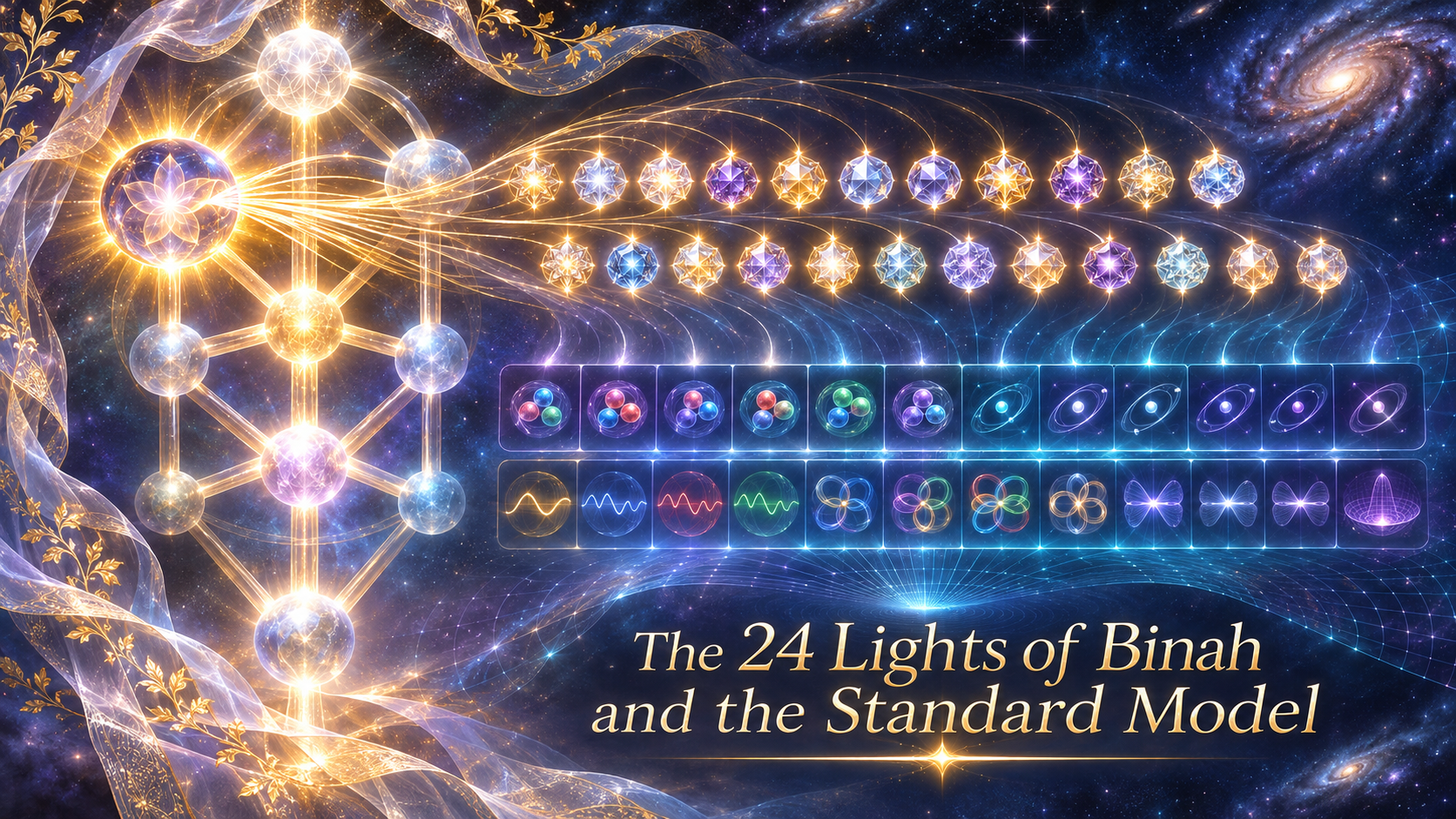
The 24 Lights of Binah and the Standard Model
What a Jewish mystical teaching and modern physics have in common
What could a Jewish legend about the first bride have in common with the particles that make up our universe? At first glance, nothing at all.
The Kabbalah, the mystical tradition of Judaism, speaks in images: divine lights, a heavenly Mother, a bride and her groom. Particle physics speaks in equations and measurements. The two grew up in different worlds and ask different questions. One asks how G-d’s unity can express itself in a world full of variety. The other asks what the world is made of and how its parts hold together.
And yet I have come to see a striking parallel between them. It starts with a number, twenty-four, but it does not end there. Beneath the number lies a shared idea: a rich and beautiful world is possible only because its parts differ from one another and still fit together.
The bride’s twenty-four ornaments
The story begins in the Garden of Eden:
And the Lord God built the side that He had taken from the man into a woman, and He brought her to the man” (Genesis 2:22).
In Hebrew, every letter also stands for a number. The word for “and He brought her,” vayevi’eha (ויבאה), adds up to twenty-four: 6 + 10 + 2 + 1 + 5. Jewish commentators saw in this a hint of the twenty-four ornaments with which G-d adorned Eve before presenting her to Adam.
The tradition is old. The Midrash, the ancient rabbinic commentary on the Bible, says that G-d did not simply lead Eve to Adam. He first adorned her with twenty-four ornaments, like a bride on her wedding day. The Talmud adds a tender detail: G-d Himself braided her hair. Another Midrash identifies a bride’s twenty-four ornaments with the jewelry and finery listed by the prophet Isaiah (Isaiah 3:18–24).
The Zohar, the central book of the Kabbalah, learns a wedding custom from the same verse: the bride’s father and mother bring her to the groom. In the mystics’ reading, the father and mother are heavenly ones, and the bride stands for the Shechinah, G-d’s presence within the world. Her ornaments are not mere decoration. They prepare her, give her form, and make her ready to meet her partner.
The same Hebrew word appears once more in the Torah, when Isaac brings Rebecca into his mother Sarah’s tent and marries her (Genesis 24:67). The repetition invites us to read the two scenes together, as two pictures of the same sacred union.
The story also has a darker side. According to the Zohar, when the serpent seduced Eve, it cast into her twenty-four kinds of impurity. The Zohar finds this number, too, in the words of the Bible. When G-d curses the serpent, He says: “I will put enmity between you and the woman” (Genesis 3:15). The Hebrew word for “enmity,” ve’eivah (ואיבה), uses exactly the same five letters as vayevi’eha, so it also adds up to twenty-four. Twenty-four ornaments of holiness stand against twenty-four forms of impurity. I will come back to this mirror image later.
The Mother who gives form
Where do the ornaments come from? Here the Kabbalah introduces one of its central ideas.
The Kabbalists describe G-d’s activity through ten divine qualities, called sefirot. Two of them belong to the mind: Chochmah, “Wisdom,” and Binah, “Understanding.” Chochmah is the first flash of an idea, the moment of “aha!” before you can explain what you have seen. Binah is what comes next: the patient work of unfolding that flash into something with parts, details and order. The Talmud defines a person of understanding as one who “understands one thing from another,” someone who can draw distinctions and see where they lead.
The mystics even see this in the shapes of Hebrew letters. The first letter of G-d’s four-letter name, the yud (י), is little more than a point. It stands for Wisdom. The next letter, the heh (ה), looks like that point stretched out in length and breadth. It stands for Understanding.
The Kabbalah calls Binah the “heavenly Mother,” and the image fits. A mother’s body takes a single fertilized cell and, step by step, develops it into a child with bones, organs and a beating heart. A living body is not a lump of identical cells. It works because its parts have become different and each plays its own role.
According to Rabbi Isaac Luria, the great sixteenth-century Kabbalist of Safed, the bride’s twenty-four ornaments flow from this heavenly Mother. He describes them as twenty-four “judgments.” The word sounds harsh, but here it means limits and boundaries: the lines that give a thing its shape. A sculptor makes a statue by deciding where the stone ends. In the same way, these twenty-four boundaries give the bride her form, and once she has received them they appear as jewels that complete and beautify her.
A well-known rabbinic teaching makes the same point. Adam, the rabbis said, was first created as a single being, male and female joined back to back. G-d then separated them so that they could turn and face each other. In this view, separation is not the opposite of love; it is what makes a real relationship possible. Two beings that cannot be told apart cannot truly meet.
The universe’s short list of ingredients
Now let us jump to modern physics.
Over the past century, physicists have discovered that everything we see, from the air we breathe to the most distant stars, is built from a surprisingly short list of basic particles. The theory that describes them goes by the modest name “the Standard Model.” It is one of the most thoroughly tested theories in the history of science. (It does not include gravity, which is still waiting for its place.)
The particles fall into two groups.
The first group consists of twelve particles of matter. Six are quarks, the building blocks of the protons and neutrons in the center of every atom. The other six are the electron, two heavier cousins of the electron, and three ghostly particles called neutrinos, which can pass through the entire Earth almost without a trace. These twelve come in three “families” of four. Ordinary matter is built almost entirely from the first family. The other two are heavier copies, and nobody knows why they exist.
The second group consists of the particles that carry forces between the particles of matter. There are twelve of these as well:
- the photon, the particle of light, which carries electricity and magnetism;
- eight gluons (from “glue”), which bind quarks together inside protons and neutrons;
- three carriers of the “weak force,” which causes some kinds of radioactivity and helps the sun to shine.
Twelve particles of matter and twelve force carriers: twenty-four in all.
Isn’t that just a matter of counting?
A fair question. The number usually quoted for the Standard Model is seventeen, because popular accounts count the eight gluons as one, count two of the weak-force carriers as one, and add the Higgs boson (more on it in a moment). So why count to twenty-four?
Because this way of counting is not my invention. The Standard Model is built on three underlying symmetries, a kind of mathematical blueprint for the forces. Each symmetry requires a fixed number of force carriers: eight for the first, three for the second and one for the third. Eight plus three plus one makes twelve. The number of force carriers is not something physicists chose; the structure of the theory demands it. The twelve particles of matter are likewise a basic fact of nature: three families of four.
That leaves the Higgs boson, famous since its discovery at CERN in 2012. It belongs to neither group. It is the visible trace of an invisible field that fills all of space and gives many of the other particles their mass. In the language of our story, the Higgs is not one of the ornaments. It is more like the parents who dress the bride and bring her to the wedding. I offer this as an image, not as a scientific claim.
Lights and vessels
The number is the hook, but it is not the most interesting part of the parallel. The deeper link lies in the two groups themselves.
In 1925 the physicist Wolfgang Pauli discovered a simple rule: no two particles of matter of the same kind can be in exactly the same state. Two electrons cannot share the same place and the same motion. This rule has enormous consequences. It forces the electrons in an atom to stack in layers instead of crowding together, and those layers give each chemical element its character. It is why chemistry exists, why there is a periodic table, and why your chair holds you up instead of collapsing.
The force carriers obey the opposite rule. Any number of them can share exactly the same state. That is why countless particles of light can march in perfect step in a laser beam.
The Kabbalah has a remarkably similar pair of ideas: “lights” and “vessels.” Lights flow, overlap and merge. Vessels hold, contain and set limits. Nothing in the world exists without both. Particles of matter behave like vessels: each insists on its own place, and from their boundaries comes structure. The force carriers behave like lights, and the most familiar of them is light itself.
Notice, too, where boundaries come from in the Kabbalah: from Binah, the Mother whose twenty-four “judgments” give the bride her shape. Pauli’s rule is, in its way, a law of limits. Without it there would be no atoms, no chemistry and no life.
A mirror world
Remember the twenty-four ornaments standing against twenty-four forms of impurity? Physics has its own mirror image. Every particle of matter has an antimatter twin with the opposite electric charge. When a particle meets its twin, the two destroy each other in a flash of energy.
In the first moments after the Big Bang, matter and antimatter were created in almost equal amounts, and nearly all of them destroyed each other. Everything that exists today, including us, is made from a tiny leftover: roughly one particle of matter for every billion pairs that vanished. Why matter won is still one of the great open questions of physics. The Kabbalah’s picture of two opposing sets of twenty-four, in which holiness prevails, offers a suggestive echo.
Why ornaments and not bricks?
There is one more curious detail. Why does the tradition speak of ornaments at all? If the twenty-four stand for the bride’s basic structure, why not compare them to bones or foundations? Why jewelry?
Perhaps because an ornament does something a brick does not. A brick is simply part of a wall. An ornament reveals character. A crown speaks of royalty; a ring speaks of commitment. The bride’s ornaments show that she is complete and ready.
The particles of physics are similar. They are not just tiny bricks. The electron matters not merely because it exists but because of what it does. Its charge, its lightness and its refusal to share its place make atoms and chemistry possible. Each particle’s identity lies in its role within the larger whole.
Coincidence?
I have to face the obvious objection. Am I simply finding the same number in two unrelated places and building a story around it?
The worry is fair. People are very good at finding patterns, and twenty-four is a popular number in Jewish tradition. The Hebrew Bible has twenty-four books, and the Midrash compares them directly to the bride’s ornaments: just as a bride is adorned with twenty-four ornaments, a scholar must be adorned with knowledge of all twenty-four books. On the night of Shavuot, many Jews stay up reading passages from each of those books, a custom the Zohar describes as adorning the bride for her wedding with G-d. A day has twenty-four hours. The four letters of the divine name Ad-nai (“my Lord”) can be arranged in twenty-four ways.
Physics, too, offers more than one route to twenty-four. Count the twelve particles of matter together with their twelve antimatter twins, and you reach twenty-four again.
So I do not claim that the Zohar predicted the Standard Model. Nor can I match particular ornaments to particular particles. A scientific claim would need that kind of precise matching, and I have none. What I can say is that the count I use is not arbitrary: each half reflects something basic about how nature is built.
An analogy does not have to be a proof to be worth having. Metaphors are not equations. A good comparison can shed light on two different things without claiming that one caused the other.
The beauty of difference
How does a world of endless variety come from a single source? The Kabbalah answers in the language of divine light that unfolds, step by step, into distinct qualities and forms. Physics answers with a small set of particles and forces whose differences produce atoms, stars, planets and living things.
The two languages could hardly be more different. Yet both point to the same truth. Creation is not just existence; it is structured existence. It is not just many things, but many things woven into one.
Perhaps that is the message hidden in the twenty-four ornaments of the first bride: the beauty of Creation lies not in the absence of differences, but in the harmony that allows those differences to form a unified whole.
Sources
- Bible: Genesis 2:22, 3:15, 24:67; Isaiah 3:18–24.
- Midrash and Talmud: Bereshit Rabbah 18:1 (Eve’s twenty-four ornaments) and 8:1 (Adam created as two joined beings); Talmud, Berakhot 61a and Shabbat 95a (G-d braided Eve’s hair); Talmud, Chagigah 14a (definition of understanding); Midrash Tanchuma, Ki Tisa, cited by Rashi on Exodus 31:18 (the bride’s ornaments and the twenty-four books).
- Zohar: I, 8a (Shavuot night); I, 48b–49a (the parents bring the bride); III, 79a (the serpent’s twenty-four kinds of impurity).
- Kabbalah and Chassidut: R. Chaim Vital, Etz Chaim (teachings of R. Isaac Luria); “Ornaments for the Bride,” trans. Moshe Yaakov Wisnefsky, Chabad.org; R. Shneur Zalman of Liadi, Tanya, Likutei Amarim ch. 3 and Iggeret HaTeshuvah ch. 4; Gershom Scholem, Kabbalah (Keter, 1974).
- Physics: CERN, “The Standard Model” (home.cern); Particle Data Group, Review of Particle Physics (pdg.lbl.gov).
This is an abridged version of a longer essay “Eve’s Twenty-Four Ornaments and the Standard Model” published on on QuantumTorah.com.
Related Topics
Related Posts