

Covering the Antizionist Era
Ex Neo-Nazi: Antizionists Spread the Same Lies About Jews as White Supremacists
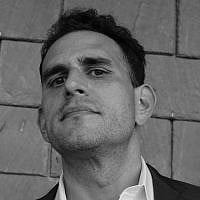
Arno Michaelis spent seven years as a neo-Nazi skinhead, white power musician, and committed antisemite. Today, after sixteen years spent helping people leave racist extremist movements, he says many of the ideas driving the antizionist hate movement in the West today are the same ones propagated by the white power movement he once helped lead in Wisconsin.
“There’s actually very little contrast with 30 years ago when I was a neo-Nazi and today’s antizionists,” Michaelis, 55, told me.
Back when he was propagating racism in America’s white supremacist scene, Michaelis and his fellow neo-Nazis placed Jews at the center of nearly every bigoted conspiracy theory, blaming them for cultural decline, political corruption, immigration, and malevolent control of the media.
“We referred to the United States government as the Zionist Occupational Government,” he said.
Listening to antizionists talk about Israel and its Jewish American supporters today, Michaelis says he hears the same false claims and obsessions that were commonplace in the hate movement he joined as a 16-year-old.
He bristles at the racist comparisons antizionists make equating Nazis and “Zionists” — a term created to describe supporters of the Jewish national liberation movement, but which antizionists have turned into a catch-all slur that marks Jews for stigmatization, exclusion, and violence.
“It’s really ironic that the antizionist narrative is based around this accusation that Zionists are somehow Nazis,” Michaelis said. “I was a neo-Nazi for seven years, and I spent the past 16 years fighting hate in all of its forms, especially Nazi forms, and I can say that all the Zionists I know don’t hate anybody.”
“What Nazis do is hate Jews,” he continued. “And antizionists are in lockstep right now with notorious neo-Nazis like David Duke or Nick Fuentes or any of these other big voices in white nationalism today.”
“If you go and follow white nationalist social media accounts, you’ll see every single one of them claim to be just heartbroken over the plight of the Palestinians, when they actually hate them as they hate anyone else considered “non-white,” Michaelis added.
He pointed out how both neo-Nazis and antizionist bigots feign concern for Palestinians, but never mention the genocidal terror group Hamas or the authoritarian government that rules over Palestinians in the police states of Gaza and the West Bank, respectively.
Antizionists obsessively libel Israelis and Jews as “Nazis,” “white oppressors,” and racial “supremacists,” falsely suggesting a link between Jews and actual white supremacists.
In fact, Michaelis said, he would hand over his last dime “to the first antizionist who can show me a white nationalist who remotely approves of Israel, not to mention is a Zionist.”
“It won’t happen, because every single white nationalist, every single neo-Nazi on this planet hates Israel with the same vehemence that antizionists do.”
When Michaelis first became addicted to hate, it wasn’t the ideology that drew him in as much as the violence and subversiveness.
“I started out as a bully on the school bus, and I got a kick out of it,” he said.
His behavior escalated, with bullying leading to fighting, and fighting to vandalism. Drinking made it all worse.
“When I added alcohol to the mix, it was like gasoline on a fire,” Michaelis said.
Eventually he found white power skinhead culture and racist music, sporting swastikas and becoming a founding member of the Northern Hammerskins, a regional chapter of the violent neo-Nazi skinhead group Hammerskin Nation. During the late 1980s and early 1990s, he also served as the frontman for the hate-metal band Centurion.
The ideology never fit comfortably with the life he had actually lived. Michaelis grew up with Jewish friends and spent time around Jewish families. He knew those Jewish people bore no resemblance to the caricatures promoted by neo-Nazis.
“I felt bad about turning my back on all these friends, and not just turning my back on them, but jumping into something that literally called for their annihilation,” he said.
One of the people who left a lasting impression on him was a Jewish employer named Jack Cooper. When Michaelis showed up to work for Cooper wearing a swastika, the boss could have fired him immediately.
Instead, Michaelis recalls, Cooper told him he was a good kid going through a phase.
The memory of Cooper’s kindness stayed with him, as did the hilarious scenes on America’s most beloved, Jewish-created show, Seinfeld.
“Being a Seinfeld fan made it really difficult to continue being an antisemite,” he said.
Michaelis remembers spending time with fellow white power musicians writing songs about Jewish conspiracies and racial war, then sitting around watching This Is Spinal Tap, directed and co-written by Jewish filmmaker Rob Reiner.
The turning point for Michaelis came in 1994. Still in the grips of his addiction to hate, his girlfriend left him and he became the single father of an 18-month-old daughter. Around the same time, another friend was murdered in street violence.
“It finally hit me that if I didn’t change my ways, death or prison was going to take me from my daughter,” he said.
After escaping the world of white supremacy with the help of friends and family, Michaelis got involved in international peace-building and anti-extremism efforts that help others recover from their addictions to hate. Following the 2012 Sikh Temple massacre in Oak Creek, Wisconsin, he formed a close friendship with Pardeep Singh Kaleka, whose father was murdered in the attack. The two men later co-authored a book, The Gift of Our Wounds, and spent years speaking about hate, violence, and recovery.
Michaelis said his support for Israel is rooted not in contemporary politics, but in the Zionist vision articulated by Theodor Herzl, the father of the Jewish national liberation movement. A longtime admirer of Herzl and his writings, Michaelis expressed frustration that many antizionists invoke Herzl’s name while presenting a distorted version of Zionism that bears little resemblance to Herzl’s well-documented views.
“I’m talking about Israel as a concept, as Herzl conceived it,” Michaelis said.
Herzl’s novel Altneuland, “Old New Land,” resonated deeply with Michaelis. In it, Herzl imagined a society in which Jews, Muslims, and Christians would participate together in the civic and economic life of the country as co-equals, as they do today as Israeli citizens.
Michaelis said he is troubled by portrayals of Herzl’s Zionism as a movement rooted in exclusion or ethnic supremacy, since Herzl’s own writings show the opposite is true.
“I advocate for the beauty of the reestablishment of Israel in a place where people have spoken Hebrew and practiced Judaism for thousands and thousands and thousands of years,” Michaelis said. “To me it’s very poetic justice that Jewish sovereignty is reestablished in that land after thousands of years of being homeless.”
That is why the October 7 massacre hit him so hard.
After the Hamas-led October 7 massacre in Israel, in which some 1,200 people were murdered and Israelis systematically targeted with rape, mutilation, and torture, Michaelis watched with alarm as most of his professional network — people he had long counted on to fight racist extremism — sided with Hamas terrorists over their Jewish victims.
“About two-thirds of that network disowned me for condemning Hamas,” he said. “For saying killing Israeli people is wrong. Killing Jews is wrong.”
“My immediate reaction was the same reaction I had after every other attack [by extremists], which was to express my solidarity with the victims and to condemn the attackers,” he said.
For years, Michaelis had stood alongside communities devastated by hate-fueled violence. He showed up to help after the deadly mass shooting at the Sikh temple; the deadly mass shooting at Mother Emanuel AME Church in Charleston in 2015; and the Tree of Life synagogue massacre in Pittsburgh in 2018.
But after October 7, the public’s response was completely different.
“I saw people not just not standing with the victims, but condemning the victims and validating the hate narrative of the attackers,” Michaelis said. “It broke me. I fell into a relapse of hate.”
The anger he felt toward the killers and rapists of October 7 might have felt righteous, but at its root was the same obsessive, all-consuming hatred he’d once allowed to ravage his life.
With years of recovery and hard-won knowledge behind him, Michaelis was able to pull himself out of the hate spiral.
He currently serves as an exit peer specialist at the organization Parents for Peace, helping recovering bigots heal by treating hate as an addiction — a framework that offers them a path toward a life free from the hate movements that consumed their lives. Earlier this year, the organization launched the Antisemitism Intervention and Recovery Project, known as AIR, along with a dedicated helpline for people influenced by anti-Jewish hatred, including antizionism.
“We’ve just launched a new initiative called the Antisemitism Intervention and Recovery Project,” he said. “We have a dedicated helpline for this, strictly for people who are under the influence of any form of anti-Jewish hatred, including antizionism.”
Parents for Peace has spent a decade helping families confronting extremist ideologies. And Michaelis says anti-Jewish racism appears across movements that otherwise disagree on almost everything.
“It really is the foundation of all violent extremist narratives that threaten Western civilization, whether it’s Islamism or far right or far left,” he said. “All of them converge.”
The organization was founded by an African-American family whose son was radicalized by what Michaelis described as a Jew-hating Islamist narrative. Under the spell of the ideology, he fatally shot a US Army recruiter and is serving life in prison.
Parents for Peace’s AIR helpline connects callers with intervention specialists, mental-health professionals, and former extremists who have lived through the movements they are trying to leave. Michaelis works with people influenced by white-nationalist forms of antisemitism. His colleague Mubin Shaikh, a former jihadist who now works in counterterrorism, helps people influenced by Islamist forms of antisemitism.
Both work with antizionist cases.
“There’s a lot of crossover into both the neo-Nazi space and the Islamist space from antizionism,” Michaelis said. “When you are under the influence of anti-Jewish hatred, it harms you as well as anybody who’s the target of your hate.”
He says the same lesson applies whether the hatred is aimed at Jews, Zionists, or Israel.
“The only thing you’re going to accomplish by hating Israel, hating Jews, is to ruin your own life,” he said. “When you are consumed by hate, whether it’s for Zionists or anybody else, it destroys your ability to truly experience love.”
Parents for Peace’s dedicated AIR antisemitism helpline can be reached at 1-912-214-4AIR (4247).
Related Topics
Related Posts
