
CEO of Time to Stand Up for Israel
Existence is a right, not a privilege
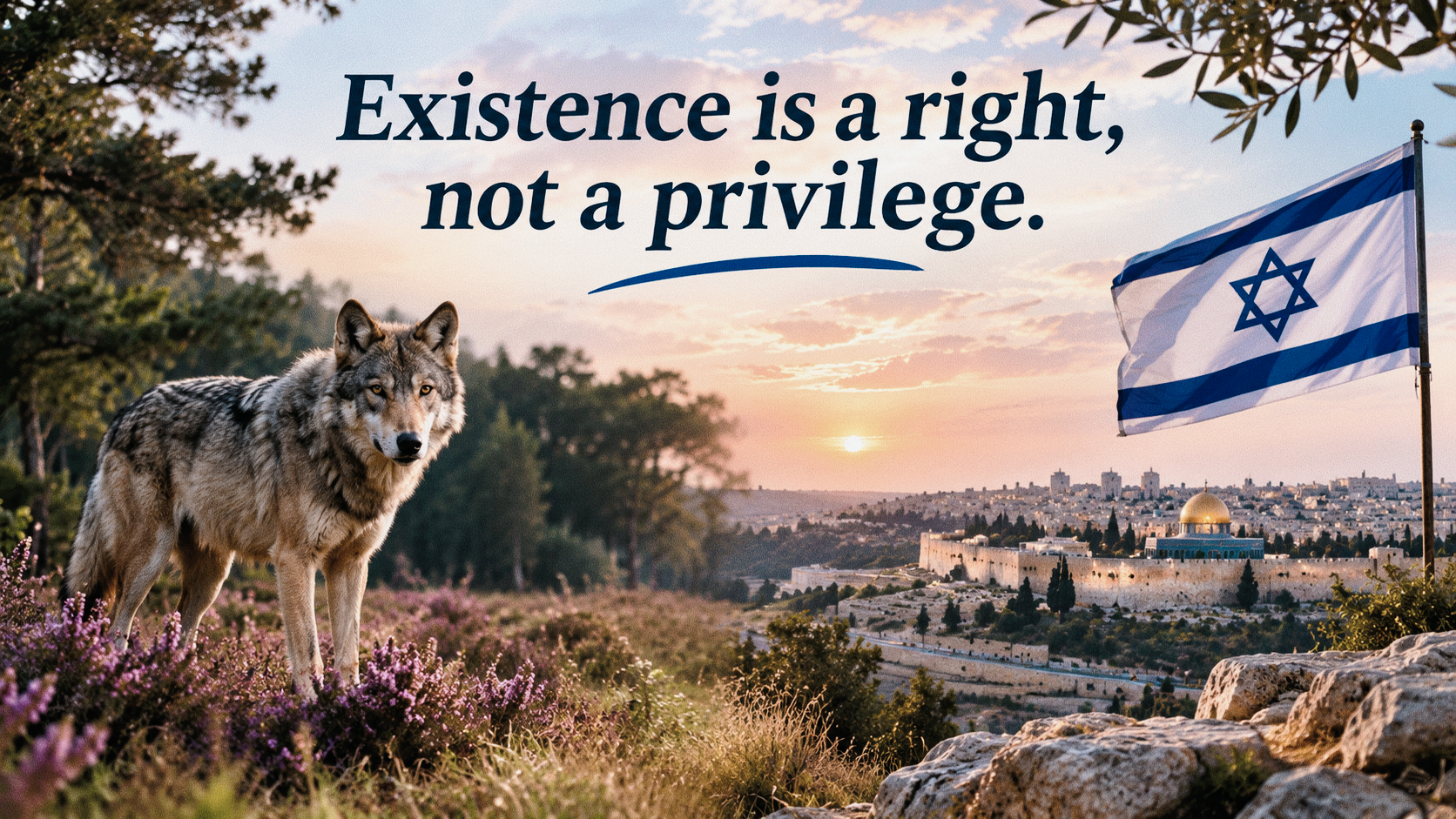
Photo Credits: Sabine Sterk (AI)
What Is Next? Destroy Everything That Does Not Fit Your Narrative?
The Netherlands is moving towards allowing the shooting of wild wolves, a development that I personally find devastating. Humanity has destroyed the natural habitat of countless animals, occupied their territories, disrupted ecosystems and driven entire species towards extinction. Yet, when an animal returns to its original habitat and its presence becomes inconvenient to us, we apparently consider killing it an acceptable solution.
Instead of investing in coexistence, protecting livestock and accepting that humanity does not have an exclusive right to this planet, lethal intervention is increasingly presented as a solution. Of course, legitimate concerns about public safety deserve attention, but when did the destruction of life become such an easily acceptable answer to a complicated problem?
It raises a much broader and deeply disturbing moral question. What is next? Are we going to destroy everything we do not like, everything that challenges our comfort and everything that does not fit our preferred narrative?
When I look at the way Israel is treated by parts of the international community, I recognize a disturbingly similar mentality. The comparison is not between human beings and animals, but between the attitudes of those who consider elimination an acceptable alternative to coexistence.
It sometimes appears that Israel, just like the wolf in the Netherlands, has been declared unwanted. Its presence is portrayed as a problem, its determination to survive as an inconvenience and its ability to defend itself as an obstacle to the ambitions of others.
The Jewish people have an ancient, historical and cultural connection to the Land of Israel. After centuries of persecution, discrimination, expulsions and massacres, Jewish sovereignty was restored in 1948. Yet, almost eight decades later, Israelis are still confronted with movements that refuse to accept the very existence of their country.
Instead of concentrating on how different populations can coexist, there are people who openly advocate the disappearance of the Jewish State. Instead of condemning terrorism without reservation, some attempt to justify it through political narratives, historical grievances or ideological convictions.
The atrocities of October 7, 2023, demonstrated how far this mentality can go. What was particularly disturbing was not only the brutality of the Hamas attack, but also the willingness of some people around the world to celebrate, rationalize or excuse the deliberate murder of Israeli civilians.
Since when does a political conviction justify the slaughter of innocent human beings? Since when does disagreement with a government invalidate the right of its citizens to live? And since when has the destruction of an entire sovereign nation become an acceptable political aspiration?
Criticism of Israeli policies is legitimate, just as criticism of any other government is legitimate. However, there is an enormous moral difference between criticizing a country and demanding its disappearance. There is an equally enormous difference between supporting the rights of another population and celebrating the murder of Israelis.
What concerns me most is the apparent erosion of our collective moral compass. We increasingly seem to determine the value of life according to our own interests, ideological preferences and political sympathies. Compassion becomes selective, morality becomes conditional and violence becomes acceptable whenever its victims are sufficiently unpopular.
Humanity likes to portray itself as civilized, progressive and compassionate. We speak endlessly about human rights, tolerance, diversity and peaceful coexistence. Yet the true measure of those values is not how we treat those we like, but how we treat those whose presence challenges us.
I refuse to accept that the destruction of life should become the default solution to inconvenience. I refuse to accept that the existence of Israel is negotiable, that Jewish sovereignty requires constant international approval or that Israeli lives are somehow less valuable because of political disagreements.
The protection of Israeli lives does not require indifference towards the suffering of others. On the contrary, a consistent moral compass demands that we reject the deliberate killing of innocent people, regardless of their nationality, ethnicity or religion.
Peace cannot be achieved by eliminating one of the parties. Coexistence cannot be established by denying another’s right to exist. And civilization cannot progress when destruction becomes an acceptable substitute for finding solutions.
Whether we are discussing our responsibility towards nature or our responsibility towards fellow human beings, the underlying moral question remains the same: are we capable of accepting the existence of something that does not fit our preferred narrative?
Because once we normalize the destruction of everything we consider unwanted, where exactly do we draw the line?
Israel has the right to exist, to flourish and to defend its citizens. That right is not conditional upon its popularity.
The moment we consider existence a privilege rather than a right, we surrender the very principles that make us civilized.
Related Topics
Related Posts