Existential Lessons of Vayigash
Existential Lessons of Vayigash
Vayigash is not a parashah of success or easy reconciliation. It is the most dangerous point in the narrative: the place where the past returns with real power—power to destroy or to transform. After Yosef’s ascent in Miketz, what remains unresolved is what matters most: the wound. The text teaches that the true test arrives not when one rises, but when the past knocks at the door.
Authentic teshuvah does not consist in explaining oneself, but in offering oneself. Yehudah does not defend himself or negotiate. He does not justify his history nor argue his change. He approaches and places his own life as guarantee. In that gesture, a radical rupture occurs: for the first time, a brother does not sacrifice another in order to save himself. Responsibility is born when one becomes willing to carry the fate of another, not only one’s own. As long as the self seeks excuses, the past governs. When the self offers itself, the cycle begins to break.
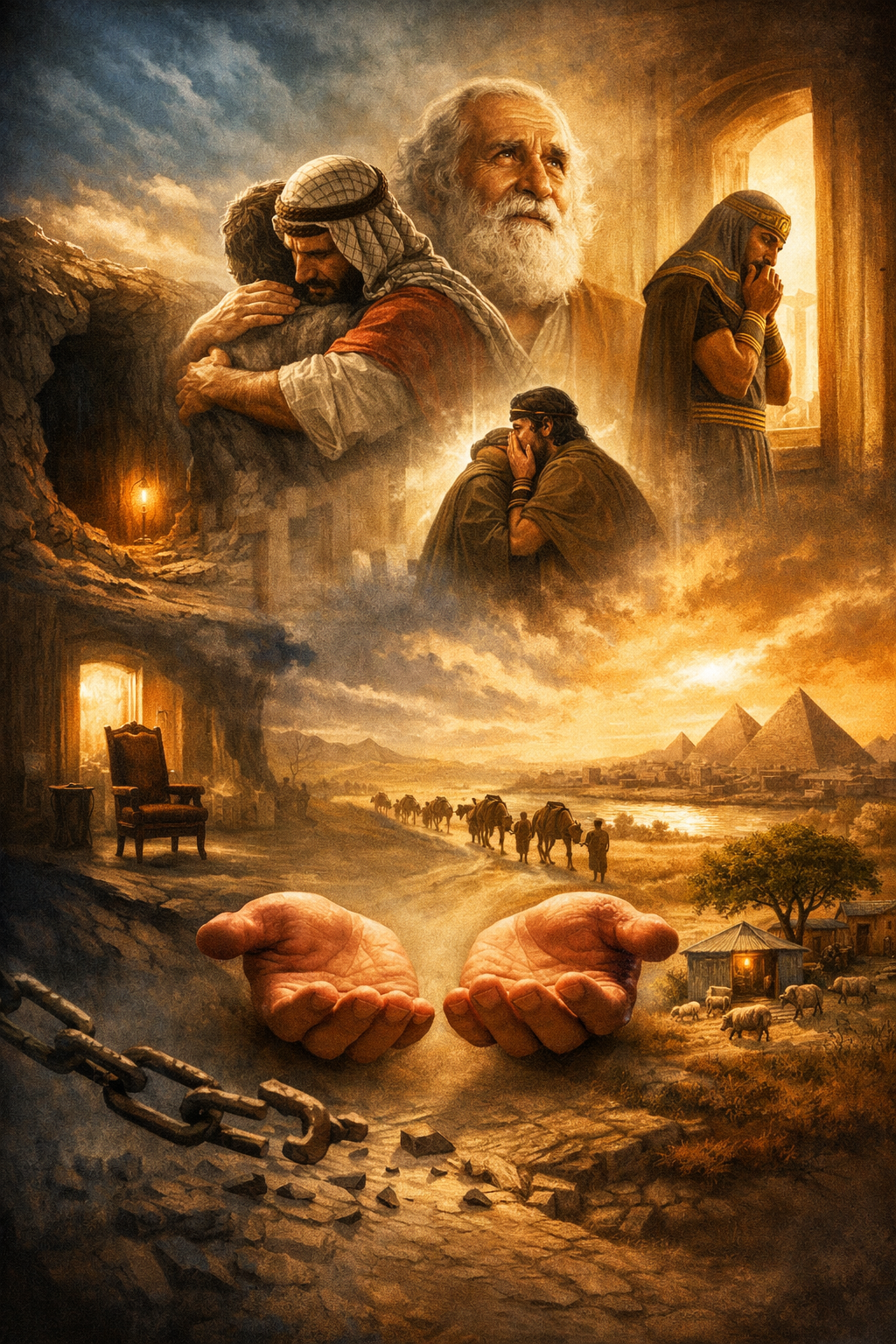
The highest truth does not impose itself; it reveals itself trembling. Yosef—the man of power, order, and perfect administration—breaks. He sends everyone out. The political scene empties so that truth can appear. When he says, “I am Yosef,” he does not ask about the harm done to him, but about the life that may still remain on the other side: “Is my father still alive?” A truth that transforms does not humiliate or collect debts. It exposes itself in vulnerability. Only such truth can open a future.
Healing the past does not mean denying it, but rereading it from another place. Yosef does not erase the betrayal, nor does he minimise it. Nor does he turn it into a weapon. He rewrites his life from responsibility for life itself. The pit ceases to be the centre and becomes material. The past stops enslaving when it is no longer needed to justify one’s own hardness. As long as a wound defines identity, it governs. Once integrated, it serves.
The spirit revives when the future manages to enter a place inhabited only by loss. Yaakov does not grow young again. He does not recover what was lost. He does not go backwards. But his spirit revives. Life does not return by erasing grief, but by allowing something yet to come to pass through the place frozen by pain. Hope does not deny the wound; it pierces it.
It is possible to dwell within an empire without losing one’s root, but not without an inner space that is non-negotiable. Goshen is neither assimilation nor enclosure; it is conscious design. To live in “Egypt” requires an inner Goshen—a place where identity is not up for discussion. Without such a space, exile becomes absorption. With it, exile can become a laboratory.
True reconciliation is not superficial peace, but the end of tragic repetition. The brothers reconcile without denying the harm. The father revives without erasing age. The people descend knowing that Egypt is not their final home. The story can truly begin when the wound no longer dictates decisions.
Approaching without defence breaks the cycle of trauma. As long as one speaks in order to protect oneself, the script repeats. When one approaches without calculation, something new becomes possible. This is not weakness; it is a higher strength than argument. In that gesture, memory ceases to be vengeance and becomes legacy.
Vayigash does not offer a happy ending. It offers something more demanding: the real possibility that the story will not repeat itself. And this only happens when someone dares to approach without defence, to speak from responsibility, and to allow the past to cease being a prison and become material for life.