Fabulous beasts and winding streets: Prague, Kafka, and the Jewish condition
A Clock Does Not Only Tell Time
A thin curtain of fog draped itself across Prague. The streets were nearly empty. I had flown in that evening to begin a journey through the city with a group of travelers, but I could not resist the pull of the Old Town Square. At night, Prague seemed to belong less to tourists than to shadows and looming towers.
At 9:55 p.m., I stood beneath Prague’s Astronomical Clock and waited for the hourly chime. My eyes were fixed on the bizarre characters perched beside the lower dial. Each one is an allegory from the medieval imagination: Vanity gazing into a mirror, Greed clutching his purse, Lust embodied in a foreign figure of earthly temptation. Above all, it is Death who commands the hour.
When the bells begin to toll, the skeleton pulls the cord, sounds the chime, and the hourglass of mortality is turned upside down. The other characters shake their heads in mute refusal, resisting the fate that Death announced so calmly. Above them, two small windows opened, and the 12 apostles passed in solemn mechanical procession.
Perhaps we still flock to the celebrated clock because these “medieval” anxieties have never truly left us; they accompany us in our own lives, wearing different masks but carrying the same weight.
Shadow Residents of Prague
That sense of the uncanny has long been woven into Prague’s identity. In the courtyards and chambers of Prague Castle, Emperor Rudolf II gathered astrologers, natural philosophers, and seekers of arcane learning, turning the city into a magnet for those who believed that knowledge might be hidden in metals, stars, and secret signs.
Alchemy itself was a strange blend of superstition, natural science, and philosophy. Its highest quest was the discovery of the Philosopher’s Stone, the elusive substance believed to possess the power to transform base metals into gold. Later traditions embroidered the story further, imagining concealed workshops and passageways linking the castle to the Jewish Quarter, where alchemists could move in secrecy, safely beyond official scrutiny.
Down along the Vltava’s riverbanks in the Lesser Town, the mist is said to conceal lurking water goblins — vodníci — waiting to trap unwary pedestrians and drag them into the depths.
And no legend casts a longer shadow than that of the Golem, the clay guardian and avenger said to have been fashioned by Rabbi Judah Loew ben Bezalel to defend Prague’s Jews from persecution. The Golem has escaped the confines of Prague to become the first Jewish superhero — a symbol of strength born from vulnerability. Yet the story is also a cautionary tale, reminding us that power, once unleashed, can become as dangerous as the threats it was created to confront. Whether rooted in fact, folklore, or the space between them, these stories have made Prague a place where history and myth seem less like opposites than companions. In Prague, one does not simply hear such stories. One begins, if only for a moment, to believe them.
An Old Friend Emerges
I walked back toward my hotel through the narrow streets of Josefov, Prague’s historic Jewish Quarter. I passed the building commonly known as the Spanish Synagogue. Originally known as The Israelite Temple of Prague, it was built on the site of the Altschul (the oldest synagogue in the historic ghetto, not to be confused with the famous, still-standing Altneuschul or Old-New Synagogue nearby). I stopped before the striking bronze monument standing in the adjacent square. The sculpture, directly inspired by Franz Kafka’s early short story “Description of a Struggle,” features a smaller figure of the author riding high upon the shoulders of a massive, empty, and headless suit.
The neo-Moorish Temple synagogue was frequented primarily by Prague’s integrated Jewish elite; it was the congregation to which Kafka’s family belonged, though they seldom attended.
The alchemists of Rudolf II, the water sprites of the Vltava, and the Golem all belong to Prague’s mythography. But Kafka transformed the atmosphere of the city that was his home into something altogether new. He inherited Prague’s tradition of mystery and sharpened it into a vision that reached far beyond the city’s narrow streets and medieval legends. His stories are not really about Prague, nor are they confined to the early 20th century. They are about us. The inexplicable authorities, invisible systems, shifting identities, quiet humiliations, and persistent anxieties that populate his fiction have become defining features of modern life. Kafka reminds us that the uncanny is not merely the province of folklore or ghosts. It is woven into the ordinary structures of our world.
Never Travel Alone
Back in my hotel room, I filled the kettle and brewed a cup of tea. From my suitcase I pulled a weathered copy of The Complete Stories of Franz Kafka. Whenever I travel, tucked between the socks and shirts, I pack an author who knows my destination far better than I ever could. In Madrid, it might be Miguel de Cervantes and Don Quixote. In Poland, perhaps Isaac Bashevis Singer and A Day of Pleasure. In Prague, it is almost always Kafka. These writers become my traveling companions; their books serve as conceptual guidebooks rather than rote maps. They reveal landscapes invisible to the casual visitor, giving voice to a place’s deepest memories, contradictions, and longings. My task is simply to listen carefully enough to become, in a small way, their shofar.
Why do I visit Prague with Kafka in my bag and on my mind? Part of the answer is obvious — he was born and grew up in Prague. Although a German-language Jewish author, his life and work were inextricably bound up with this city. He is one of Prague’s most famous sons, even if most people have never actually read his work. However, most readers are instantly familiar with the term “Kafkaesque.”
“Kafkaesque” is shorthand for a specific kind of modern nightmare: a world of surreal, faceless bureaucracies, endless corridors, and labyrinthine systems where rules are hidden and the authorities are unreachable. The claustrophobia that permeates Kafka’s fiction was not drawn from a blank slate; it was mapped directly onto the tight, winding alleyways of the Old Town, where he lived, studied, and wrote.
The Kafkaesque
To explain “Kafkaesque,” one needs only to look at a standard modern frustration: have you ever tried to call a corporate or government office, only to be asked by a computer-generated entity to wait while a dribble of generic elevator music repeats and loops indefinitely? You find yourself transferred from bot to bot, pressing requested numbers in a futile sequence, until finally — with no explanation or closure — the line is abruptly disconnected. In that quiet aftermath, you are left to decide: is it worth it to enter the labyrinth again?
That exact sensation of helplessness, of navigating an opaque system that operates on an unwritten logic entirely indifferent to your existence, is the core of the Kafkaesque. Kafka simply recognized this bureaucratic absurdity at its inception, transforming the physical and administrative dead-ends of early 20th-century Prague into a universal metaphor for the human condition.
A Jewish Angle?
And there is another aspect of Kafka that is particularly relevant for the Jewish story of Prague and of modern Europe. These are the places where, if you peel back the layers of his stories to arrive at the hidden fruit, you find a writer contending with the gap between promises made and the reality that always falls short and sometimes betrays. This tension directly mirrors the fragile legacy of the Enlightenment and Jewish emancipation in Central Europe. Emancipation, enlightenment, and antisemitism were the three gates that Jews faced as they struggled in Europe for basic human rights. The Haskalah (Jewish Enlightenment) and the modern bureaucratic state had promised universal civic equality and integration in exchange for cultural adaptation. Yet, the political reality proved to be a conditional contract, where legal emancipation did not eradicate prejudice but instead replaced traditional religious animosity with modern, systemic forms of social, national, and racial exclusion.
Kafka lived at a volatile cultural intersection: he was a German-speaking Jew in a Czech-speaking city, living under the fading shadow of the Austro-Hungarian Empire. He belonged fully to none of these worlds, existing instead in a state of perpetual displacement.
Kafka’s “Humanimal” Fables
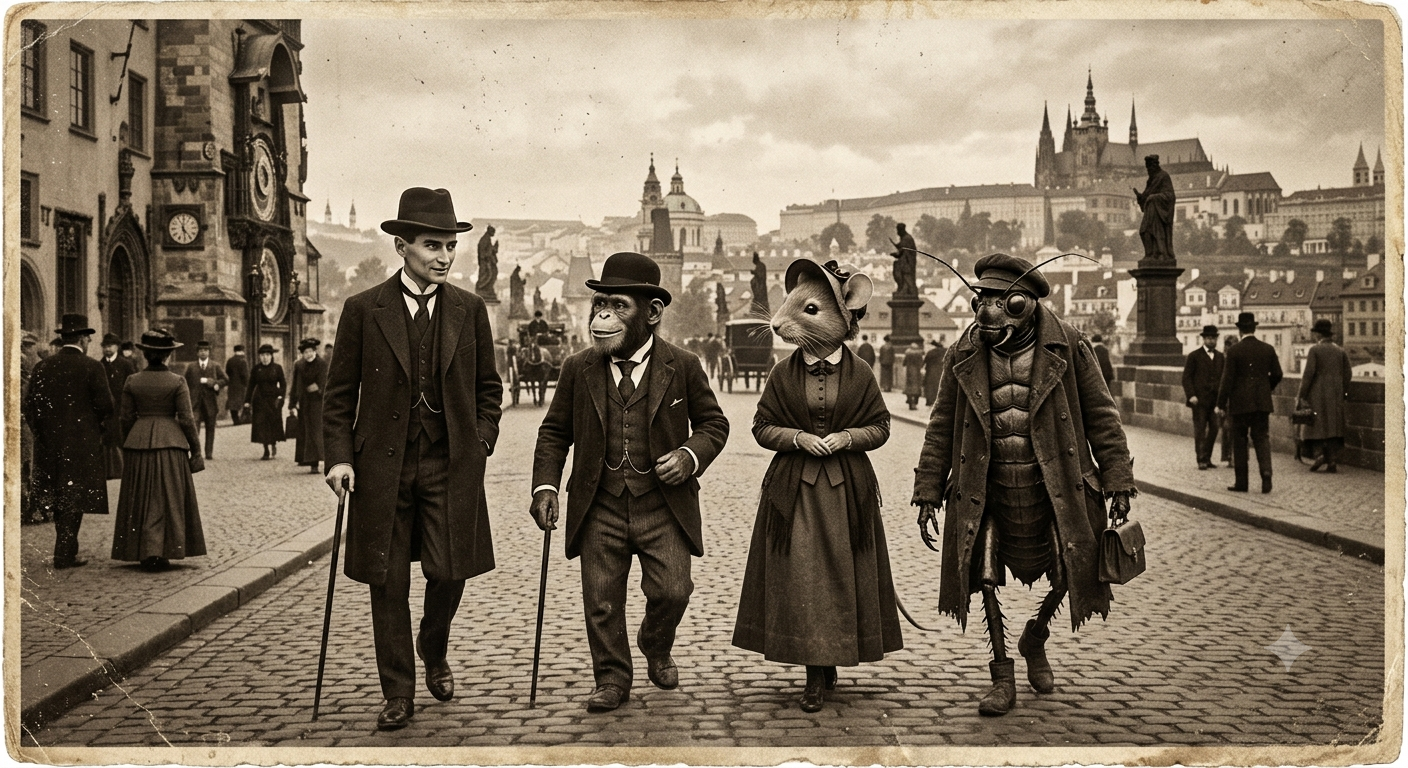
In stories like The Metamorphosis, A Report to an Academy, and Josefine the Singer, or the Mouse Folk, Kafka pivots away from traditional human protagonists to explore the perspective of creatures caught between two worlds—or what the scholar Naama Harel calls the “humanimal.” By blurring the boundary between human and animal, Kafka raises vital questions about what it meant to be a Jewish minority in a dominant non-Jewish society. These hybrid figures embody the psychological tightrope of conditional acceptance, integration, and the constant threat of erasure.
These hybrid “humanimal” figures embody the ultimate state of displacement and conditional acceptance:
- Gregor Samsa in The Metamorphosis: As Kafka’s most widely recognized work, Gregor’s sudden transformation into a monstrous insect makes visible the deep alienation of an outsider trying to survive under crushing societal demands. The choice of word here is critical: In German, Ungeziefer translates precisely to “vermin” or “pest” — the exact, painful vocabulary used in the pervasive antisemitic discourse of early 20th-century Europe to describe Jews as parasitic, unclean, and inherently foreign. By transforming Gregor into vermin, Kafka captures the devastating psychological reality of what happens when a minority group internalizes the hatred directed at them by the dominant culture. Gregor does not rebel against his condition; instead, he accepts his abject state. This dynamic reflects a tragic chapter in the story of European Jews who wrestled with profound ambivalence and even self-loathing, seeing themselves through the exclusionary eyes of the society around them.
- Rotpeter in “A Report to an Academy”: Decades before The Planet of the Apes offered a dark comic critique of human society, Kafka chose an ape to display the psychological bargain of Jewish assimilation. Rotpeter, an ape captured in the wild, is not looking for enlightenment or true equality; he explicitly states he is looking only for a “way out.” To escape his cage, he realizes he must get onto the stage, to become a celebrity. He systematically sheds his natural identity to master the behaviors of his captors — learning to drink alcohol, speak formal German, and mimic bourgeois manners. Rotepeter is trapped by the false promise of assimilation; that total cultural fluency grants safety and acceptance. The ape who wanted to be human stands as an outsider constantly performing to maintain his fragile freedom.
- Josefine in “Josefine the Singer, or the Mouse Folk”: Kafka’s final completed story centers on a fragile community of mice living under constant threat. Josefine’s “singing” is little more than ordinary whistling, yet it draws the community together, preserving memory and quiet solidarity. Unlike the false promises of assimilation or the despair of exclusion, Josefine offers hope sung in a minor key – a reminder that a vulnerable people can endure through culture, community, and the stubborn act of gathering.
“Josefine” was Kafka’s final completed story, written during the last years of his life, when his engagement with Jewish life had become more pronounced. By then, he was studying Hebrew with marked dedication. Together with his partner, Dora Diamant, he contemplated settling in Tel Aviv and opening a small café. Dora imagined running the café while Kafka joked that he would cook and wait tables. His diaries and correspondence suggest that he was drawn to Hebrew and to Zionism primarily as expressions of Jewish cultural renewal and the possibility of a vibrant Jewish communal life.
Of course, these modern fables are not only about Kafka or his reading of the Jewish condition. Yet they cannot be read without recognizing the “humanimals” as literary mirrors through which questions of Jewish identity are refracted. How is the Jew seen? How do Jews see themselves? And what does it mean to inhabit a world in which belonging always seems to remain provisional?
Back on the Streets of Prague… with Kafka
Most of us are not Kafka fanatics. Prague is full of remarkable stories and memorable characters beyond Franz Kafka. Yet Kafka remains an essential guide when walking with travelers through the city.
We might stop outside his childhood home at the House at the Minute (Staroměstské nám. 2) or pause by the Worker’s Accident Insurance Institute at Na Poříčí 7, where he clerked, processing complex insurance claims. It is likely that his daily encounters with bureaucratic absurdity found their way — magnified — into his fiction. We might stand next to one of the coffee shops named in his honor, or watch people take selfies in front of the massive, rotating silver bust designed by David Černý at Charvátova. What would Kafka himself say about his own celebrity status? About his face and figure becoming a commodity emblazoned on a t-shirt or on a beer mug.
Walking in Prague and sharing one of Kafka’s stories serves a distinct educational purpose: to open a discussion as we walk or stop for lunch. How have the questions surrounding Jewish identification, integration, and experience changed since Kafka’s time, and in what ways do they remain fundamentally unchanged?
In October 1921, Kafka wrote in his diary: “It is entirely conceivable that life’s splendor forever lies in wait about each one of us in all its fullness, but veiled from our view, deep down, invisible, far off. It is there, though, not hostile, not reluctant, not deaf. If you summon it by the right word, by its right name, it comes. This is the essence of magic, which does not create but summons.”
In a city like Prague — shrouded in its historic mists and long celebrated as a capital of alchemy and mystery — Kafka also offers a subtle hope. Facing the grim chapters of history does not mean denying the possibility of hope. It simply means understanding that hope is an elusive kind of magic: it does not demand that we conjure something out of nothing, but rather that we find the courage to pierce the heavy veil of history and summon the splendor that awaits within our own story.
–
Hit Follow at the top of the page to keep up-to-date with my blog and with this ongoing series on Jewish experiential travel. Stay tuned.