
Writer covering Israel–Africa, Jewish affairs, and Israel worldwide
Fauda of the Two-State Dream: When Peace Maps Concealed the Real War
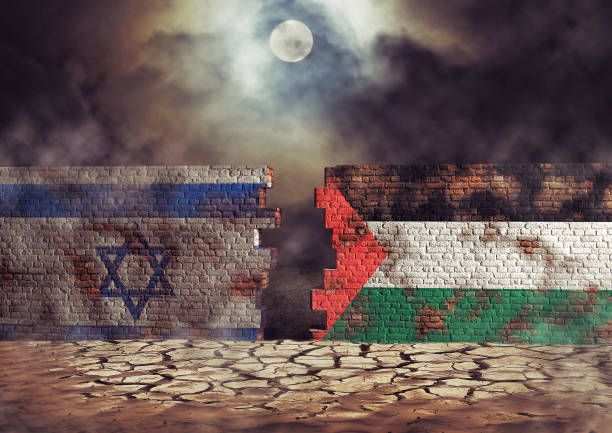
Painted flags split by a fissure — conflict etched into national identity.
Every now and then, the “two-state solution” gets pulled out like an old family recipe—promised to fix everything if only we’d follow it right this time. But I often find myself wondering: who actually came up with this idea in the first place, and what were they really thinking? Was it a genuine hope for peace, or just a clever political maneuver dressed in moral language? History, as it turns out, has a habit of exposing the difference between idealism and strategy—and it rarely flatters the strategists.
Lessons from the Past: When “Two States” Tried to Fix the Unfixable
When you leaf through 20th-century history, the evidence piles up fast. India and Pakistan’s partition in 1947 — a frantic, bureaucratic rush to separate two peoples — promised stability. What it delivered was the largest migration crisis in modern history and a wound that never quite healed. Entire cities were split, millions displaced, and both sides armed with historical grievance as a birthright. The war that followed wasn’t an accident; it was baked into the design.
The same logic shaped Cyprus. In 1974, the island was carved between Greek and Turkish communities. Half a century later, its “temporary” line of division remains permanent, and Varosha the famous Cypriot “ghost town” still stands as a sun-bleached museum of what partition leaves behind. Residents fled; time stopped. That ghost city tells the same story partitioned India did: separation freezes conflict rather than cures it.
History reclaimed calls of the 1947 partition a “tragedy with a long shadow,” and that shadow stretches toward the Middle East. The moral is clear the two-state idea works on paper, not in practice, when hearts, economies and security are too entangled to divide cleanly.
The Early Architects: Motives Behind the Map
To understand how it got here, it helps to revisit the map-makers themselves. The two-state proposal wasn’t born out of moral clarity but out of political necessity. Early advocates saw it as a pragmatic containment plan: to limit bloodshed and maintain Western leverage in the region. Idealism, yes but bounded by self-interest.
Many of those “architects” — diplomats, ideologues, and academics — emerged from colonial and Cold-War traditions where dividing territories was seen as a neat administrative solution to ethnic or national conflict their aim in part, was to preserve influence rather than to make resolve. In that light, “peace” was as much a geopolitical management tool as a humanistic goal. A two-state model built on unresolved fundamentals was bound to wobble. Plus the people who drafted the blueprint never had to live inside its walls whichever way the implications of their solutions panned out.
Hijacked Hopes: The Two-State Solution Off Its Original Tracks
Fast-forward to the present, and what once looked like a pragmatic peace plan has become a slogan, recited out of habit rather than conviction. For some in Israel, the idea of two states feels like a slow-motion suicide pact; for some Palestinian factions, it’s a tactical pause before the next round. Either way, the concept’s moral center has collapsed under the weight of ideology. Parts of Palestinian leadership and the global activist class have learned to romanticize “resistance” while doing little to build a functioning government. Instead they have fostered a culture sustained on perpetual “oppressed” grievances successfully ensuring peace talks become theatrics not progress.
And then there’s the regional interference Iran and the Muslim Brotherhood have mastered the art of weaponizing the conflict to project ideological power. They offer rhetoric about “justice for Palestine” while funding or inspiring factions that thrive only in perpetual crisis. Every time such actors gain the microphone, the two-state vision loses its credibility as a peace framework and becomes a pawn in broader regional chess. That hijacking has consequences. The two-state idea was originally meant to be a technocratic compromise: two secure, recognized, and viable states. Today, it’s shorthand for inaction invoked by diplomats to fill silence, wielded by politicians to dodge responsibility. Even those who still believe in it can’t agree what it means anymore.
A Fading Blueprint
The more I read and watch, the more the pattern feels familiar: each “partition” is sold as closure but ends as containment. The moral hazard of the two-state idea lies not in its aspiration but in its refusal to confront who benefits from stalemate. Peace has always had two enemies: extremism and convenience. The first kills it outright; the second starves it quietly. Until both are named, borders alone won’t fix what history and ideology keep breaking. So maybe the real question isn’t if the two state blueprint is possible but rather whether the world is still honest enough to admit that the real issue is that the blueprint was never drawn with Israel’s survival at the center of it.
Related Topics
Related Posts