
F#ck the New York Times. And Yet.
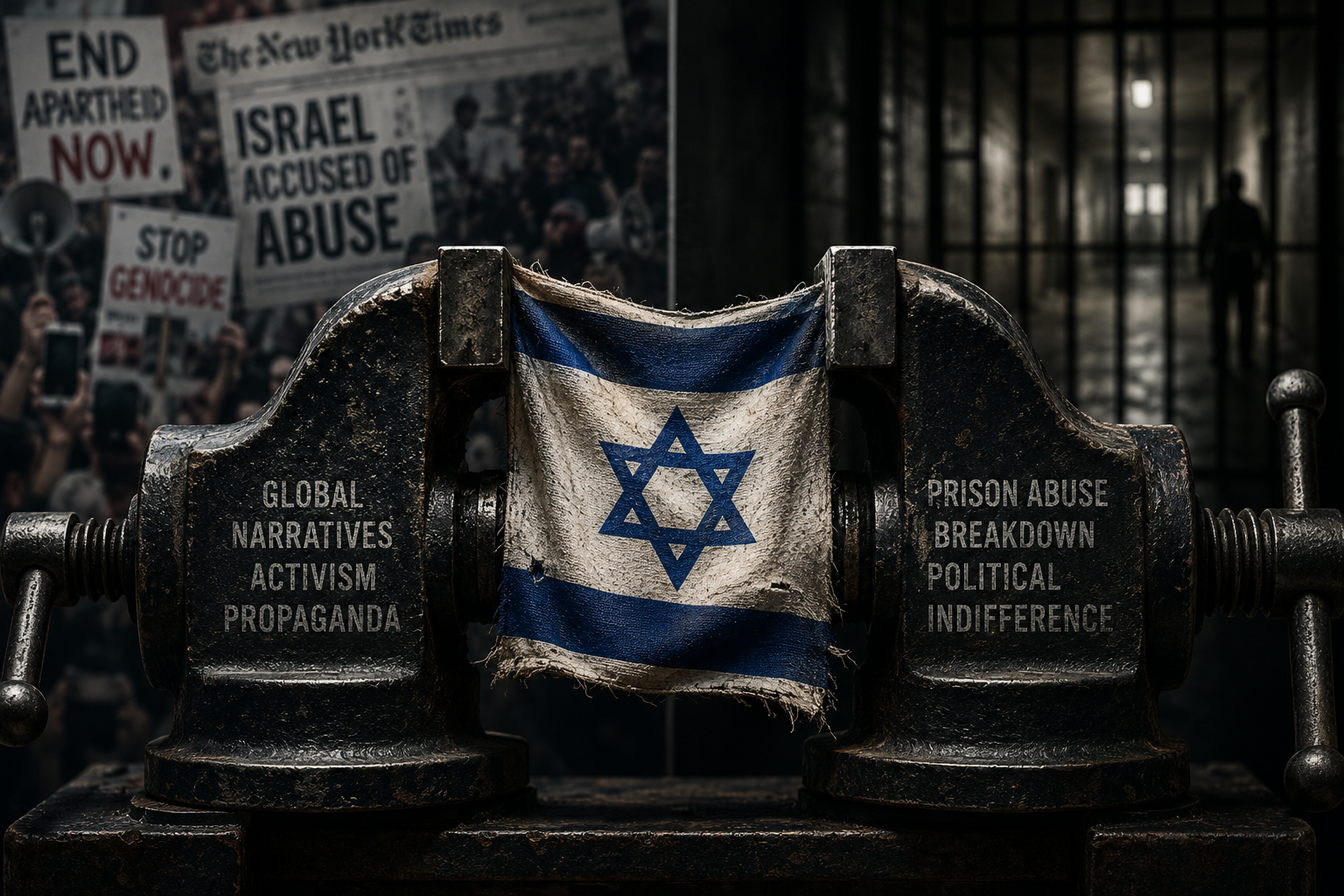
Last night I read Nicholas Kristof’s latest opinion piece on alleged abuse of Palestinian prisoners inside Israeli detention facilities. And then I read Haviv Rettig Gur’s response. Both left me angry. But for very different reasons.
Before going further, a brief note on the two writers at the center of this debate.
Nicholas Kristof is a longtime New York Times columnist and two-time Pulitzer Prize winner known for his reporting on war, poverty, human rights, and humanitarian crises around the world.
Haviv Rettig Gur is an Israeli journalist and senior analyst at The Times of Israel known for his fair and balanced reporting and commentary on Israeli politics, Jewish history, and the Israeli-Arab conflict.
For readers who want to engage more directly with the issues discussed in these essays, here are the links to do so:
— Kristof’s New York Times opinion essay
— Haviv Rettig Gur’s response essay
Let me start here: if Israeli soldiers or prison guards are abusing prisoners, Israel has an obligation to investigate it, stop it, punish it, and confront it honestly. Full stop.
Not because the UN demands it. Not because campus activists demand it. Not because the New York Times demands it.
Because Jews should demand it.
Because democracies fighting existential wars do not survive by surrendering discipline, morality, and accountability. They survive by preserving them under impossible conditions. That distinction matters. Especially now.
One of the most exhausting features of the period since October 7 has been the constant pressure to flatten reality into slogans. Either Israel is a uniquely evil state committing cartoon atrocities at industrial scale. Or every accusation is automatically propaganda and nothing morally troubling could possibly be happening.
Serious people know reality is not that simple.
Prison abuse is not unimaginable. Every prison system in the world struggles with brutality and misconduct, especially during wartime. Israel is not magically exempt from human failure, trauma, rage, fear, or moral breakdown. Thousands of detainees entered the system after October 7. Reservists were pulled into prison duty. Emotions were raw. Discipline clearly frayed in some cases.
That should alarm every Israeli patriot. And frankly, what alarms me further is the apparent indifference of parts of Israel’s political leadership to the issue itself. Ben Gvir seems far more interested in performative rage than institutional responsibility. A mature country cannot allow that kind of drift inside its prison system. Not strategically. Not morally.
But there is another layer to all of this that also deserves to be said plainly. I grew up believing the New York Times represented the gold standard of journalism. Imperfect, yes. But serious. Careful. Relentlessly verified. Increasingly, I no longer believe that standard consistently applies when Israel is involved. And that pains me to say.
The problem is not that the Times investigates Israeli wrongdoing. It should. The problem is the growing asymmetry many Jews now perceive in elite media coverage surrounding Israel.
Maximal skepticism toward Israeli claims.
Minimal skepticism toward activist narratives.
Amplification first.
Verification later.
Corrections quietly, if at all.
Over time, that pattern erodes trust. Not because Jews cannot tolerate criticism of Israel. Israelis criticize Israel more harshly than almost anyone on earth. The erosion comes from the sense that many journalists no longer approach Israel as a complicated democratic ally fighting a brutal war against nihilistic enemies, but as a symbolic vessel for Western sins: colonialism, militarism, nationalism, racism, power.
Once that framing hardens, every story begins bending toward the same moral conclusion. And context starts disappearing.
The hostage-taking disappears. The decades of terrorism disappear. October 7 becomes background scenery. Hamas propaganda networks become insufficiently scrutinized. The unprecedented global obsession with this one conflict somehow becomes invisible to the very people amplifying it.
That does not mean every claim against Israel is false. It does mean many Jews increasingly feel gaslit by institutions they once trusted deeply. And the deeper problem now is not one article. It is the collapse of trust itself.
When elite institutions repeatedly amplify sensational claims sourced through activist ecosystems without applying the same skepticism, contextual rigor, or evidentiary caution they would apply elsewhere, people stop believing the referees are neutral.
And once trust collapses, everything becomes poison. Real abuses become harder to confront honestly because every accusation arrives entangled with propaganda, ideology, historical trauma, and political warfare. That is an incredibly dangerous place for a democracy. And for Jews.
Jews are not imagining the historical echoes here either. Throughout history, societies have repeatedly attributed monstrous, fantastical evil to Jews — poisoning wells, murdering children, secretly manipulating governments, corrupting civilization itself.
Modern versions arrive dressed in the language of human rights and decolonization rather than medieval theology, but sometimes the emotional architecture feels disturbingly familiar.
Which brings me back to Haviv Rettig Gur.
What struck me about his response was not the anger. Jews have plenty of reasons to be angry right now. It was the refusal to collapse into either denial or surrender.
Yes, there is a global propaganda ecosystem surrounding this war.
Yes, antisemitism has clearly attached itself to parts of the anti-Israel movement.
Yes, social media has produced an almost religious moral frenzy around Israel, unlike anything applied to any other conflict on earth.
Yes, many wildly exaggerated or outright fabricated claims have spread with astonishing speed and very little scrutiny.
And yet.
That still does not absolve Israel from confronting real abuses where they exist. In some ways, that is the entire test of democratic power. Can a society defend itself against people openly committed to its destruction without becoming consumed by hatred, vengeance, fanaticism, or moral numbness itself?
That is not an abstract question for Israel. It is the daily burden of Israeli life. And for diaspora Jews watching all this unfold from afar, the emotional tension is enormous. We are watching a global movement increasingly incapable of distinguishing between opposition to Israeli policy and obsessive hostility toward the world’s only Jewish state. We are watching institutions we once trusted lose credibility in real time. We are watching Hamas cynically weaponize suffering, propaganda, and Western moral language while still openly promising more October 7ths.
And simultaneously, we are watching parts of Israel’s own leadership behave with breathtaking irresponsibility.
Both things can be true at once.
In fact, they are. Which means the answer cannot be tribal denial. And it cannot be self-destructive moral collapse either. Israel does not need to become perfect to deserve existence. No nation meets that standard. But Israel does need to remain recognizably committed to law, restraint, accountability, and civilization even while fighting enemies that reject all four.
Not for the New York Times. Not for the UN. Not for TikTok activists.
For itself.
And for the kind of Jewish future Israelis are still trying to defend.