
Communications professional, writer, storyteller
Finding Beauty in Brokenness: A Yom Kippur Reflection
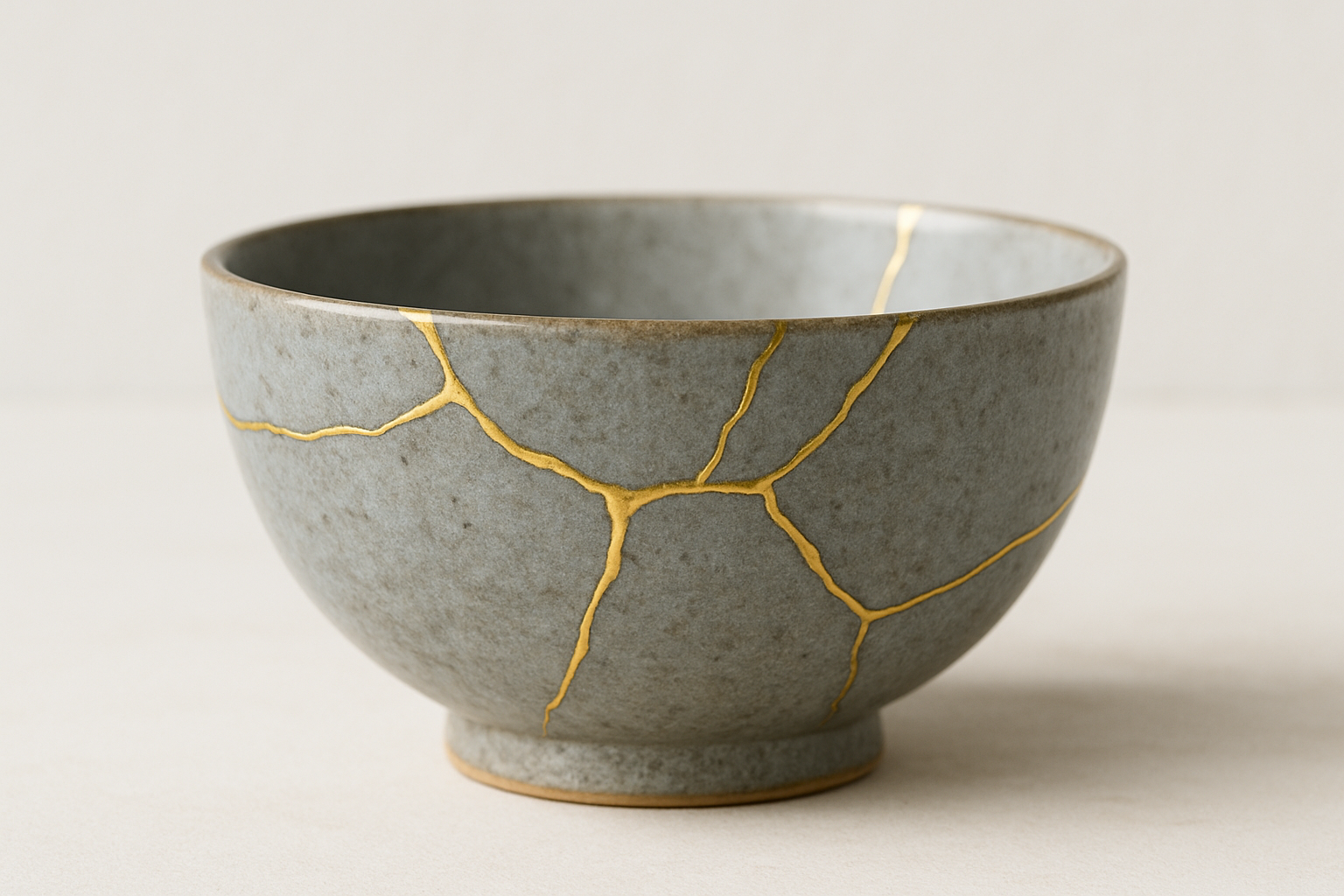
Image: Illustration of Japanese ceramic "kintsugi" bowl, created by Chat-GPT 5 and used with permission.
Yom Kippur, the Day of Atonement, is a time for spiritual renewal through fasting, prayer, and deep introspection.
But to truly understand what this holiest day accomplishes, we need to look at the Hebrew word Kippur itself. Kippur comes from the Hebrew root k-p-r, meaning both “to cover” and “to wipe clean,” giving us a dual understanding of atonement that goes deeper than simple forgiveness.
The “wiping clean” meaning connects to the ancient Temple ritual, where sins were purged from the spiritual record, cleansing the sanctuary and the people. But the primary meaning relates to “covering”—not hiding sins, but rather divine mercy that covers and shields the penitent person from the consequences of their wrongdoing.
These two meanings work together in the Yom Kippur framework: sins are both cleansed from the person and covered by divine mercy. The covering isn’t concealment but protection, while the cleansing removes the stain entirely.
But atonement involves more than divine action alone. The tradition emphasizes that teshuvah (repentance) requires genuine human effort: recognizing wrongdoing, feeling remorse, confessing, making amends, and resolving not to repeat the behavior. This active human participation in atonement reminds me of an unlikely parallel—the Japanese art of kintsugi.
Kintsugi involves repairing broken ceramics with gold or silver, creating something more beautiful than the original piece. Rather than hiding the damage, the artist highlights the cracks, transforming them into decorative elements. The brokenness becomes part of the object’s story and beauty.
Like kintsugi, Yom Kippur’s covering doesn’t erase our past but integrates our failures into a stronger, more complete version of ourselves. Both processes require deliberate human work. The kintsugi artist must carefully choose how to repair each crack, while the penitent person must actively work to transform their brokenness into wisdom and character.
This parallel finds strong support in the Talmud. In Tractate Yoma 86b, Reish Lakish teaches: “Great is repentance, for intentional sins become merits.” The Talmud distinguishes between two types of repentance: if one repents out of fear, intentional sins are turned into unintentional sins; but if one repents out of love, intentional sins actually become merits.
The commentaries explain how this transformation works. The Maharsha (Rabbi Shmuel Eliezer ben Yehuda HaLevi Edels, 1555-1631), one of the most influential Talmudic commentators of the late Renaissance period, suggests that repentance from love leads to “complete teshuvah and adds extra good deeds, beyond what is required in relation to that sin.”
Rav Kook (Rabbi Abraham Isaac Kook, 1865-1935), the first Ashkenazi Chief Rabbi of British Mandate Palestine and a leading mystical philosopher, adds that “repentance influences a person both to hate evil and to love good,” making the sin itself become “the very source of merit.”
Just as someone who misunderstood a subject but then discovers his error often ends up with deeper understanding than if he had grasped it correctly the first time, genuine repentance leads to profound insights and powerful resolve that transform past failures into wisdom and strength.
The fact that both a classical 16th-century Talmudic scholar and a 20th-century mystical philosopher arrived at similar insights about the transformative power of repentance shows how deeply rooted this concept is in Jewish thought across the centuries.
The covering in atonement, then, isn’t about hiding flaws but about divine mercy working through human effort to create something more beautiful than the original. Just as the gold lines in kintsugi pottery tell a story of resilience and renewal, the process of teshuvah allows our moral failures to become part of a larger narrative of growth and spiritual development.
This comparison is a visual metaphor to help understand the purpose and power of Yom Kippur. While kintsugi deals with physical objects, the principle it illustrates—that brokenness can become a source of beauty and strength rather than shame—applies to the spiritual work of atonement.
The analogy emphasizes transformation through deliberate effort, whether artistic or spiritual. We don’t seek to break pottery or commit sins, but when brokenness occurs, both traditions offer a path forward that acknowledges rather than erases the past.
As we approach Yom Kippur, the kintsugi metaphor reminds us that the day’s work isn’t simply about getting a clean slate. It’s about the harder but more meaningful task of integrating our whole selves—including our failures—into who we’re becoming. The covering of atonement doesn’t make us perfect; it makes us complete, with our scars transformed into sources of strength and beauty.
This Yom Kippur, may we find the courage to see our brokenness not as disqualification but as raw material for renewal.
Related Topics
Related Posts