Finding God When We Stop (Vayeitzei)
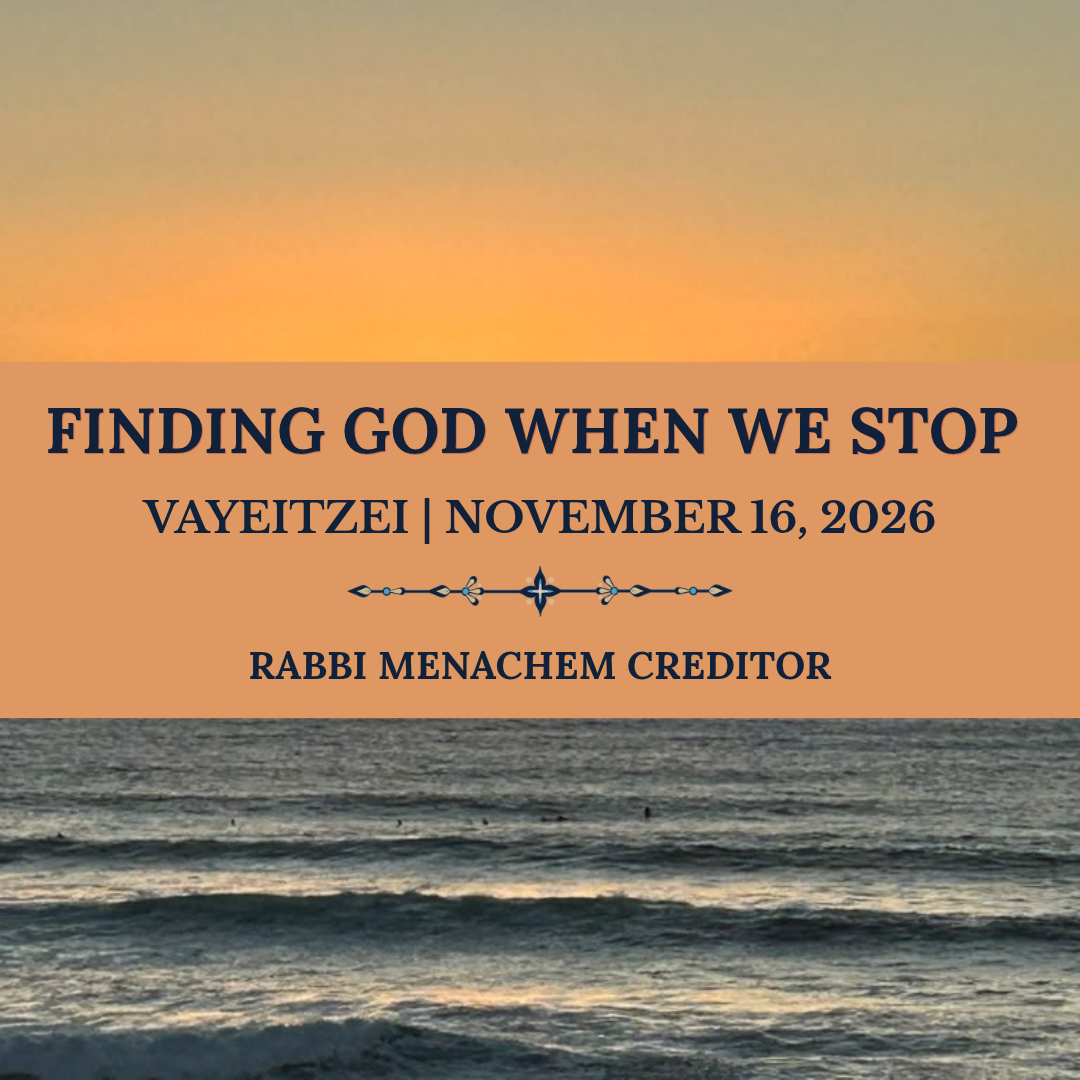
Jacob is running for his life.
At the end of last week’s Torah portion, his family is in crisis. Jacob has deceived his father and received the blessing Isaac intended for Esau. Esau, furious, promises to kill his brother after their father’s death. Rebecca urges Jacob to flee.
This week’s portion begins, “Vayeitzei Yaakov – And Jacob left” Beersheba and went toward Haran. The translation is accurate, but the context gives the word increased urgency. Jacob did not simply depart. He ran.
He is afraid, and his fear is real. He is implicated in the circumstances that sent him on his way. Jacob is not an innocent bystander to the fracture in his family. He has participated in it. The journey ahead will change him, but at this moment he is still a young man carrying the consequences of what he has done.
Then comes a remarkable verse: “He encountered the place and spent the night there, because the sun had set. Taking one of the stones of the place, he put it under his head and lay down in that place” (Gen. 28:11).
The Hebrew for “he encountered the place” is vayifga bamakom. It can be translated that way, but it can also suggest a collision or an injury. Listening with midrashic ears, we might hear that Jacob ran until he crashed into the place.
And what precisely is “the place”?
The Torah does not name it here. We have encountered an unnamed place before. In the story of the binding of Isaac, Abraham sees hamakom, “the place,” from a distance (Gen. 22:4). Now Isaac’s son reaches a place of his own, burdened by another chapter in his family’s story.
There is an even deeper meaning. In Jewish tradition, Hamakom, “the Place,” is also a name for God. When we comfort mourners, we say, “May Hamakom comfort you.” God is “the Place” in which we can be held, even when the world as we have known it has come apart.
With those meanings in mind, listen again: Jacob is running for his life, and he crashes into God.
I wonder how many of us know something of that experience. We keep going because stopping feels impossible. We carry fear, responsibility, conflict, and exhaustion. Sometimes we are running from circumstances we did not choose. Sometimes, like Jacob, we have helped create the situation from which we are trying to escape. Often, the truth is more complicated than either of those descriptions can hold.
And then we hit a wall. We have no choice but to stop and lay our heads down.
Jacob does not seem to arrive at this place through a carefully cultivated spiritual practice. He is exhausted, vulnerable, and alone. Yet as he sleeps, he dreams of a ladder reaching toward heaven, with angels ascending and descending. When he wakes, he says, “Surely God is in this place, and I did not know it” (Gen. 28:16).
I find comfort in those words. Even in a place of exhaustion, even after we have made mistakes, even when we do not know how to move forward, God is there.
But perhaps Jacob’s story offers us another possibility as well. What if we learned to pause before we crash? What if we rested when we needed to, spoke more honestly about where we are, and cared for ourselves and one another along the way? Perhaps we could become more mindful of the choices we make and of the relationships those choices affect.
May we know, when we reach the places that force us to stop, that God is there too. And may we learn to stop, to breathe, and to encounter the Divine before exhaustion makes the choice for us.